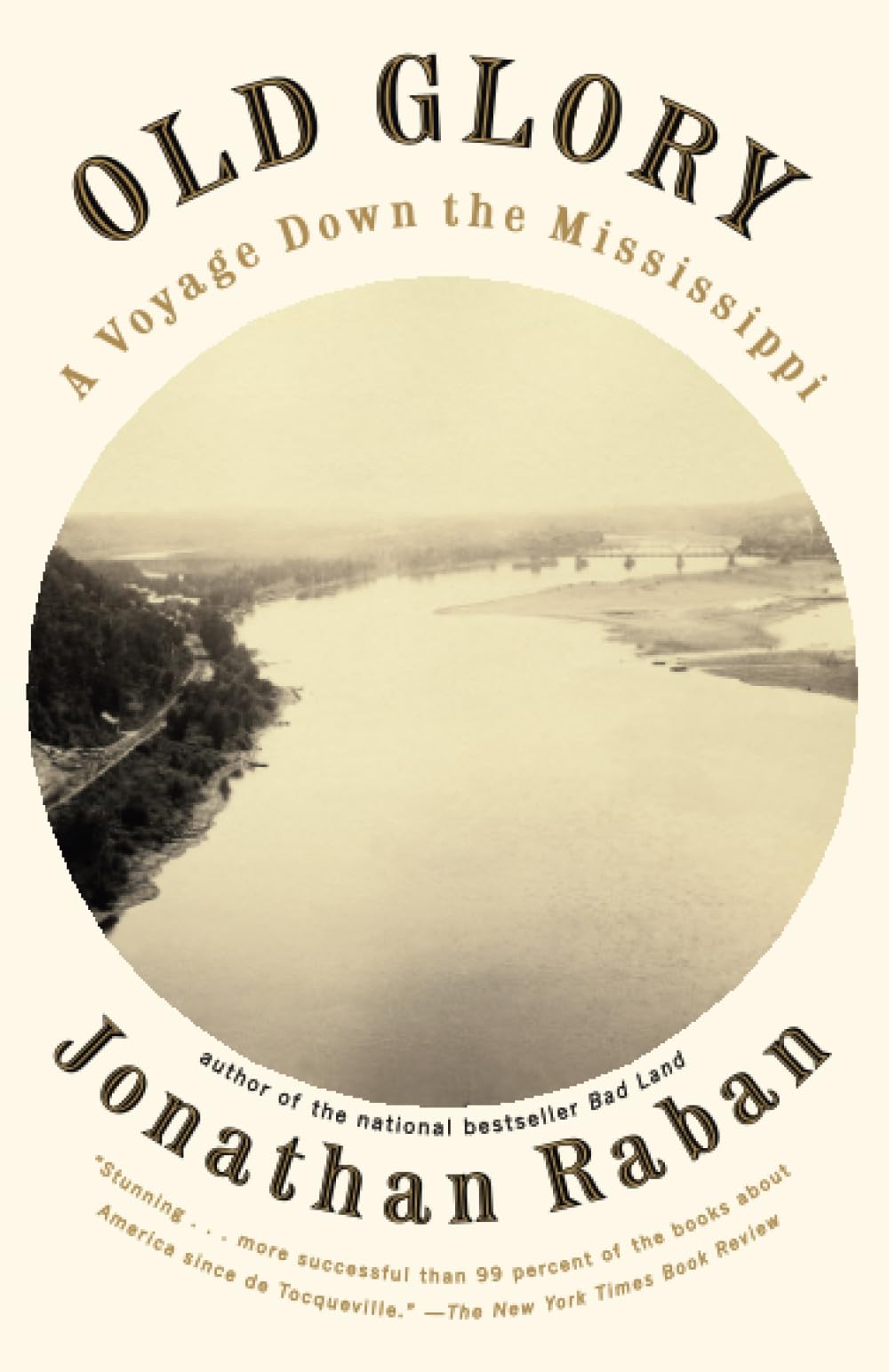



The bestselling, award-winning author of Bad Land realizes a lifelong dream as he navigates the waters of the Mississippi River in a sixteen-foot motorboat, producing yet another masterpiece of contemporary American travel writing. "Stunning." — The New York Times Book Review In the course of his voyage, Raban records the mercurial caprices of the river and the astonishingly varied lives of the people who live along its banks. Whether he is fishing for walleye or hunting coon, discussing theology in Prairie Du Chien or race relations in Memphis, he is an expert observer of the heartyland's estrangement from America's capitals ot power and culture, and its helpless nostalgia for its lost past. Witty, elegaic, and magnificently erudite, Old Glory is as filled with strong currents as the Mississippi itself. "It is as big and depthless as the sky itself. You can see the curve of the earth on its surface as it stretches away for miles to the far shore." So begins Old Glory , in which Jonathan Raban recounts his eye-opening descent of the Mississippi River in a 16-foot aluminum motorboat. As the English author explains, his obsession with the subject began with Huckleberry Finn, which he first read as a 7-year-old. And in fact, his opening sentences refer as much to the imaginary river as to the real one, which turns out to be less bucolic than Raban expected. Three miles upstream from Oquawka, Illinois, he's nearly pulverized by a towboat. Later on, the intrepid voyager only just manages to escape a treacherous whirlpool near St. Louis, calming himself afterwards with a generous dose of tobacco and Valium. True, when Raban isn't cheating death he encounters some stunning terrain, which he describes in no-less-stunning prose. Yet Old Glory is much, much more than a travelogue. It is also a brilliant interrogation of the American psyche, in the tradition of De Tocqueville and Crevecoeur. And ultimately, Raban tells us a great deal about the very phenomenon of travel, with all its rigors and rewards, and its peculiar, metaphysical dislocations: "Riding the river, I had seen myself as a sincere traveler, thinking of my voyage not as a holiday but as a scale model of a life. It was different from life in one essential: I would survive it to give an account of its end." "Stunning...more successful than 99 percent of the books about America since de Tocqueville." — The New York Times Book Review "He can skewer life in an anecdote and evoke a river scene in a few brushstrokes." — The Nation "Wonderful…Mr. Raban…is excellent company. He is a popcorn-popper of opinions, and they are unpredictable." — The New York Times Book Review "Throughout his epic journey he struggles to reconcile the real, treacherous, protean river with the shimmering dream-waters of his boyhood. This is what gives his book its remarkable power, elevating it close to the level of myth." — Salman Rushdie The author of Bad Land realizes a lifelong dream as he navigates the waters of the Mississippi River in a spartan sixteen-foot motorboat, producing yet another masterpiece of contemporary American travel writing.In the course of his voyage, Raban records the mercurial caprices of the river and the astonishingly varied lives of the people who live along its banks.Whether he is fishing for walleye or hunting coon, discussing theology in Prairie Du Chien or race relations in Memphis, he is an expert observer of the heartyland's estrangement from America's capitals ot power and culture, and its helpless nostalgia for its lost past.Witty, elegaic, and magnificently erudite, Old Glory is as filled with strong currents as the Mississippi itself. The author of Bad Land realizes a lifelong dream as he navigates the waters of the Mississippi River in a spartan sixteen-foot motorboat, producing yet another masterpiece of contemporary American travel writing. In the course of his voyage, Raban records the mercurial caprices of the river and the astonishingly varied lives of the people who live along its banks. Whether he is fishing for walleye or hunting coon, discussing theology in Prairie Du Chien or race relations in Memphis, he is an expert observer of the heartyland's estrangement from America's capitals ot power and culture, and its helpless nostalgia for its lost past. Witty, elegaic, and magnificently erudite, Old Glory is as filled with strong currents as the Mississippi itself. JONATHAN RABAN is the author of the novels Surveillance and Waxwings; his nonfiction works include Passage to Juneau, Bad Land, and Driving Home . His honors include the National Book Critics Circle Award, the PEN/West Creative Nonfiction Award, the Pacific Northwest Booksellers’ Award, and the Governor’s Award of the State of Washington. He died in 2023.