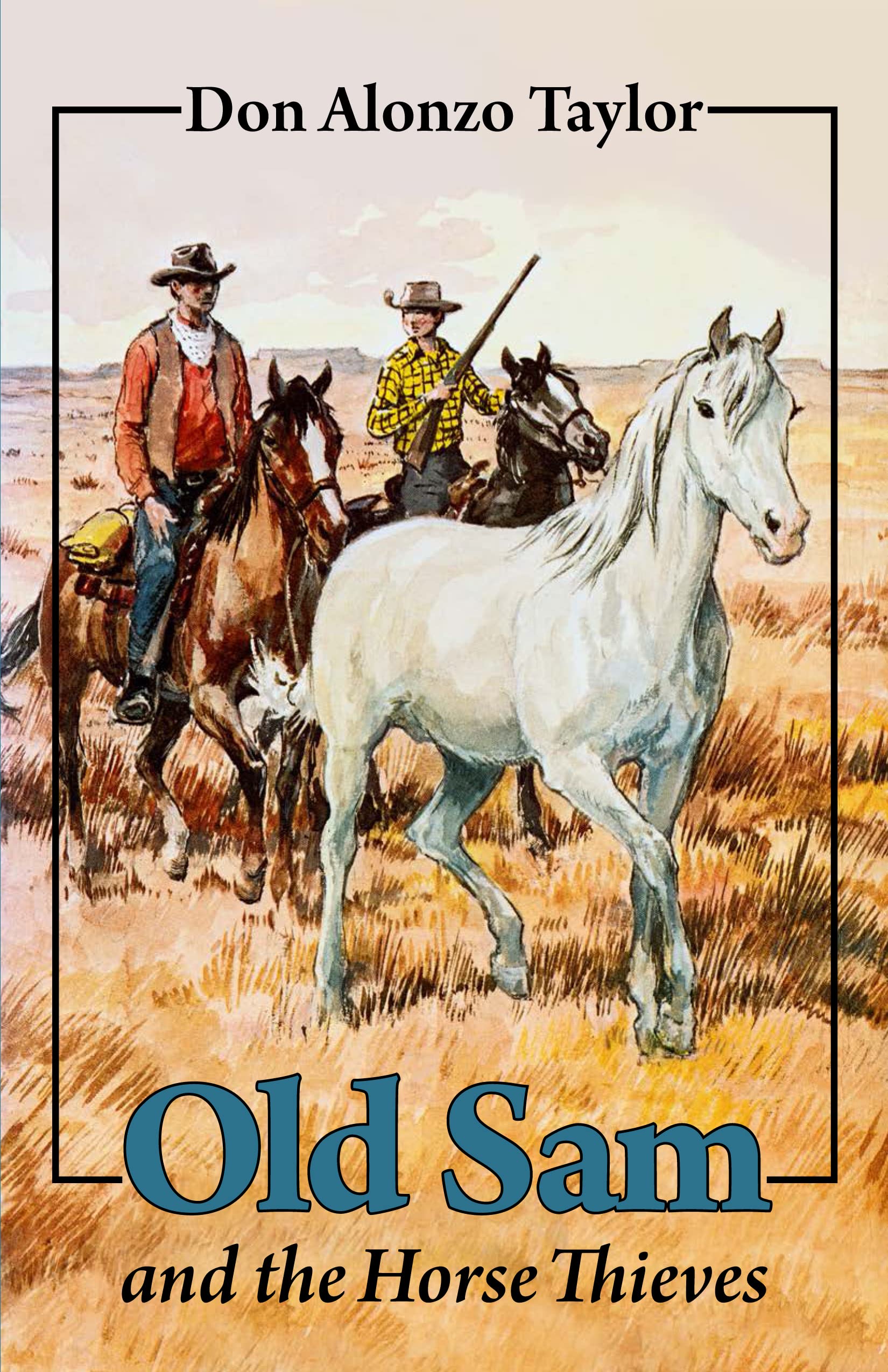



Lee and Johnny Scott are back—and so is Old Sam—in this sequel to Old Sam, Dakota Trotter. Despite the disfiguring injury that ended Old Sam’s career as a champion thoroughbred trotter, he is still as fast—and as canny—as ever, an indispensible help for the Scott family in their new home. Then, Old Sam mysteriously goes missing. Johnny figures that any thief who dares to steal that horse will soon be sorry. With the help of Lee and their gang of friends, Johnny soon has things well in hand, finding Old Sam’s track, setting up a communication system that works with mirrors and well-placed minions—and generally running circles around his elders. And, of course, Old Sam does not let his boys down. That Johnny also encounters some sobering moments in his headlong pursuit of justice is a sad, perhaps unavoidable, consequence in a way of life still on the fringes of civilized society. Both books about Old Sam and the Scott family are based on the author’s true-life, homesteading experiences in what is now the southeastern region of the state of North Dakota. United States, 1880s. RL5 Of read-aloud interest ages 8-up Don Alonzo “Lon” Taylor , the Johnny in this book, was born of a pioneering family whose moves westward closely followed America’s development. An early ancestor, Thomas Taylor, was born at an Indian outpost on the Merrimac River, north of Boston, in 1710; the family progressively moved west, ending with his own migration to California in 1924. It is not surprising that in 1882, the Taylors, along with twenty other families, were on the first train ever to come to the Dakota Territory. Eight-year-old Lon, with his four siblings, reveled in the homesteading life in the area north of Ellendale, North Dakota. As an adult, he also worked as a contractor, building silos, barns and houses. Upon his marriage to Jennie Anderson in 1901, he built a home in nearby Oakes, North Dakota, where they raised their four children. In 1924 the family moved to the milder California climate, settling in the town of Alpine, near San Diego, where Lon continued to work in construction. His daughter, Hazel Hohanshelt, had his stories about Old Sam published in 1955 and 1967. NEW PEOPLE WERE continually moving in, to add to the twenty families who had come out to Dakota in the spring of 1882. My father, Joe Scott, had organized that immigrant train. Along with our family had come the Sherms, the Shipleys and the Frenches, whose two boys Jess and Levi were good friends of my brother Lee and me. Then of course, there was Mike Strub, the young man who had taken up the north half of the section that cornered our homestead on the southwest. He had a team and a wagon and a saddle pony, and spent as much of his time as he could spare from his homestead, just driving about the country, hunting and camping. Everyone knew each other and even their neighbors’ horses by their first names. Everyone knew Old Sam. We had brought him with us on that immigrant train. He had belonged to us for five years—since that time on the bridge near our Illinois home, when Sam had broken his leg. My brother Lee and I, and my cousins Laura and Frank, had begged and pleaded for his life. Old Sam’s owner had asked my father to shoot the horse. How thankful we were that he didn’t! Sam’s hock healed, and eventually he could race again. His right hip always rode high, but crippled though he was, my brother Lee and I never doubted that he could beat any trotter in the world. You have probably read the story of the famous race on the Fourth of July, 1884, that made Old Sam the best-known horse on the plains. Sam had beaten Thompson’s famous trotter, Chestnut Prince, and won a purse of fifty dollars in gold. Only three years before we came to Dakota, this had been the feeding ground of thousands of buffaloes. Since then they had become nearly extinct. Now the farmers were breaking hundreds of acres of the tough sod and planting grain. The tree claims were greening with the seedlings sprouted from the wild plum, box-elder and chokecherry seeds we had gathered in the Coteaus—the hills to the west of our prairie land. One of the newcomers, a Mr. Brooks, had bought a half-section adjacent to that owned by Mr. French. Mike Strub owned the land on the other side. Mr. Brooks’ home was in Illinois, where he owned considerable property. Each spring he came up to see that his crops were put in, and again to see about harvest and threshing. He was about forty-five years old, of average height, and he had a full beard. His sharp nose was usually wrinkled at the sides, as if the light were too strong. From the start, Mr. Brooks had trouble with his neighbors. Most of the farmers let their stock run in the spring until the grain was planted and again after threshing. If one man’s stock got into another man’s stubble field, it was all right; no one paid attention to such things. It saved a lot of feed that would otherwise go to waste. But Mr. Brooks wanted no trespassing on his