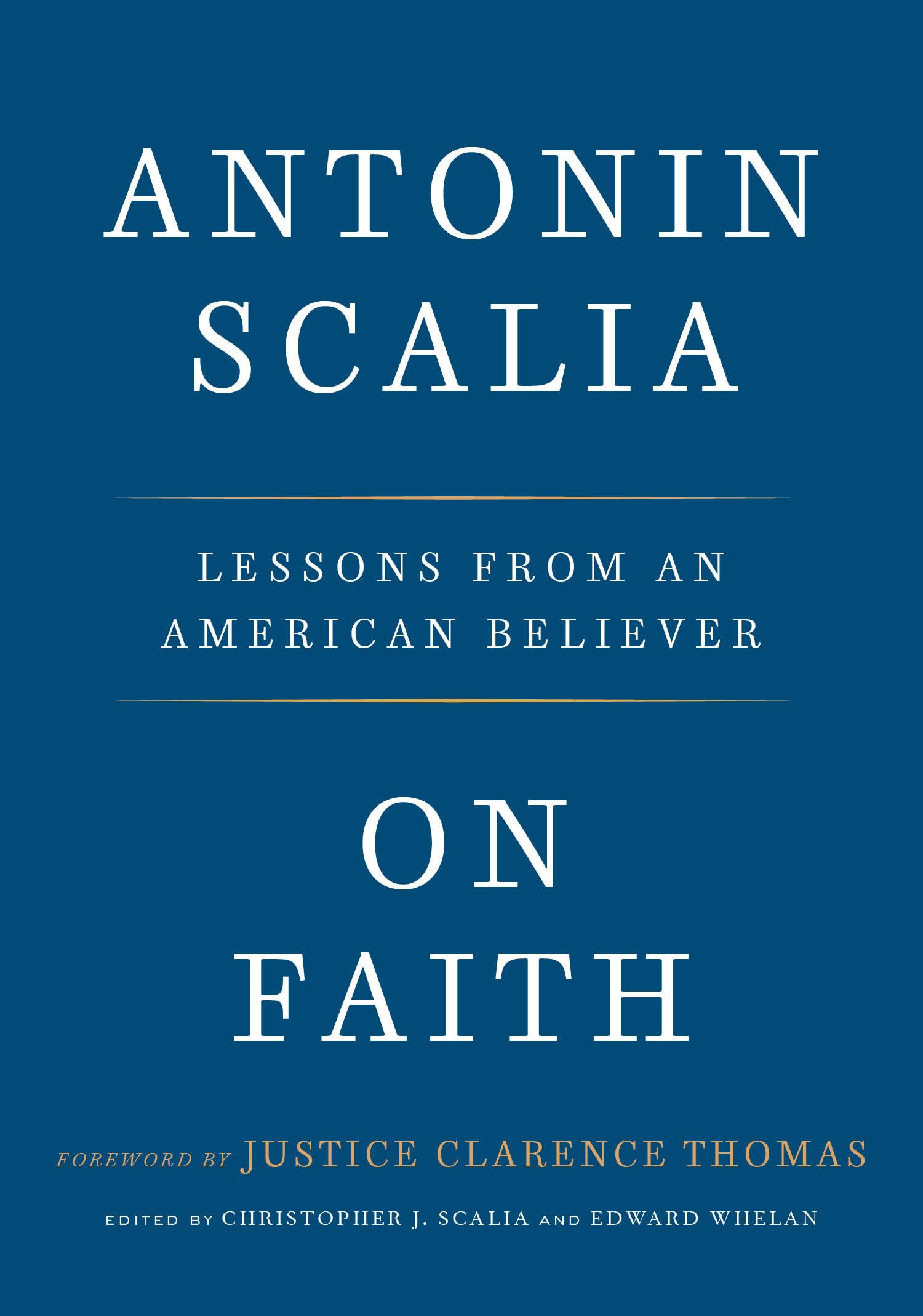



On Faith is an inspiring collection of the late Supreme Court justice Antonin Scalia's reflections on his own faith, on the challenges that religious believers face in modern America, and on the religious freedoms protected by the Constitution. Featuring a personal introduction by Justice Scalia's son Father Paul Scalia, this volume will enrich every reader's understanding of the legendary justice. Antonin Scalia reflected deeply on matters of religion and shared his insights with many audiences over the course of his remarkable career. As a Supreme Court justice for three decades, he vigorously defended the American constitutional tradition of allowing religion a prominent place in the public square. As a man of faith, he recognized the special challenges of living a distinctively religious life in modern America, and he inspired other believers to meet those challenges. This volume contains Justice Scalia's incisive thoughts on these matters, laced with his characteristic wit. It includes outstanding speeches featured in Scalia Speaks and also draws from his Supreme Court opinions and his articles. In addition to the introduction by Fr. Scalia, other highlights include Fr. Scalia's beautiful homily at his father's funeral Mass and reminiscences from various friends and law clerks whose lives were influenced by Antonin Scalia's faith. “This book has many gems. . . . [a] valuable collection.” — National Catholic Register “A remarkable meditation on the nature of religious faith and its relationship to the world of affairs.” — The University Bookman "This book preserves a rare and indispensable voice in American Catholicism."— The Catholic World Report ANTONIN GREGORY SCALIA was born on March 11, 1936, in Trenton, New Jersey, the only child of Eugene and Catherine Scalia. In 1982, President Reagan nominated Scalia to join the U.S. Court of Appeals for the District of Columbia Circuit. Four years later, Reagan nominated him to the Supreme Court of the United States, to which he was confirmed by the Senate, 98- 0. Justice Scalia took his seat on the bench on September 26, 1986. As a Supreme Court justice, Scalia articulated and exercised the interpretive methods of originalism and textualism. He established himself as a forceful presence on the bench, a vivid and compelling writer, and a gregarious public presence. One of the most significant justices in the history of the Court, he served for nearly thirty years before his death on February 13, 2016. Antonin Scalia was married to Maureen for fifty- five years. Together they had nine children and dozens of grandchildren. He was a loving husband, a devoted father, a devout Catholic, and a proud American. CHRISTOPHER J. SCALIA, the eighth of Justice Scalia's nine children and a former professor of English, works at a public relations firm near Washington, DC. His book reviews and political commentary have appeared in The Wall Street Journal, The Washington Post, The Weekly Standard , and elsewhere. He lives in Virginia with his wife and three children. EDWARD WHELAN, president of the Ethics and Public Policy Center, is a former law clerk to Justice Scalia. He is a leading commentator on the Supreme Court and on issues of constitutional law. A father of four, he lives with his family in the DC area. Mr. Scalia and Mr. Whelan previously co-edited Scalia Speaks: Reflections on Law, Faith, and Life Well Lived (Crown Forum, 2017), a New York Times bestselling collection of Justice Scalia's speeches. Not to the Wise—the Christian as Cretin How can intelligent Christians exercise their faith in a skeptical world? How can they reconcile reason and faith? To address these questions, Justice Scalia considered the perspectives of two great men named Thomas. Perhaps surprisingly given Scalia’s admiration for the American founding, Thomas Jefferson served as a negative example, as he viewed belief in miracles as “vulgar ignorance.” Justice Scalia contrasted Jefferson with St. Thomas More, the lord high chancellor of England who was executed for respecting the Pope’s authority to refuse King Henry VIII’s divorce. Because he saw with the eyes of faith, this learned man of reason was regarded as a fool by his friends and even by his wife. St. Thomas More, the patron saint of lawyers, was a hero to Justice Scalia, who delivered the following speech to religious audiences around the country. The title of my talk today is “Not to the Wise—the Christian as Cretin.” The second half of that title, “The Christian as Cretin,” is meant, of course, to be a play on words. And it is a wordplay that has some etymological basis. The English word cretin, meaning “a person of deficient mental capacity,” in fact derives from the French word chrétien, meaning “Christian,” which was used in the Middle Ages to refer to the short, often grotesque, severely retarded people who were to be found in some remote valleys of the Alps—perhaps the result of excessive inbreeding. These