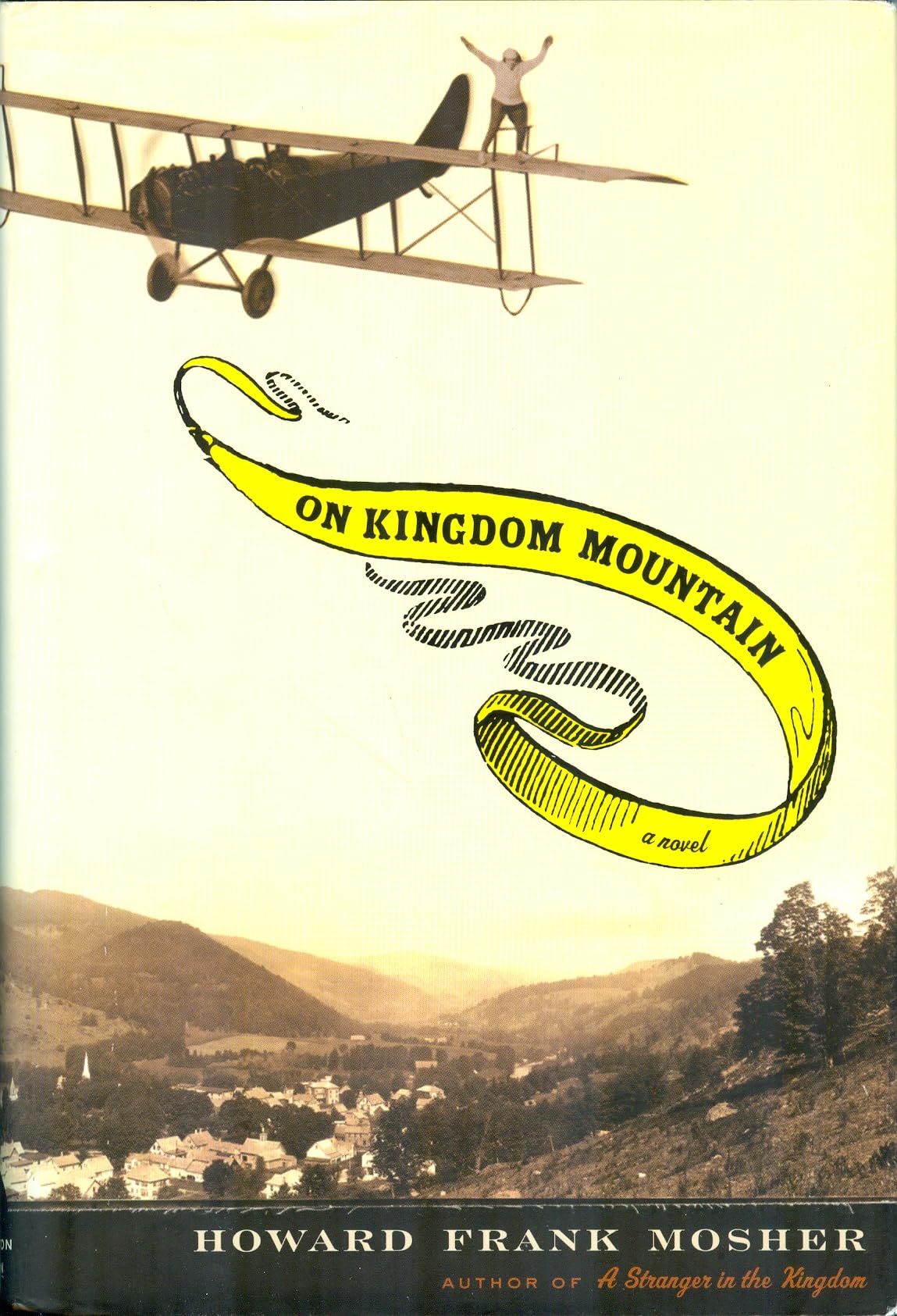



Set in northern Vermont in 1930, On Kingdom Mountain introduces us to Miss Jane Hubbell Kinneson. A renowned local bookwoman and eccentric bird carver, she is the last remaining resident of a wild mountain on the U.S.-Canadian border, now threatened by a proposed new highway known as the Connector. On her fiftieth birthday, a mysterious stunt pilot and weathermaker enters her life when his biplane crashes on the frozen lake at the foot of her mountain. He brings with him a riddle -- handed down from his grandfather -- containing clues to the whereabouts of $100,000 in stolen Civil War gold that may have been hidden on Miss Jane's property. As she and the footloose aviator begin to search for the treasure, Miss Jane finds herself confronted by the most important decisions of her life. Featuring daring action scenes and outrageous comedy, along with a passionate and surprising love affair, On Kingdom Mountain represents traditional storytelling at its best, rooted deeply in Howard Mosher’s own family history and in a way of life on the brink of extinction. Jane Hubbell Kinneson is the sole owner and last resident of Kingdom Mountain, Vermont, a wild and unspoiled place on the U.S.-Canadian border in 1930. Outside forces led by her cousin Eben are trying to get the Connector, a new highway that will run through the mountain, pushed through. Miss Jane says, "Over my dead body," and means it. On her fiftieth birthday, stunt pilot and rainmaker Henry Satterfield crashes his biplane on her lake. Miss Jane offers him shelter and Henry joins her fight against the Connector. Henry is in Vermont to solve the riddle his Confederate grandfather left him about the location of stolen federal gold. The two go to the state supreme court, put on a wing-walking show, and eventually become lovers. Miss Jane is a fascinating character, and the host of small-town Vermonters who populate the story are little gems, both hilarious and poignant. It's not hard to see where the story is going, but the scenery along the way is well worth the trip. Brad Hooper Copyright © American Library Association. All rights reserved HOWARD FRANK MOSHER is the author of ten books, including Waiting for Teddy Williams, The True Account, and A Stranger in the Kingdom, which, along with Disappearances, was corecipient of the New England Book Award for fiction. He lives in Vermont. Prologue In the late summer of the last full year of the bloodiest war in American history, two men in butternut uniforms rode hard into the northern Vermont village of Kingdom Common, yelling and firing their rifles into the air. They galloped across the short north end of the rectangular central green, scattering a gang of kids playing one old cat on the grass under the tall New England elms, waking up the old men dozing on the porch of the Common Hotel.While one man held the horses, the other ran into the squat brick First Farmers and Lumberers Bank of Kingdom Common and demanded, in what a clerk later characterized as a Rebel- sounding” accent, all of the gold on hand. He stipulated that he wanted only gold, the clerk remembered. Besides his rifle and two holstered pistols, he had eight white linen sacks for the clerks to fill. He made eight trips back outside to the horses, staggering under the weight of each sack. His companion, in the meantime, continued to holler and spout all kinds of threats, damning the Union army in general and Vermont Yankees in particular, and firing his rifle at random intervals. To this day there is a pockmark the size of a half-dollar partway up the granite clock tower of the courthouse, presumably from one of the stray bullets fired by the cursing raider. The Gray Ghosts, as the two riders would become known in the mythology of Kingdom County, were not long at their work. At most, the robbery took ten minutes. No one had any idea who they were. They might have been Confederate soldiers hoping to divert Union forces to the north or common bandits disguised as Confederate soldiers. Still shouting, they galloped east out of town on the county road, then, it was thought, up the Canada Pike Road over Kingdom Mountain toward the border, five miles to the north. By the time the sheriff, a seventy-year-old Mexican War veteran who, at the time of the raid, was playing checkers at the feed store at the other end of town, had assembled a posse of other graybeards too old for active service and teenage boys too young, the raiders had a good half-hour start. Beyond the border, the pike road was just a faint trace, scarcely more than an animal trail through big woods and trackless bogs and bigger woods still, some of the last true wilderness east of the Rocky Mountains. It was not surprising that the Ghosts got away with their plunder scot- free. The legend of the Great Kingdom Common Raid, however, was considerably enhanced by two unusual circumstances. First, the nondescript little country bank happened to be one of the wealthiest in northern N