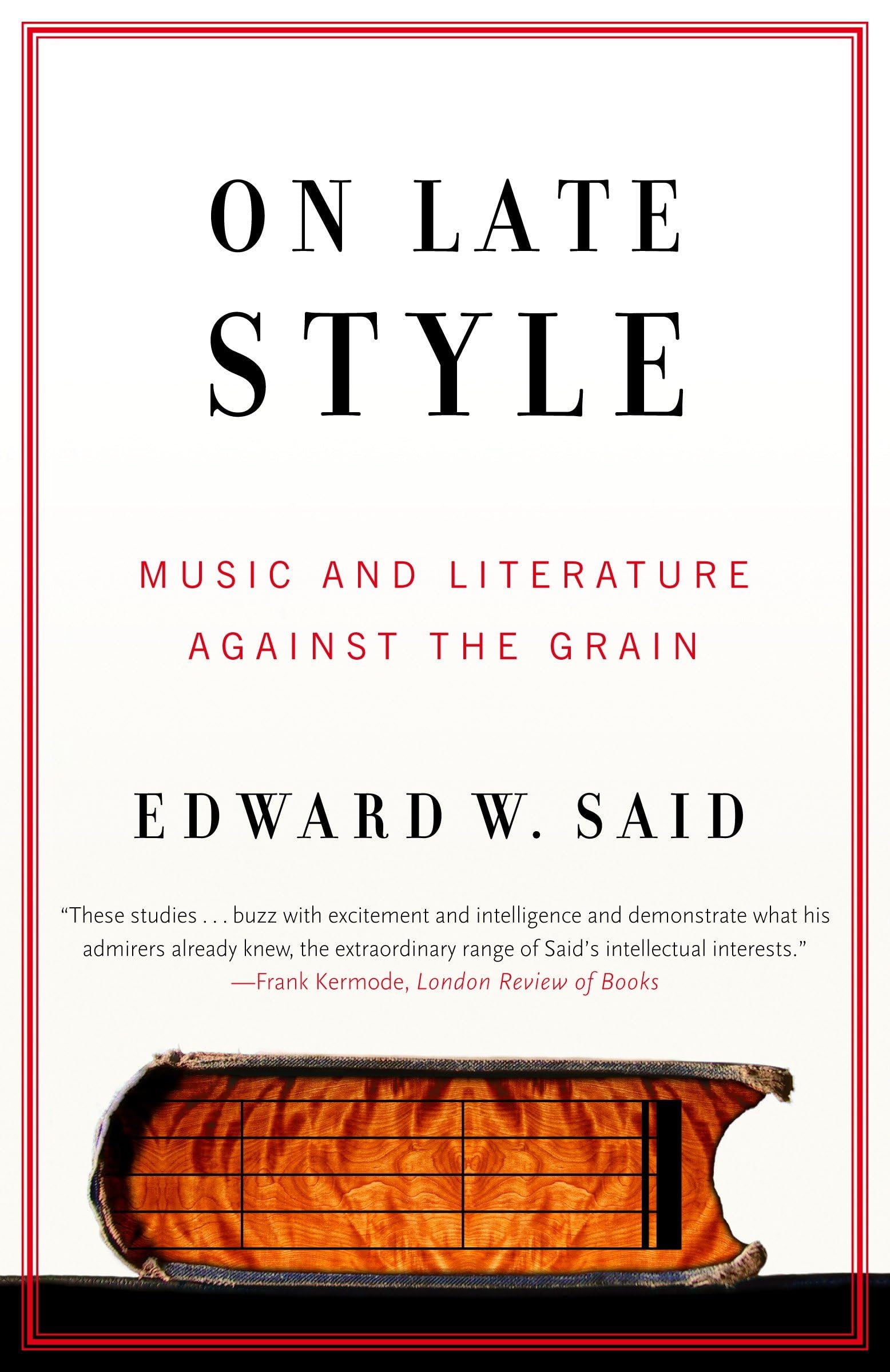



In this fascinating book, Edward Said looks at the creative contradictions that often mark the late works of literary and musical artists. "These studies . . . buzz with excitement and intelligence and demonstrate...the extraordinary range of Said’s intellectual interests.” —Frank Kermode, London Review of Books Said shows how the approaching death of an artist can make its way into his work, examining essays, poems, novels, films, and operas by such artists as Beethoven, Genet, Mozart, Lampedusa, Euripides, Cavafy, and Mann, among others. He uncovers the conflicts and complexity that often distinguish artistic lateness, resulting in works that stood in direct contrast to what was popular at the time and were forerunners of what was to come in each artist's discipline–works of true genius. Eloquent and impassioned, brilliantly reasoned and revelatory, On Late Style is Edward Said's own great last work. “These studies . . . buzz with excitement and intelligence and demonstrate what his admirers already knew, the extraordinary range of Said’s intellectual interests.” —Frank Kermode, London Review of Books “Brilliant. . . . This gracefully unquiet, probing and wise book [is] Said’s own elegiac masterpiece of late style.” — Financial Times “Fascinating and stimulating. . . . Said, as with the best writers, is someone you like to spend time with. . . . This book is a fine monument to his life and work.” — The New Statesman “His critic’s eye remain[s] original and compelling.” — Wilson Quarterly Edward W. Said was University Professor of English and Comparative Literature at Columbia University. He was the author of more than twenty books, including Orientalism, which was nominated for the National Book Critics Circle Award; Culture and Imperialism; Representations of the Intellectual; The End of the Peace Process; Power, Politics, and Culture; and Out of Place: A Memoir. His books have been published in thirty-six languages. He died in 2003. Timeliness and Lateness The relationship between bodily condition and aesthetic style seems at first to be a subject so irrelevant and perhaps even trivial by comparison with the momentousness of life, mortality, medical science, and health, as to be quickly dismissed. Nevertheless, my contention is as follows: all of us, by virtue of the simple fact of being conscious, are involved in constantly thinking about and making something of our lives, self-making being one of the bases of history, which according to Ibn Khaldun and Vico, the great founders of the science of history, is essentially the product of human labor. The important distinction therefore is that between the realm of nature on the one hand and secular human history on the other. The body, its health, its care, composition, functioning, and flourishing, its illnesses and demise, belong to the order of nature; what we understand of that nature, however, how we see and live it in our consciousness, how we create a sense of our life individually and collectively, subjectively as well as socially, how we divide it into periods, belongs roughly speaking to the order of history that when we reflect on it we can recall, analyze, and meditate on, constantly changing its shape in the process. There are all sorts of connections between the two realms, between history and nature, but for now I want to keep them apart and focus only on one of them, history. Being myself a profoundly secular person, I have for years been studying this self-making process through three great problematics, three great human episodes common to all cultures and traditions, and it is the third of these problematics that I want specifically to discuss in this book. But for purposes of clarity, let me quickly summarize one and two. The first is the whole notion of beginning, the moment of birth and ori- gin, which in the context of history is all the material that goes into thinking about how a given process, its establishment and institution, life, project, and so on, gets started. Thirty years ago I published a book called Beginnings: Intention and Method about how the mind finds it necessary at certain times to retrospectively locate a point of origin for itself as to how things begin in the most elementary sense with birth. In fields like history and the study of culture, memory and retrospec- tion draw us to the onset of important things—for example, the beginnings of industrialization, of scientific medicine, of the romantic period, and so on. Individually, the chronology of discovery is as important for a scientist as it is for someone like Immanuel Kant who reads David Hume for the first time and, he says memorably, is briskly awakened from his dogmatic slumber. In Western literature, the form of the novel is coincidental with the emergence of the bourgeoisie in the late seventeenth century, and this is why, for its first century, the novel is all about birth, possible orphanhood, the discovery of roots, and the c