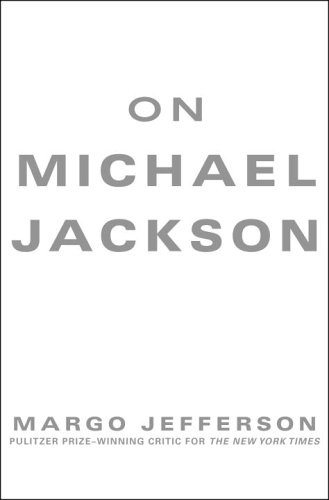



Michael Jackson was once universally acclaimed as a song-and-dance man of genius; Wacko Jacko is now, more often than not, dismissed for his bizarre race and gender transformations and confounding antics, even as he is commonly reviled for the child molestation charges twice brought against him. Whence the weirdness and alleged criminality? How to account for Michael Jackson’s rise and fall? In On Michael Jackson —an at once passionate, incisive, and bracing work of cultural analysis—Pulitzer Prize–winning critic for The New York Times Margo Jefferson brilliantly unravels the complexities of one of the most enigmatic figures of our time. Who is Michael Jackson and what does it mean to call him a “What Is It”? What do P. T. Barnum, Peter Pan, and Edgar Allan Poe have to do with our fascination with Jackson? How did his curious Victorian upbringing and his tenure as a child prodigy on the “chitlin’ circuit” inform his character and multiplicity of selves? How is Michael Jackson’s celebrity related to the outrageous popularity of nineteenth-century minstrelsy? What is the perverse appeal of child stars for grown-ups and what is the price of such stardom for these children and for us? What uncanniness provoked Michael Jackson to become “Alone of All His Race, Alone of All Her Sex,” while establishing himself as an undeniably great performer with neo-Gothic, dandy proclivities and a producer of visionary music videos? What do we find so unnerving about Michael Jackson’s presumed monstrosity? In short, how are we all of us implicated? In her stunning first book, Margo Jefferson gives us the incontrovertible lowdown on call-him-what-you-wish; she offers a powerful reckoning with a quintessential, richly allusive signifier of American society and popular culture. Its a high-wire act to admire and defend someone as genuinely bizarre and embattled as Michael Jackson. Most of the public has long come to a conclusion about him, so much so that his name rarely grabs tabloid headlines anymore. That Margo Jefferson, a Pulitzer Prizewinning culture and theatre critic for the New York Times, is able to tease out some new insights into Jacksons relevance is something of an accomplishment. That she provokes some sympathy for her subject is even more impressive. Not that the praise is universal. Her own home paper finds that fanaticism blurs her judgment, something weve all been guilty of from time to time. Copyright © 2004 Phillips & Nelson Media, Inc. Longtime New York Times writer Jefferson devotes her short first book to the man who surely must be the most interesting living American entertainer. She tries to account for how Michael Jackson became what he is, beginning with the chapter "Freaks," which uses Jackson's interest in P. T. Barnum--he gives copies of the great bunkum artist's autobiography to all who work for him--to suggest that Jackson is not uninterested in being a freak and is intrigued by public deception and deliberate ambiguity (when a Barnum attraction was shown up as phony, Barnum wouldn't dispute revealed truth but also wouldn't retract the falsehood; that way, both truth and falsehood became means of attracting paying customers). In "Home" and "Star Child," Jefferson brings in the domestic and professional peculiarities, many of them pretty unwholesome, that nurtured Jackson's narcissism and perfectionism and led him to become the nonpareil physical figure she considers in "Alone of All His Race, Alone of All Her Sex" --that is, an apparently raceless, sexless, humanlike being. Finally, "The Trial" discusses how Jackson prevailed against child molestation charges and speculates on his guilt or innocence, inclining to the latter because of Jackson's fetishization of childlike innocence, positing that Jackson is tempted to molest but gets his kicks, as it were, out of always resisting. Replete with exegesis of Jackson's exceptional dancing and his great music videos and how they derive from African American entertainment traditions and relate to Jackson and his public's fascinations, this is one smart little book. Ray Olson Copyright © American Library Association. All rights reserved Margo Jefferson has written for The New York Times since 1993 and received the Pulitzer Prize in 1995. Her reviews and essays have also appeared in The Nation, Vogue, Grand Street, The Village Voice, American Theatre, Dance Ink, and Harper’s Magazine. She lives in New York City. Every mind is a clutter of memories, images, inventions and age-old repetitions. It can be a ghetto, too, if a ghetto is a sealed-off, confined place. Or a sanctuary, where one is free to dream and think whatever one wants. For most of us it’s both—and a lot more complicated. A ghetto can be a place of vitality; a sanctuary can become a prison. Michael Jackson escaped the ghetto of Gary, Indiana, and built the sanctuary of Neverland. It’s become a circuslike prison, emblematic of the mind of Michael Jackson. Think of his mind