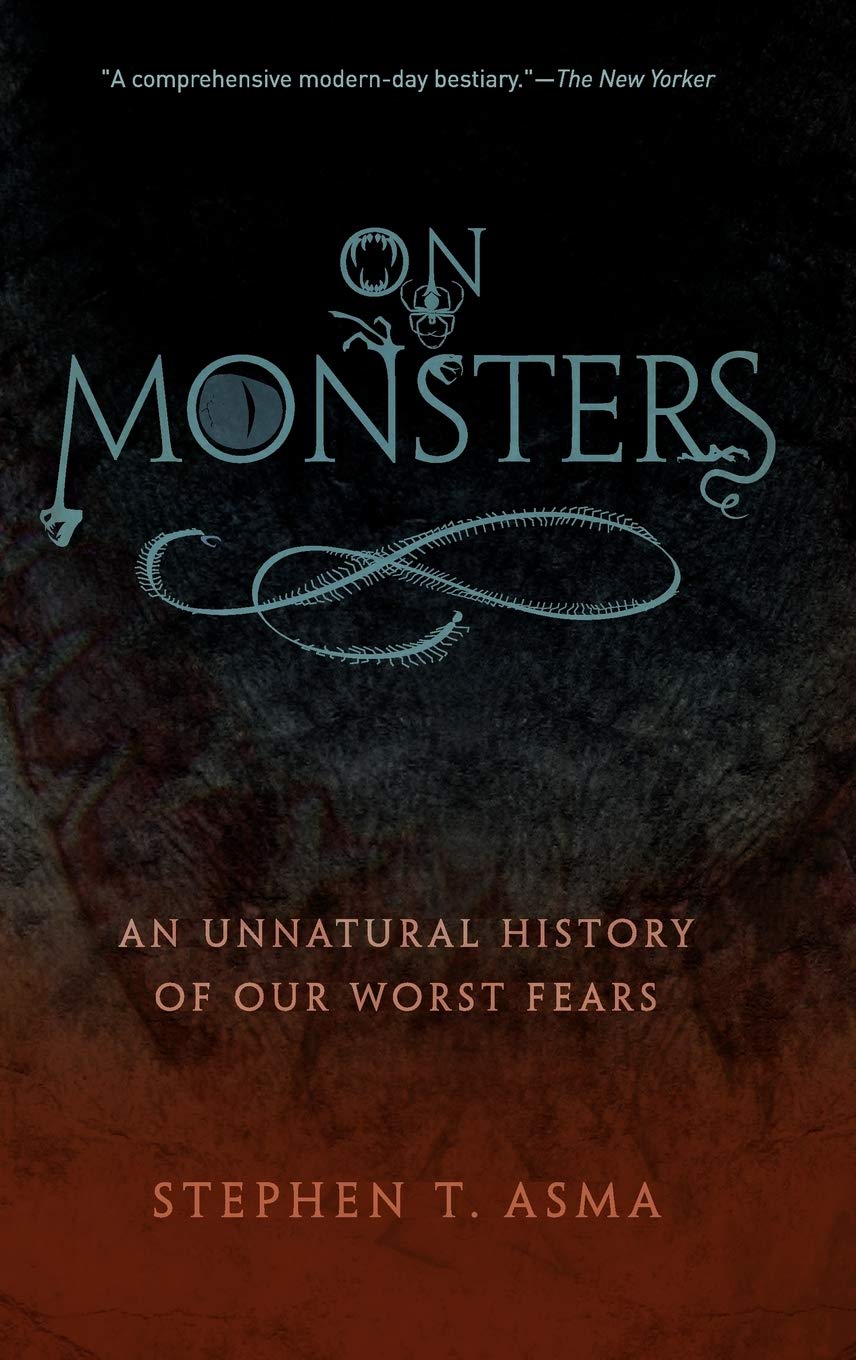



Hailed as "a feast" ( Washington Post ) and "a modern-day bestiary" ( The New Yorker ), Stephen Asma's On Monsters is a wide-ranging cultural and conceptual history of monsters--how they have evolved over time, what functions they have served for us, and what shapes they are likely to take in the future. Beginning at the time of Alexander the Great, the monsters come fast and furious--Behemoth and Leviathan, Gog and Magog, Satan and his demons, Grendel and Frankenstein, circus freaks and headless children, right up to the serial killers and terrorists of today and the post-human cyborgs of tomorrow. Monsters embody our deepest anxieties and vulnerabilities, Asma argues, but they also symbolize the mysterious and incoherent territory beyond the safe enclosures of rational thought. Exploring sources as diverse as philosophical treatises, scientific notebooks, and novels, Asma unravels traditional monster stories for the clues they offer about the inner logic of an era's fears and fascinations. In doing so, he illuminates the many ways monsters have become repositories for those human qualities that must be repudiated, externalized, and defeated. Real or imagined, literal or metaphorical, monsters have exerted a dread fascination on the human mind for many centuries. Using philosophical treatises, theological tracts, newspapers, films, and novels, author Stephen T. Asma unpacks traditional monster stories for the clues they offer about the inner logic of our fears and fascinations throughout the ages. Take a Closer Look at the Mythical Creatures from On Monsters Click on image to enlarge The manticore monster was thought to favor human flesh. Descriptions of the beast appear in the natural history texts of Ctesias, Aristotle, and Pliny. Pencil drawing by Stephen T. Asma © 2008, based on a sketch from Edward Topsell’s seventeenth-century bestiary. The Golem is a bumbling monster of Jewish folklore. The clay creature was animated by Rabbi Judah Loew to protect the Jewish ghetto but could not be controlled and wreaked havoc in Prague. Pen and ink drawing by Stephen T. Asma © 2008. The Cyclops legend was fueled by ancient Greek misinterpretations of mastodon skulls found in Mediterranean caves. Pencil drawing and collage by Stephen T. Asma. Symbolic of God’s power, the biblical Behemoth appears in the Book of Psalms and Job. Pencil drawing by Stephen T. Asma © 2008. "Monsters literal and metaphorical are dissected with skill and discernment in philosopher and scholar Asma's penetrating "unnatural history." Erudite, funny, and deeply attuned to the profound psychological and moral implications of monstrousness, Asma encompasses the mystical and the scientific as he ponders the simultaneous repulsion and attraction monsters arouse... Asma is insightful and entertaining in his discussion of monsters of the deep, supernatural doppelgangers, zombies, and vampires, and intense in his discussion of Freud and the 'science of monstrous feelings...' Asma's far-reaching book of monsterology is original, captivating, and profoundly elucidating."-- Booklist starred review "With insight, erudition, and humor, Asma's compendium of monsterology traces the evolving meanings and manifestations of monsters since antiquity, in religion, philosophy, science, literature, popular culture, and the human psyche. To explain the eternal attraction and repulsion of the monstrous, Asma draws on material from Aristotle to nanotechnology, revealing myriad, surprising ways that supernatural, natural, and metaphorical monsters inhabit the landscape of our imagination."--Adrienne Mayor, author of The First Fossil Hunters and The Poison King "On Monsters is a humorously omnivorous consideration of the monstrous. It's a delightful book, a terrific balance of scholarship and wonder."--Audrey Niffenegger, author of The Time Traveler's Wife "A wide-ranging exploration of fear and evil, Asma's presentation and theories are original and practical, depicting those dark, repulsive notions of an unstable, turbulent world in which everybody must struggle to remain human and civilized." -- Publishers Weekly "A comprehensive modern-day bestiary."-- New Yorker "Cleverly conceived and slyly written...I have seldom read a book that so satisfyingly achieves such an ambitious goal... His new book is a feast." -- Washington Post "Spelunking adventure through the caverns of world history, culture and thought." -- Chicago Sun-Times "Asma has a lucid, engaging style, and he uses it to provide a thoughtfully breezy survey of the bizarre and the lurking." -- Chicago Reader In his new book, On Monsters: An Unnatural History of Our Worst Fears , Columbia College lecturer Stephen Asma lays out a frightful and compelling bestiary." -- Time Out Chicago "This highly readable, often humorous book is suitable for anyone interested in the history of ideas, culture, and the imaginatio