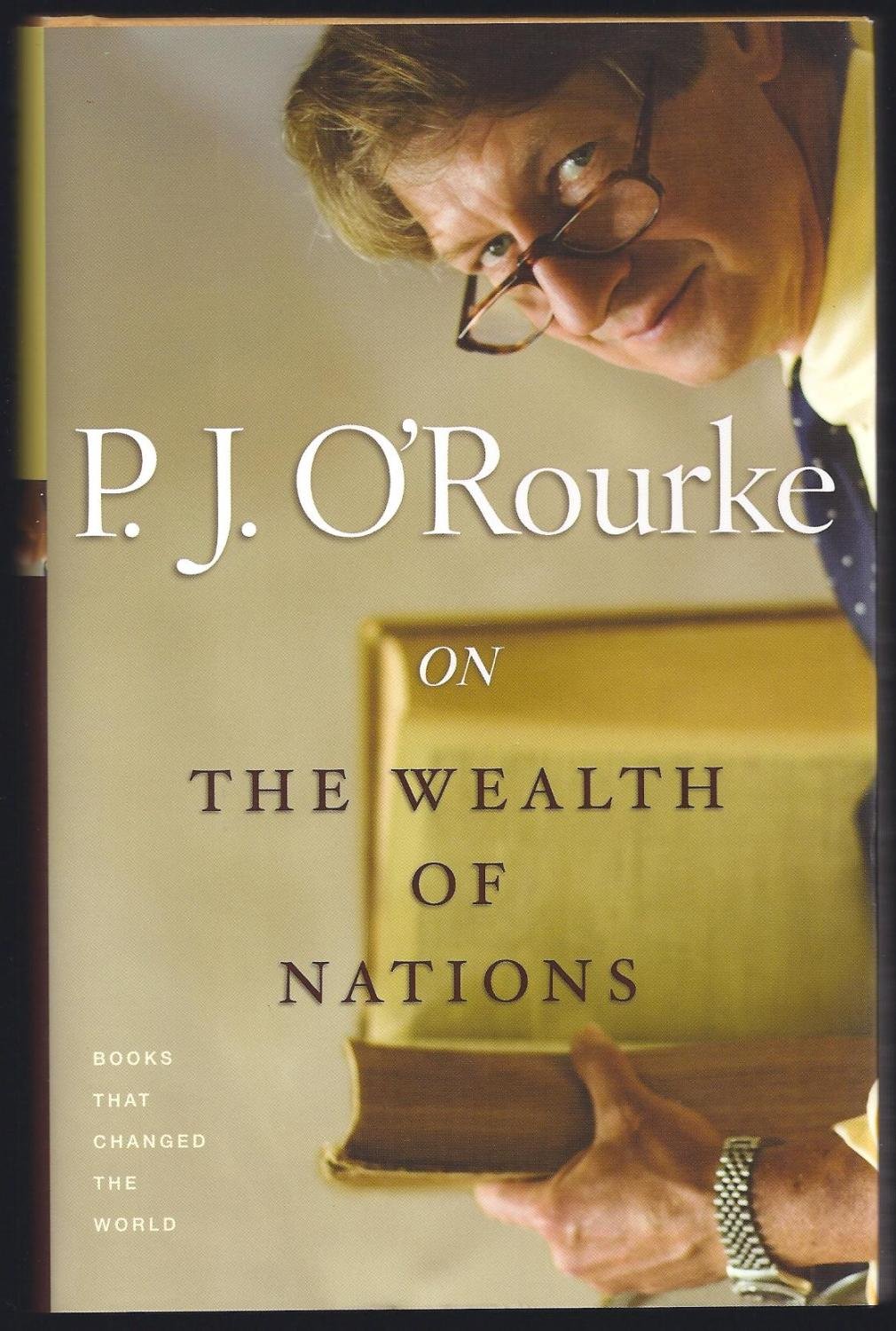



As one of the first titles in Atlantic Monthly Press’ Books That Changed the World” series, America’s most provocative satirist, P. J. O’Rourke, reads Adam Smith’s revolutionary The Wealth of Nations so you don’t have to. Recognized almost instantly on its publication in 1776 as the fundamental work of economics, The Wealth of Nations was also recognized as really long: the original edition totaled over nine hundred pages in two volumesincluding the blockbuster sixty-seven-page digression concerning the variations in the value of silver during the course of the last four centuries,” which, to those uninterested in the historiography of currency supply, is like reading Modern Maturity in Urdu.” Although daunting, Smith’s tome is still essential to understanding such current hot-topics as outsourcing, trade imbalances, and Angelina Jolie. In this hilarious, approachable, and insightful examination of Smith and his groundbreaking work, P. J. puts his trademark wit to good use, and shows us why Smith is still relevant, why what seems obvious now was once revolutionary, and why the pursuit of self-interest is so important. Old and weighty as it is, Adam Smith's The Wealth of Nations remains the seminal work on the fundamentals of economics. Political satirist O'Rourke plumbs the hefty tome, examining the eighteenth-century text in relation to our modern economy, demonstrating the enduring wisdom and application of Smith's work. O'Rourke marvels at Smith's ability to cut to the marrow of economic concepts, the simplicity behind the notion of division of labor and self-interest. Despite the lack of personal introspection shown by authors of Smith's era, O'Rourke finds Smith's sense of humor shining through the long-winded writing typical of the time. In a discourse on the need for imported goods, Smith ponders the trading of French wine for English hardware to avoid an oversupply of pots and pans in the nation. Working without benefit of the graphs and jargon that modern-day economists employ, Smith analyzed the nation's early mercantilism and its benefit to society. In a highly accessible, often hilarious tone, O'Rourke parses Smith's notions of political and economic freedom. Readers well versed and not so well versed in economic theory will enjoy this delightful look at Smith's famous and famously dense work. Vanessa Bush Copyright © American Library Association. All rights reserved Reviewed by Daniel Gross Back in 1776, a subject of the British Empire published a remarkably durable statement about the desires and striving of mankind and the deep human yearning for freedom. This document, whose verities echo and resonate throughout the generations, is regarded with something close to adoration. Oh, and the Declaration of Independence was published that year, too. An Inquiry Into the Nature and Causes of the Wealth of Nations, the lengthy tome penned by Adam Smith, then a 53-year-old Scottish logician and economist, has had nearly as great an impact on mankind as the much shorter document inked by Thomas Jefferson. A staple of Great Books courses, The Wealth of Nations is a sort of Bible for free-market devotees. Like the Bible, however, it is more cited than read -- and frequently least read by those who cite it most. And so having a well-known, highly accessible writer introduce Smith's great work to contemporary audiences is a great idea. The guide for the perplexed is P.J. O'Rourke -- satirist, libertarian, author, wit. It's an incongruous pairing. Smith embarked on a systematic, lengthy, earnest examination of the economic world. "My job is to make quips, jests, and waggish comments," O'Rourke states. But like chocolate and salt, this unlikely combination works well together. In this book, O'Rourke is a charming, highly literate blogger -- one who thinks before actually writing -- elucidating Smith's arguments and making insightful comments along the way. It's a safe bet the words "Talmud" and "P.J. O'Rourke" have never been used in the same sentence. Yet there is something slightly Talmudic to the approach. O'Rourke nicely lays out Smith's chief contributions to our understanding of economic relationships and of the ways in which government policies can help or hinder trade. "Adam Smith cannot be said to have constructed the capitalist system," explains O'Rourke. "What he did was provide the logic of a level ground of economic rights upon which free enterprise could be built more easily." To a large degree, Smith was light years ahead of his time -- in arguing aggressively for free trade, in proclaiming the dignity of labor at a time when much labor was unfree, and in making the now obvious connections between the pursuit of sustenance and riches and the pursuit of life, liberty and happiness. "Smith saw the moral potential in both our interest in others and our self-interest," O'Rourke writes. O'Rourke neatly highlights the inconsistencies and occasional contradictions inherent in Smith