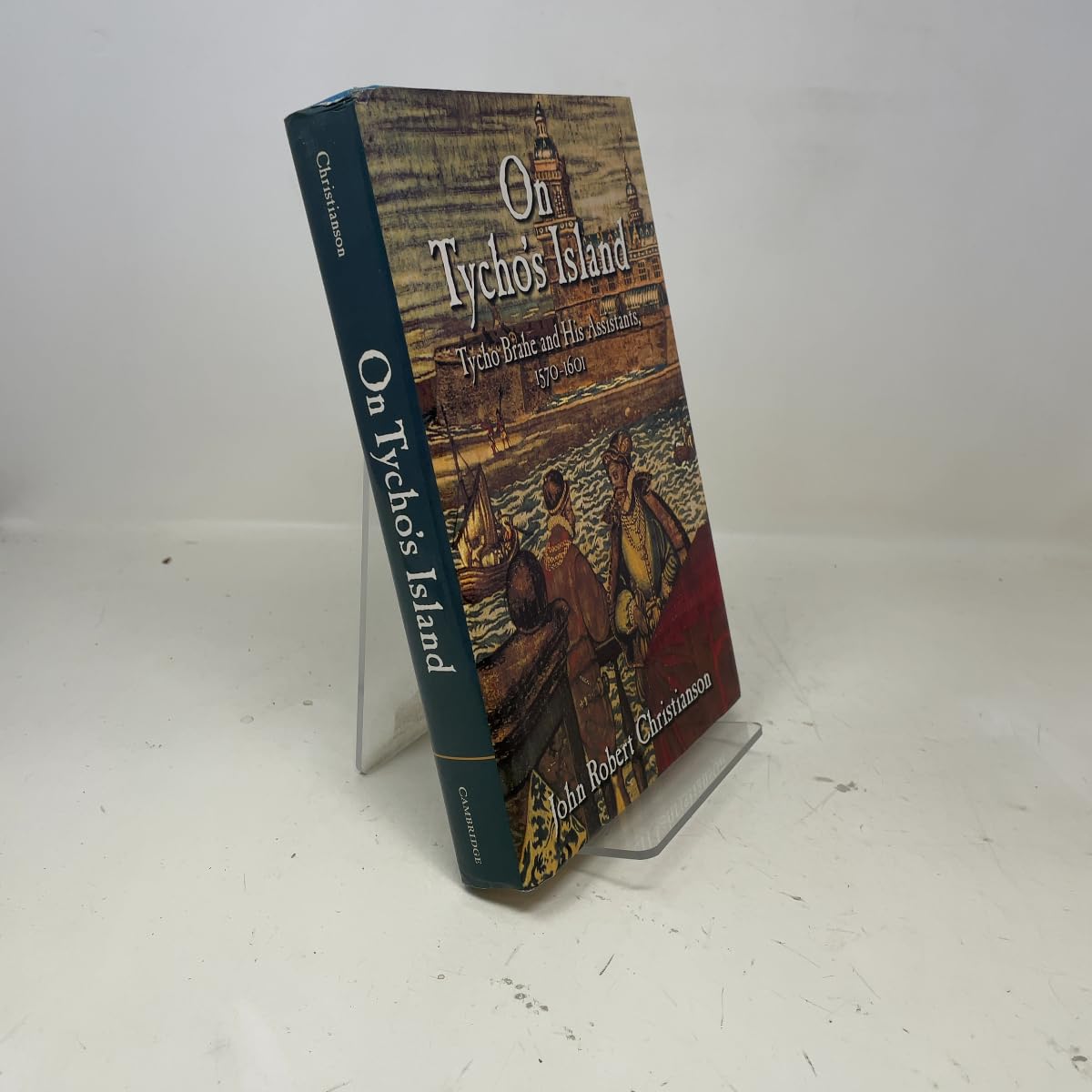
On Tycho's Island: Tycho Brahe and his Assistants, 1570–1601
$60.64
by John Robert Christianson



A Platonic philosopher, Paracelsian chemist, Ovidian poet, and devoted family man, Tycho Brahe was the last Renaissance man and the first great organizer of modern science. This book provides the fullest portrait available of the research and cultural interests of the man who became the premier patron-practitioner of science in sixteenth-century Europe. Starting from Brahe's well reputed role of astronomer, author Christianson adds lesser known details of the man who was both a geodetic surveyor as well as a garden designer, and ultimately established a new role of scientist as administrator, active reformer, and natural philosopher. Coverage reveals how from his private island in Denmark, Brahe used patronage, printing, friendship, and marriage to incorporate men and women skilled in science, technology, and the fine arts into his program of cosmic reform. Through their teamwork, they achieved breakthroughs in astronomy, scientific method, and research organization that were essential to the birth of modern science. Also included are over 100 capsule biographies of Tycho's clients, coworkers, and friends, including Johannes Kepler, Willebrord Snel, Willem Blaeu, several bishops, and numerous technical specialists all of whom helped shape the culture of the Scientific Revolution. This pioneering exposition will appeal to science history buffs, especially those with an interest in the late Renaissance and will inspire anyone who has a passion for science and a penchant for the world of ideas. John Robert Christianson received his Ph.D. from the University of Minnesota. He was dubbed Knight of the Royal Norwegian Order of Merit by King Harald II in 1995. We think of Big Science, with heavy government support and huge teams working on long-term projects, as typically modern, but Danish astronomer Tycho Brahe was thinking big in the late 16th century. While Copernicus laid the theoretical foundation for the new astronomy, it was Tycho (1546-1601) who brought it to fruition with his meticulous observations and the regular publication of his results. A Danish noble educated in German universities, Tycho inherited landed wealth, but the life of a courtier did not interest him. In 1575, he convinced King Frederick II to give him as his fief the island of Hven, where he constructed a world-class observatory, with numerous instruments he designed and built himself. Tycho's plans involved considerable social upheaval on Hven. The project drafted the local peasants and fishermen for ``boon labor,'' and brought in specialists from all over Europe. At its peak, Uraniborg (as the science center was called) supported not only Tycho's large family and servants, but a substantial group of assistants. After a day's work, the extended family of Tychos scholars would gather for a communal dinner, at which they would improvise Latin verse, drink deeply, and discuss their findings in the light of neo-Platonist philosophy. Christianson (History/Luther College) puts Tycho's scientific achievements in the context of the daily life, intellectual milieu, and courtly politics of the era. He provides full scholarly apparatus, including short biographies of Tycho's assistantssome, like Johannes Kepler, famous in their own right, others comparatively obscurea useful glossary of technical terms, and numerous illustrations. Despite his often dry style, Christianson provides a double share of fascinating insights into the era and the career of perhaps the greatest astronomer of the pre-telescope era. A gold mine for anyone interested in one of the giants of Renaissance science. -- Copyright ©1999, Kirkus Associates, LP. All rights reserved. "Anyone with an interest in astronomy or the history of science will enjoy this tale, thanks to Christianson's lively style and thorough research." Dan Falk, Toronto Globe & Mail "...Christianson provides a double share of fascinating insights into one era and the career of perhaps the greatest astronomer of the pre-telescope era. A gold mine for anyone interested in one of the giants of Renaissance science. Kirkus Reviews "brims with intriguing material." Physics Today "...explains how Brahe built Uraniborg with labor from Hven's farm village of Tuna; what exalted friendships Brahe established, and what his Latin verse says about that extended familia; how Brahe's complex household, observatory, printing press, map-making projects and chemistry labs operated; and how the Uraniborg group disseminated its methods, ideas and students across northern Europe....Christianson's narrative combines the intrigue of Reformation courts with the excitement of early modern science." Publisher's Weekly "On Tycho's Island brims with intriguing material...." Physics Today "A well-rounded portrait of Brahe...is presented in a study which includes intriguing facts on his contemporaries." The Midwest Book Review On Tycho's Island allows us to appreciate Uraniborg as the site of enormous practical and theoretical adva