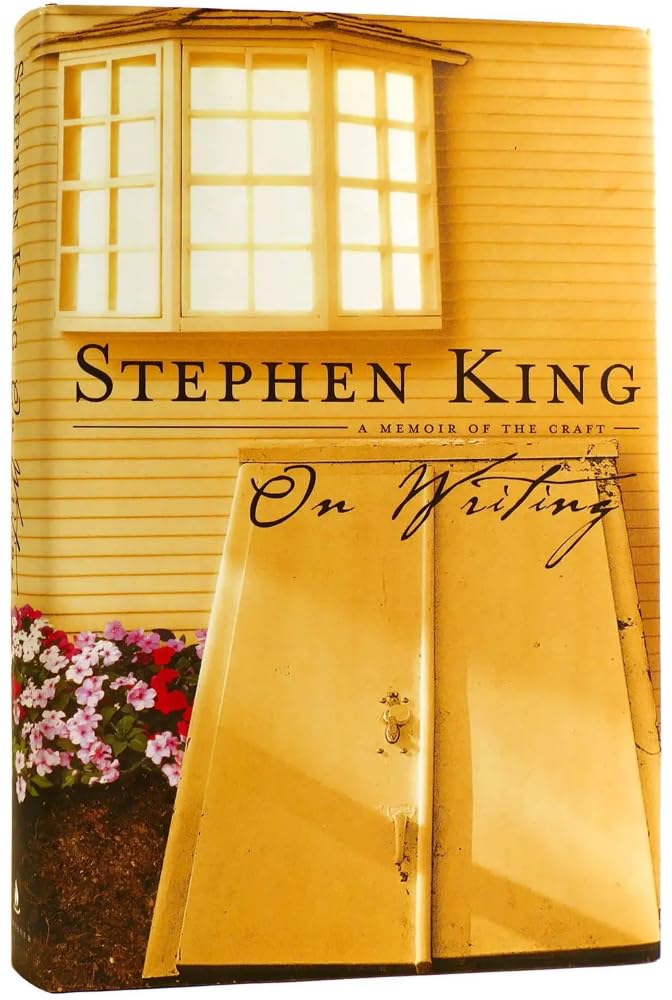



The author of The Stand, The Shining, and other great books shares his insights into the craft of writing, offering a breezy, humorous perspective on his own experience as a writer. 500,000 first printing. BOMC Main. QPB Alt. Short and snappy as it is, Stephen King's On Writing really contains two books: a fondly sardonic autobiography and a tough-love lesson for aspiring novelists. The memoir is terrific stuff, a vivid description of how a writer grew out of a misbehaving kid. You're right there with the young author as he's tormented by poison ivy, gas-passing babysitters, uptight schoolmarms, and a laundry job nastier than Jack London's. It's a ripping yarn that casts a sharp light on his fiction. This was a child who dug Yvette Vickers from Attack of the Giant Leeches , not Sandra Dee. "I wanted monsters that ate whole cities, radioactive corpses that came out of the ocean and ate surfers, and girls in black bras who looked like trailer trash." But massive reading on all literary levels was a craving just as crucial, and soon King was the published author of "I Was a Teen-Age Graverobber." As a young adult raising a family in a trailer, King started a story inspired by his stint as a janitor cleaning a high-school girls locker room. He crumpled it up, but his writer wife retrieved it from the trash, and using her advice about the girl milieu and his own memories of two reviled teenage classmates who died young, he came up with Carrie . King gives us lots of revelations about his life and work. The kidnapper character in Misery , the mind-possessing monsters in The Tommyknockers , and the haunting of the blocked writer in The Shining symbolized his cocaine and booze addiction (overcome thanks to his wife's intervention, which he describes). "There's one novel, Cujo , that I barely remember writing." King also evokes his college days and his recovery from the van crash that nearly killed him, but the focus is always on what it all means to the craft. He gives you a whole writer's "tool kit": a reading list, writing assignments, a corrected story, and nuts-and-bolts advice on dollars and cents, plot and character, the basic building block of the paragraph, and literary models. He shows what you can learn from H.P. Lovecraft's arcane vocabulary, Hemingway's leanness, Grisham's authenticity, Richard Dooling's artful obscenity, Jonathan Kellerman's sentence fragments. He explains why Hart's War is a great story marred by a tin ear for dialogue, and how Elmore Leonard's Be Cool could be the antidote. King isn't just a writer, he's a true teacher. --Tim Appelo Adult/High School-By the time King was 14, the scads of rejection slips he'd accumu-lated grew too heavy for the nail in the wall on which they were mounted. He replaced the nail with a spike and went on writing. This straight-up book inspires without being corny, and teens suspicious of adult rhap-sodies to perseverance will let down their guard and be put at ease by the book's gritty conversational tone. The first 100 pages are pure memoir-paeans to the horror movies and fanzines that captivated King as a child, the expected doses of misadventure (weeks of detention for distributing his own satirical zine at school; building an electromagnet that took out the electricity of half a street), and hard times. King writes just as passion-ately in the second half of the book, where the talk turns to his craft. He provides plenty of samples of awkward or awful writing and contrasts them with polished versions. Hand this title to reluctant readers and reluctant writers, sit back, and watch what happens.-Emily Lloyd, Fairfax County Public Library, VA Copyright 2001 Cahners Business Information, Inc. In 1981 King penned Danse Macabre, a thoughtful analysis of the horror genre. Now he is treating his vast readership to another glimpse into the intellect that spawns his astoundingly imaginative works. This volume, slim by King standards, manages to cover his life from early childhood through the aftermath of the 1999 accident that nearly killed him. Along the way, King touts the writing philosophies of William Strunk and Ernest Hemingway, advocates a healthy appetite for reading, expounds upon the subject of grammar, critiques a number of popular writers, and offers the reader a chance to try out his theories. But most important, we who climb aboard for this ride with the master spend a few pleasant hours under the impression that we know what it!s like to think like Stephen King. Recommended for anyone who wants to write and everyone who loves to read. -"Nancy McNicol, Hagaman Memorial Lib., East Haven, CT Copyright 2000 Reed Business Information, Inc. King could write a phone book and make it not only a best-seller but also gripping reading. So expect his fiction-writing how-to to be a megahit that reaches plenty of readers besides wanna-be novelists. It is riveting, thanks to King's customary flair for the vernacular and conversational tone,