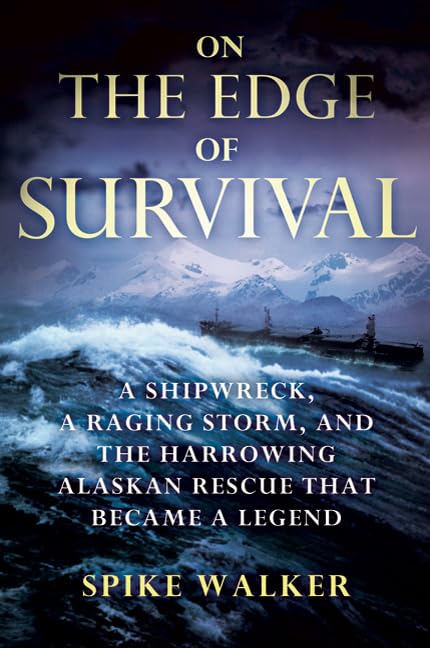
On the Edge of Survival: A Shipwreck, a Raging Storm, and the Harrowing Alaskan Rescue That Became a Legend
$36.00
by Spike Walker



From the acclaimed author whose beloved books inspired the hit television show, The Deadliest Catch, comes a thrilling true adventure tale in the Alaskan seas A Malaysian cargo ship on its way from Seattle, Washington to China ran aground off the coast of western Alaska’s Aleutian Islands on December 8, 2004 during a brutal storm, leading to one of the most incredible Coast Guard rescue missions of all time. Two Coast Guard Jayhawk helicopters lifted off immediately from Air Station Kodiak during the driving storm in an effort to rescue the ship’s eighteen crew members before it broke apart and sank in the freezing waters. Nine of the crew were lifted from the ship and dropped aboard a nearby Coast Guard cutter. But during attempts to save the last eight crew members, one of the Jayhawks was engulfed by a rogue wave that broke over the bow of the ship. When its engines flamed out from ingesting water, the Jayhawk crashed into the sea. The seven crew members from the ship who had been hoisted into the aircraft, along with the chopper’s three-man crew, plunged into the bitterly cold ocean where hypothermia began to set in immediately. Interviewing all the surviving participants of the disaster and given access to documents and photos, acclaimed author Spike Walker has once again crafted a white-knuckle read of survival and death in the unforgiving Alaskan waters. Walker mines familiar territory here with this detailed look into the grounding of a freighter on the Aleutian Islands in 2004. Through multiple interviews with the Coast Guard personnel involved, he provides a minute-by-minute account of the rescue mission that was compounded when a USCG helicopter was hit by a rogue wave, sending it into frigid waters. While readers will not find much nuance here and the dialogue sometimes falls into hyperbole, Deadliest Catch fans will appreciate hearing more about Alaska’s dangerous environment, and there is plenty of tense human drama for even the most hardened disaster epic fan. An epilogue provides a welcome and emotional follow-up to what happened to the major players involved and how the tragedy has affected their lives (which may surprise some). Walker is very good at giving his readers exactly what they want, while making it look effortless in the process. His previous success at uncovering new tales of man against the elements will only be reinforced with the release of this title. --Colleen Mondor SPIKE WALKER spent more than ten seasons aboard some of the most successful crab boats in the Alaskan fleet, and rode out one of the worst storms in Alaska’s history. He is the author of Working on the Edge, Nights of Ice and Coming Back Alive. Spike lives in Alaska and the Pacific Northwest. ONE Slammed right and left by battering, 60 mph wind gusts, blinded by snow squalls at the leading edge of an Arctic storm, search and rescue pilot Lieutenant David Neel was doing his best, early on that cold December morning in 2004, to shake off the sudden bouts of vertigo and keep his H-60 helicopter on course and in the air. Flying along over the gray and white, foam- streaked waters of the Bering Sea, Neel maintained an altitude of just three hundred feet, and no more, to prevent icing as the tall, clutching storm waves lumbered past below. He and his crew had been ordered to Dutch Harbor, where they would refuel and prepare to launch out on an emerging crisis: The Selen dang Ayu, a giant of a freighter, a 738-foot-lonag cargo ship bound for China with over 60,000 metric tons of Pacific Northwest soybeans, had apparently lost her engine while following the Great Circle route across those same, intractable waters 170 miles northwest of Dutch Harbor. With some 455,000 gallons of bulk oil stored in her tanks, and twenty- six sailors trapped aboard her, the freighter was now drifting on a collision course with the hull-crushing shores of the Aleutian Islands. If no one was able to alter her freewheeling advance, and efforts either to restart her engine or pass a towline to her failed, the freighter would soon be driven onto the rocks of Unalaska Island inside the largest maritime seabird nesting area in all of North America. Should an oil spill ensue—a distinct possibility, given the furious, wind- driven seas now propelling the ship along—the impact on those vulnerable creatures could be disastrous, the damage to the environment largely irreparable. The Panamax-class vessel, the largest of the bulk freighters whose hull could still fit through the Panama Canal, was said to be drifting beam-to the pummeling waves. Some of the prodigious breakers slamming into her and driving her toward shore were reportedly as large as freight train boxcars. At times, the wayward vessel was rolling so wildly from side to side, that the six hundred or so feet of her massive deck was tilting almost vertically. The weather reports, too, were equally alarming. A storm packing blizzard snows with peak wind gusts approaching hurrica