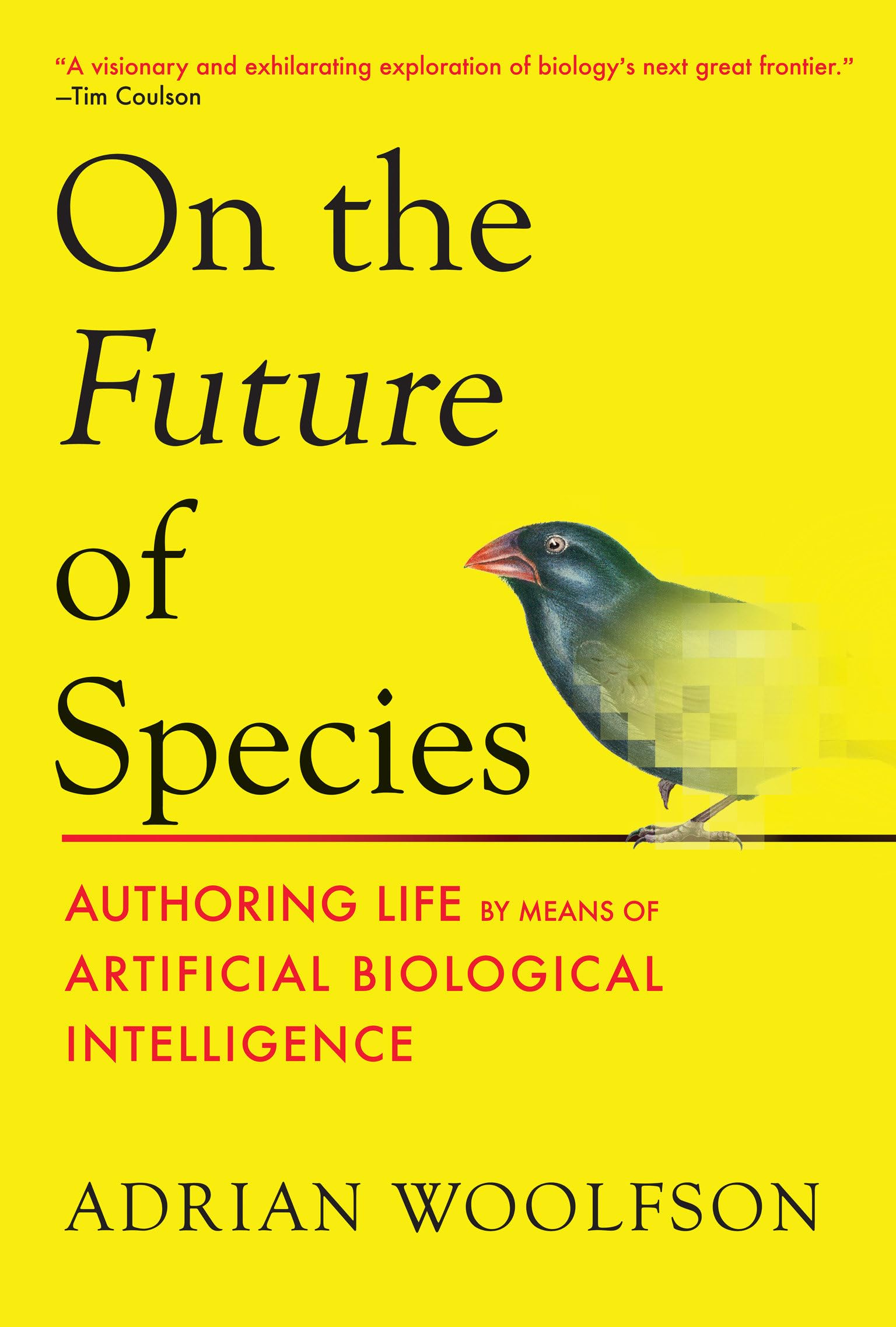
On the Future of Species: Authoring Life by Means of Artificial Biological Intelligence
$32.99
by Adrian Woolfson



A bold and visionary account of how genome writing can help preserve the planet—but may also undermine human nature and disrupt ecosystems. From a scientist at the forefront of synthetic genomics. Imagine a future where we grow houses rather than build them. Where smartphones are alive, clothing has opinions and all human knowledge fits into a speck of DNA. A world where disease is a thing of the past and the human lifespan is dramatically extended. To achieve this, says Adrian Woolfson, founder of the genome writing company Genyro, we must transform biology into a predictive, programmable engineering material. That means decoding the generative grammar of DNA: the language of life itself. We will then be able to author genomes—and, if we choose, even rewrite our own. In On the Future of Species , Woolfson describes how we are at the cusp of a technological revolution, driven by the convergence of artificial intelligence and synthetic biology. Currently at the scribbling phase—writing the genomes of viruses, bacteria and yeast—we will eventually author the genomes of extinct and never-before-realized species. Life will become computable, detached from its past and no longer bound by Darwinian evolution. While offering extraordinary opportunities, this power also carries great risk, and it is vital for everyone to understand what the future might hold. In this groundbreaking work, Woolfson provides a guide to this bold new world, offering a moral compass to help us do so safely, wisely and ethically. "A lucid, thoughtful, at times troubling review of a new era in biology." —Kirkus "A sweeping account of the history and science behind this transformational technology" —Kate Adamala, Nature "Raises some of the most challenging philosophical and ethical issues that humankind has ever had to address" ―Ben Spencer, The Sunday Times " On the Future of Species… offers a lucid and occasionally unsettling account of an under-appreciated technological revolution that will affect us all, allowing humanity to attempt what Darwin believed only nature could accomplish: to write the next chapter of life." — The Financial Times "An intriguing and disturbing analysis of a biological revolution ... Compelling, clear and straightforward" ―Robin McKie, The Guardian "A pocket guidebook for the public to comprehend a future where biology becomes infrastructure" ― Chris Stokel-Walker, The Standard "Fascinatingly scary stuff to huddle under the duvet with" ― Liz Else, New Scientist "Considers the ungodly convergence of AI and synthetic biology" ― Ian Thomson, The New Statesman "An intriguing tale…It contains much that is fascinating, enticing, and usefully provocative." ―Philip Ball , The Lancet "Essential reading" ― The Tribune Endorsements "A visionary and exhilarating exploration of biology's next great frontier. Adrian Woolfson has written a work of astonishing scope and imagination, charting the convergence of artificial intelligence and genome synthesis. He takes readers from the foundations of molecular genetics to the threshold of a world in which we may author entirely new species, whilst reimagining human health. Bold, lucid, and deeply original, On the Future of Species is essential reading for anyone interested in the destiny of life on Earth and beyond." —Tim Coulson, author of A Little History of Everything From the Big Bang to You "The book we need right now: a clear-eyed, comprehensive look at how AI, gene editing, and synthetic biology are converging to give humanity unprecedented power over its own evolution. Part history, part forecast, entirely compelling. Woolfson guides us through the landmarks of molecular biology with the assurance of an expert and the enthusiasm of a born storyteller. He brings a rare combination of industry experience and literary skill to one of the most consequential questions of our time. Essential reading for anyone seeking to understand where genomic technologies are taking us." —Tom Ellis, Professor of Synthetic Genome Engineering, Imperial College London "A brilliantly crafted, sweeping exposition with profound insights essential for any citizen of the twenty-first century." —Tim White, Professor of Integrative Biology, University of California, Berkeley "Darwin wrote The Origin of Species in 1859. With the emergence of large language of life models—artificial biological intelligence—it was the right time to envision On the Future of Species . Woolfson delivers that in this brilliant book, a very thoughtful and thorough assessment of the profound implications of editing and rewriting our code." —Eric Topol, founder of Scripps Research Institute and author of Super Agers "Scientists already know how to read the language of DNA and to edit it. Woolfson details the new frontier—writing new DNA scripts from scratch." —Thomas R. Cech, Nobel Prize winner and author of The Catalyst "A terrific read that will be intere