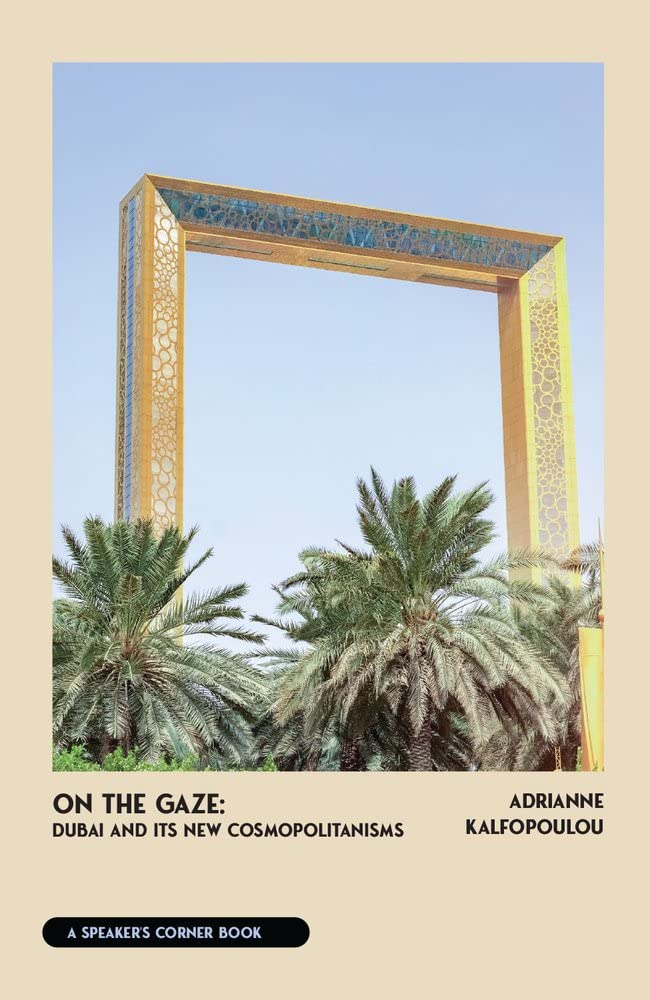
On the Gaze: Dubai and Its New Cosmopolitanisms (Speaker's Corner)
$15.95
by Adrianne Kalfopoulou



What does it mean to be cosmopolitan? To be a crossroads, a gathering place, a center for world commerce? Explore the meaning of Dubai as a nation-state at the crossroads of the world, gathering people together from around the world. Much like Syros in ancient Greece was once at the center of world commerce, Dubai has evolved into a twenty-first-century nexus for new cosmopolitanisms. Both as a port and desert city, Adrianne Kalfopoulou imagines how Dubai has projected itself onto these screens as an idea for the future — and the present. By exploring the development of Dubai both through the lens of philosophers like Baudrillard and his "hyperreal" as well as by digging into the city's history, from its disastrous collapse as a pearl-diving mecca through its complex evolution into a member of the United Arab Emirates. On The Gaze: Dubai and it's new Cosmopolitanisms fleshes out the story of Dubai, revealing it through multiple gazes. Kalfopoulou's fantastic writing and inward searching brings readers along as she examines what Dubai means to her, to the Arab world, and to the world as a whole. "We follow Kalfopoulou's multiple gazes—temporal, abstract, theoretical, and personal—and journey with her from Dubai's humble beginnings as a port village to its evolution as a global city of the digital age. The book abounds in honest and vivid portraits of people and places written in beautifully crafted prose. A very welcome addition to the growing body of anglophone literature on the Arabian Gulf." — Yahya Haidar, editor and translator, Al-Din, A Prolegomenon to the Study of the History of Religions. “In Adrianne Kalfopoulou’s brilliant book of essays, Ruin , we accompany her on the pitted road of motherhood, friendship, love, the financial meltdown of Greece and, centrally, the pilgrim’s journey into memory. Kalfopoulou’s mediations are more politically incisive than any other book of personal essays I’ve read in ages. Her self-possession and attention to suffering and her pitch of self-questioning are sharp and rare. As with the finest essayists, she is ‘like pagans respectful of what the unpredictable might have in store for us.’ But never too respectful. ‘I am a reluctant traveler,’ she tells us, but in her company, we never are.” —David Lazar, author of Occasional Desire “Balancing along the boundary that separates memoir, travel writing, and journalism, Adrianne Kalfopoulou’s book of linked essays, Ruin , courageously explores not only cities (Athens, New York, Freiburg, among others) but states of mind and soul in a pulsing, fraying time. Kalfopoulou’s writing draws us into her sensibility; reading Ruin , we share her honesty and anger, her vulnerability and nerve, her sense of humor and beauty. Not a relaxing read, Ruin is always stimulating, mercurial, and enlightening.” —Rachel Hadas, author of The Golden Road “ Ruin: Essays in Exilic Life is a palimpsest of cultural and personal crisis moments. Throughout, an inner yearning for identity is interwoven with erudite critical contemplation of issues of nation and belonging. The minutiae of daily life relentlessly engage the political moment. Whether in a Korean nail parlor in post-9/11 New York City, in Freiburg in the summer, or on the streets of Athens in the midst of the ‘bail out’ plan; whether, too, the subject is eros, motherhood, the premature death of a friend or the more mundane tribulations of teaching, Kalfopoulou plots locations of a binational self-in-crisis in tandem with those of a fluid body politic.” —Alexandra Halkias, author of The Empty Cradle of Democracy “Adrianne Kalfopoulou’s luminous chronicle of love and debt in the time of the Greek Euro crisis, A History of Too Much , is powerful lyric testimony to the courage, humor, and brave resistance with which ordinary people faced augurs of loss in Greece, where the beauty of ‘the oregano’s thick perfume, the sapphire sea’ remind them of a heritage of beauty and sacrifice, as the title poem puts it. ‘It felt so much bigger than me,’ says the speaker of the magnificent hybrid poem that caps the collection, an assemblage of the voices and visions of historic change, which is, like History itself, a tour de force.” —Cynthia Hogue, author of In June the Labyrinth “The ‘too much’ that piques the reader’s interest in the arresting title of these poems does double service: it sounds a cry of anguished exasperation uttered by this collection and comments on the way private life has been massively invaded by public upheavals. A startling theme, viewed with unexpected ambivalence, is hope—or rather ‘the carcass of hope’—that in these poems seems fated to end with ‘passionate disappointment.’ As the immigrant daughter of political exiles, I grasp that theme viscerally as Kalfopoulou pursues it through marvelous use of sensory details; attention to the voices and narratives of individuals, named and specified; love poems both tender and erotically vivid;