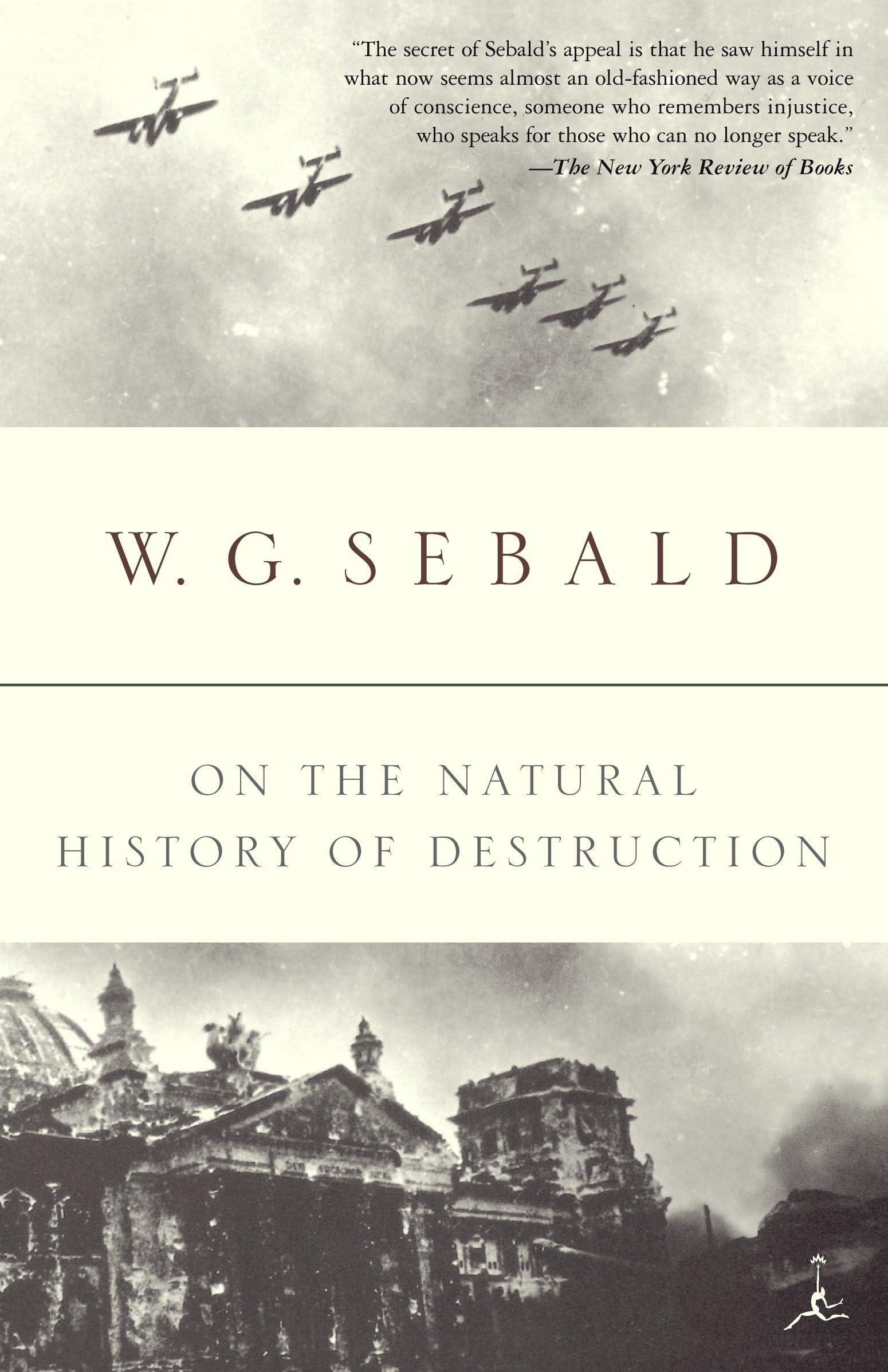
On the Natural History of Destruction (Modern Library Classics (Paperback))
$15.98
by W.G. Sebald



During World War Two, 131 German cities and towns were targeted by Allied bombs, a good number almost entirely flattened. Six hundred thousand German civilians died—a figure twice that of all American war casualties. Seven and a half million Germans were left homeless. Given the astonishing scope of the devastation, W. G. Sebald asks, why does the subject occupy so little space in Germany’s cultural memory? On the Natural History of Destruction probes deeply into this ominous silence. “Most writers, even good ones, write of what can be written. . . . The very greatest write of what cannot be written. . . . I think of Akhmatova and Primo Levi, for example, and of W. G. Sebald.” —The New York Times “[Sebald] is writing about what he regards as a disquieting refusal to face facts—not only about what was done to the nation, but by implication, by the nation. . . . No better future for humankind is possible if we do less than look upon the crimes of our past, and their catastrophic results, with ‘a steadfast gaze.’” — The Boston Sunday Globe “This may well be the last of Sebald’s writing we’ll ever have, so how amazing—and fitting—it is that it seems, in a fashion as uncanny as his prose and perceptions could often be, to close the circle of the ruminations that preoccupied his writing life.” — The Washington Post “Sebald approaches his subject with sensitivity, yet avoids neither descriptions of horrible carnage nor criticism of writers too preoccupied with absolving themselves of blame to faithfully portray a destroyed Germany. The result is a balanced explication of devastation and denial, and a beautiful coda for Sebald.” —Booklist “The secret of Sebald’s appeal is that he saw himself in what now seems almost an old-fashioned way as a voice of conscience, someone who remembers injustice, who speaks for those who can no longer speak.” —The New York Review of Books During World War Two, 131 German cities and towns were targeted by Allied bombs, a good number almost entirely flattened. Six hundred thousand German civilians died?a figure twice that of all American war casualties. Seven and a half million Germans were left homeless. Given the astonishing scope of the devastation, W. G. Sebald asks, why does the subject occupy so little space in Germany?s cultural memory? On the Natural History of Destruction probes deeply into this ominous silence. During World War Two, 131 German cities and towns were targeted by Allied bombs, a good number almost entirely flattened. Six hundred thousand German civilians died--a figure twice that of all American war casualties. Seven and a half million Germans were left homeless. Given the astonishing scope of the devastation, W. G. Sebald asks, why does the subject occupy so little space in Germany's cultural memory? On the Natural History of Destruction probes deeply into this ominous silence. W.G. Sebald taught at the University of East Anglia in Norwich, England, for thirty years, becoming Professor of European Literature in 1987. His books won several international awards, including the National Book Critics Circle Award for Fiction and the Berlin Literature Prize. He died at age 57 in 2001. Chapter 1 Air War and Literature Zürich Lectures the trick of elimination is every expert's defensive reflex. -Stanislaw Lem, Imaginary Magnitude I Today it is hard to form an even partly adequate idea of the extent of the devastation suffered by the cities of Germany in the last years of the Second World War, still harder to think about the horrors involved in that devastation. It is true that the strategic bombing surveys published by the Allies, together with the records of the Federal German Statistics Office and other official sources, show that the Royal Air Force alone dropped a million tons of bombs on enemy territory; it is true that of the 131 towns and cities attacked, some only once and some repeatedly, many were almost entirely flattened, that about 600,000 German civilians fell victim to the air raids, and that three and a half million homes were destroyed, while at the end of the war seven and a half million people were left homeless, and there were 31.1 cubic meters of rubble for every person in Cologne and 42.8 cubic meters for every inhabitant of Dresden-but we do not grasp what it all actually meant. The destruction, on a scale without historical precedent, entered the annals of the nation, as it set about rebuilding itself, only in the form of vague generalizations. It seems to have left scarcely a trace of pain behind in the collective consciousness, it has been largely obliterated from the retrospective understanding of those affected, and it never played any appreciable part in the discussion of the internal constitution of our country. As Alexander Kluge later confirmed, it never became an experience capable of public decipherment. This is highly paradoxical in view of the large numbers of people exposed to the campaign day