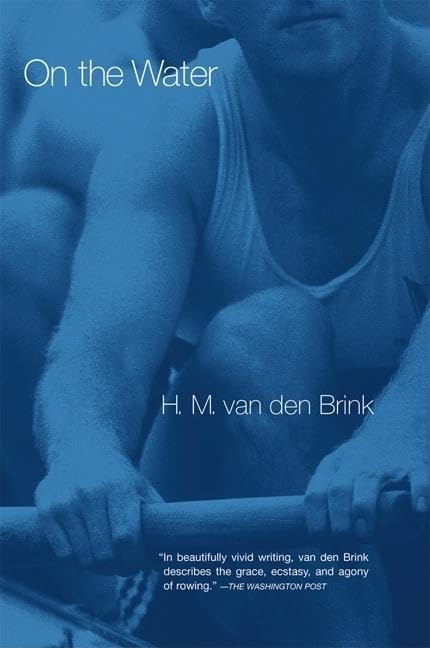



A "powerful tale of romantic regret" (The Seattle Post-Intelligencer), Los Angeles Times Best Book of 2001, and finalist for the French Prix Medicis, On the Water tells the poignant story of Anton and David, two oarsmen trained by a mysterious German coach in the golden Amsterdam summer of 1939. Anton stands on the banks of his beloved river years later, on the wintry eve of Holland's liberation, and mourns a lost world. David, his Jewish teammate and quiet obsession from that magical summer, has disappeared, and the boathouse is now derelict and deserted. Spare, lyrical, and nuanced, On the Water is quietly enormous, capturing a moment so precise and exact it is as if caught in amber -- a rowing club in Amsterdam and two of its competitors from very different backgrounds, set against the backdrop of the oncoming war. The menace of tragedy to come is subtly woven into the story of the two boys whose only concerns are practices, races, and themselves. In the end, all that is left for Anton is the memory of his supreme happiness that summer. "...beautiful, vivid writing...van den Brink describes the grace, ecstasy, and agony of rowing, the miracle of its teamwork harmony." -- Carmela Ciuraru, The Washington Post Book World "[A] small miracle of a book." -- Daniel Topolski, The Guardian On the Water By H. M. Van Den Brink Grove Press Copyright © 2002 H. M. Van Den Brink All right reserved. ISBN: 9780802138958 Chapter One I last heard the planes half an hour ago. They crossed theriver diagonally at high altitude and then their deep roarfaded away to the east. Now it is quiet again, except for thenoises that go with a winter's night by the water's edge.Restless wind. Waves lapping the posts of the jetty. Nobirds. No sudden cries anywhere. There is, though, somewherebehind me on the quay, the occasional rattle of a windowthat isn't properly closed. I'm standing alone on thefurthest jetty, its wood black with moisture and slippery asglass, and am looking intently at the water. On the far bankof the river lies the city, windows blacked out, aimless tramrails, treeless streets. I am looking at the far bank but canscarcely see it any longer. For a moment I imagined what it would be like to fly eastin the planes, towards Germany. I pictured what it was likein the confined space of the cockpit, with men in leatherjackets doing their work silently. A single gesture is enoughfor them to understand each other. There is only the light ofa couple of monitor lamps, green and blue. An illuminateddial. Perhaps the glow of a cigarette. Then I thought of thevast space below the belly of the plane, the keel seeking itsway through the thin air, with nothing to hang on to, nosupport, and I began to feel dizzy. I thought of the distancebetween the men and their target and of what slid beneaththem meanwhile, small and invisible: the polders, theheath and the woods, the farms with their steep roofs,groups of houses huddling together against the cold in thevillages, the towns with their factories and around themthe grey streets where at this moment people everywhereare sitting together with the same black paper over the windows.I thought of the lakes, the canals large and small, theditches and the rivers. I thought especially of the waterbecause water, silvery, is the first to wake when day breaksand life begins anew. Across the river lies the city. I can't see it, but it's as if I canfeel how heavily and anxiously it is breathing. Like somegreat animal that has been hibernating for too long, andstinking, far too thin, wonders if it will ever wake up. I canscarcely see even the bridge from here, the bridge with itselegant lamps that links the suburbs and the stately houseson the embankment behind me. I shiver in my raincoat. I sitdown. I close my eyes. Sleet strikes my face. But when I lean back and stretch out I suddenly feel thewood warm down my spine and against the backs of mylegs once more, as if the warmth had been waiting there forme all those years. And then it is summer again and aboveme I see an almost cloudless, brilliant blue sky, a dome ofair stretched tautly across the river, the city and the country.All day long the sun has warmed the planks of the jettyuntil they are cooked through, light grey, almost white, andred hot. In a second the sun also dries my sweaty face, leavingonly salt, which feels grainy on my skin. The jetty is actually a raft that is attached by metal ringsto a number of posts alongside the boathouse, so that it canmove up and down as the level of the river rises and falls. Itslowly sways in time with the afternoon waves, almostimperceptibly, except when, like me, you lie back languidlyand float away on your exhaustion and no longer knowwhere your body ends and where the wood, the water andthe sky begin. In the distance I hear David calling. I don't answer. I close my eyes. When I open them, he has come up behind me. I look upalong his legs, which are powerful and cov