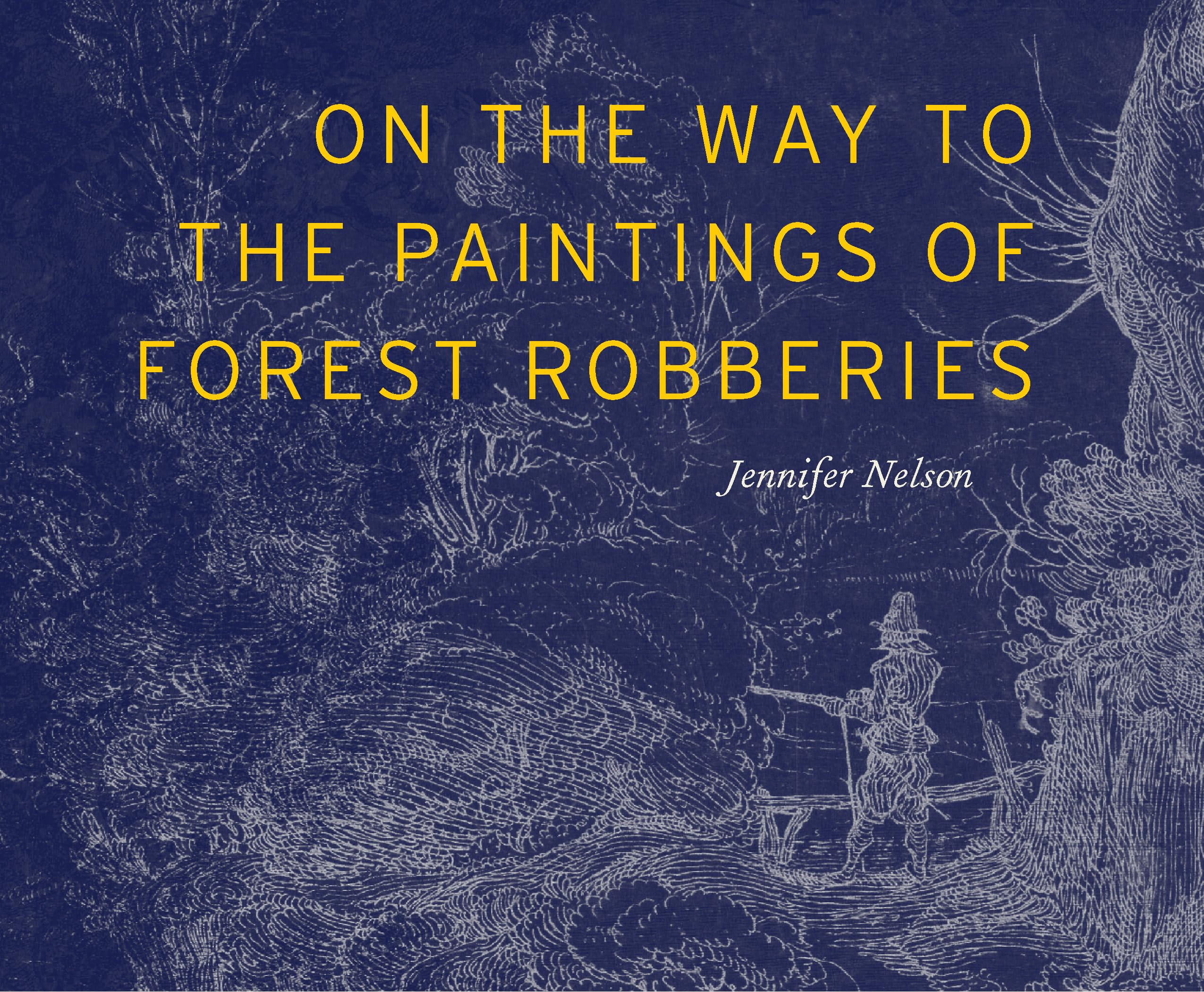
On the Way to the Paintings of Forest Robberies (The Ottoline Prize in Poetry)
$12.60
by Jennifer Nelson



On the Way to the Paintings of Forest Robberies , by poet and historian of early modern art Jennifer Nelson, makes exquisite trouble. These poems give voice to Nelson's encounters with turbulent surfaces, from the twisted spectacles of the contemporary world—geopolitical, epistemological, and local—to esteemed artworks inseparable from the legacies of colonialism. Faced with the asymmetrical warfare, incessant pandemics, and climate calamities of the 2020s, these poems offer no simple solace. With wit, they plumb the wrecked relations between academic knowledge practice and any sort of liberatory praxis. They reject the manic digital buffet proffered as antidote to the poet’s anger, guilt, and grief by late techno-capitalism’s cultural productions. Gazing into and grappling with the act of seeing, these poems blaze a path through forests of data and life, the ensnarled techno-webs of information and plunder. Here, the poet allows us to see beyond what and whom first meets the self's eye. Here one may press into the "loam of the forest floor, / the ongoing of those—unremembered / and those remembered wrong.” Though it may be the case that "the world is dying," this book’s hope is that we may, at least, persist in a form of radically productive negativity: “Let being and making/be the fullest/forms of grief.” Jennifer Nelson’s deep knowledge, care-for-the-world, and capacious attention infuse this collection and the reader with wavelengths of bracing and inclusive light. On the Way to the Paintings of Forest Robberies was selected for the 2024 Ottoline Prize. "With the eye of an art historian and the ear of a poet, Jennifer Nelson’s On the Way to the Paintings of Forest Robberies moves seamlessly between times and places, capturing the strange visual cultures that have emerged from the clash between worlds. Her language is—at once—chatty, baroque, feral, and capacious enough to contain ghosts, facsimile creatures, colonial illustrations, the life worlds of the intertidal zone, protest, columbarium, monsters, sixteenth-century paintings, and the perverse format of the tenure dossier. Filtered through Nelson’s singular poetic vision, painting is transmogrified into poetry, then back into image, remade." —Jackie Wang " Here are ekphrastic poems that interrogate the poet's own responsibility in drawing our attention to the pictures. These are poems that subvert what it means to write ekphrasis, and subvert and poke fun at the academy in general. Politics, global history, the self— all of them refracted through eyes made of art. These poems are such a pleasure. I love knowing Nelson is out there grappling with the big issues in her strange, private imagination." —Matthew Rohrer " O n the Way to the Paintings of Forest Robberies unites, in complication, the discordant present with the discordant past . Nelson's "unison of bots," an ever roaming, ever revolving consciousness is put to the task of recording the intersections where knowledge/material is exchanged and beauty sometimes sacrificed. These poems speak from deep inside the distributed information, they want the last word." —Ish Klein " Here, Jennifer Nelson carefully observes "the reduction to vestige / of entire cultures," inviting us to join her inquiry into all the things that a "forest robbery" might be . Are we talking Robin Hood, or extractive neoliberalism, or the theft of human-and-beyond lifeworlds? Where do such robberies happen but in the forest-the burning Amazon, the concrete "jungle" —where we've exiled our unwanted others, our consequences? Yet the promise of community suggested by the greenwood is also present here. How do we live this mess? We must "not misunderstand the sun [must] not/misunderstand the flowers." We can build from "the word barcada / friend-group and boat / or friend-ship" and find a river to launch on, together." —Jay Besemer Jennifer Nelson is the author of three books of poetry, most recently Harm Eden (Ugly Duckling Presse, 2021). They are an associate professor in the Department of Art History at the University of Wisconsin-Madison, and will join the Department of Art History at the University of Delaware in the fall. For the academic year 2023-24, they will be a Hilles Bush Fellow at the Harvard Radcliffe Institute. "This is the loam of the forest floor, the ongoing of those unremembered and those remembered wrong." - from "Sonnet" I dream like moss at night." - from "CV" "...Sometimes deer shrug ticks onto leaves and that is the right kind of attention. Or at a cold glass apartment wall a crow seizes up in the sky, triples in size, and answers, one intruder to another." - from "Statement of Future Research Plans" "I don't want to be the cardinal on which the revolution hangs, that brightens the winter tree. I want sufficient sun to watch shadows change. I want to turn away from death and live it another way, aloft, my guts metaphorizing pleasure as I bake my grief above..." - fro