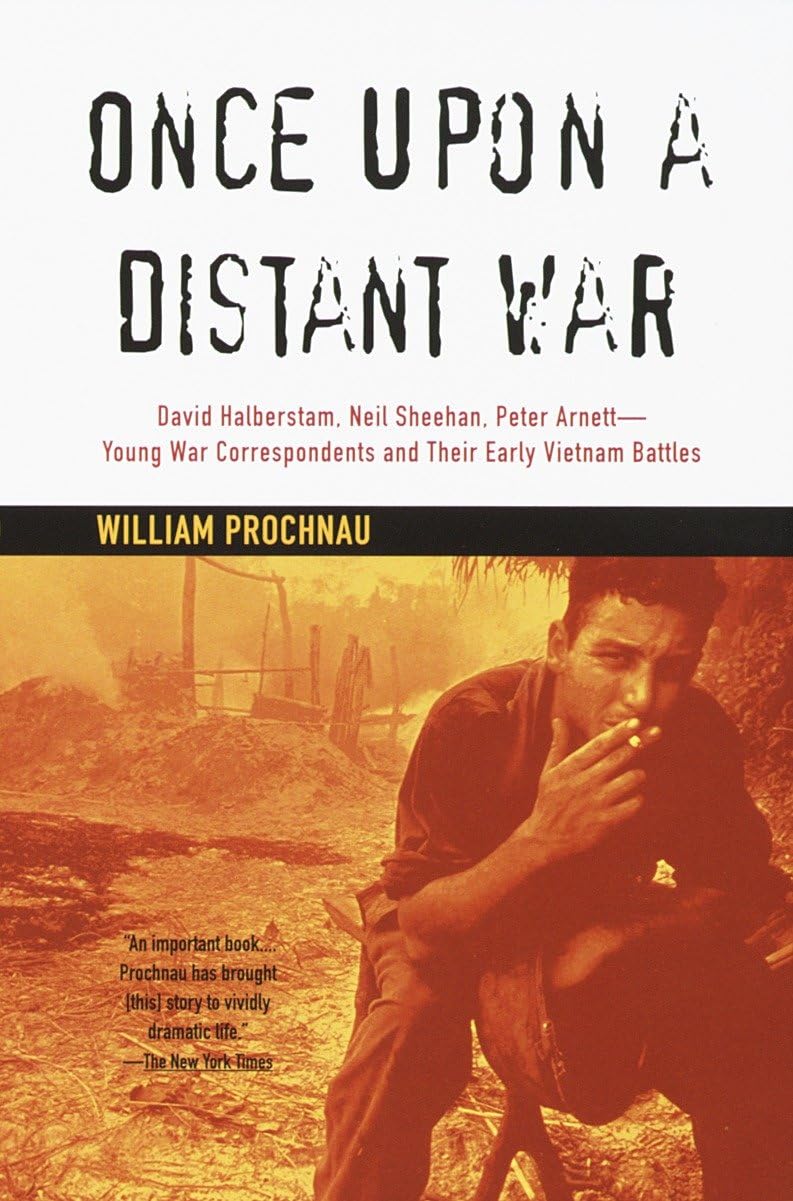
Once Upon a Distant War: David Halberstam, Neil Sheehan, Peter Arnett--Young War Correspondents and Their Early Vietnam Battles
$19.38
by William Prochnau



Once Upon a Distance War tells the stories of such young Vietnam war correspondents as Neil Sheehan, Peter Arnett, and David Halberstam, providing a riveting chronicle of high adventure and brutal slapstick, gallantry and cynicism, as well as a vital addition to the history they shaped. "Prochnau . . . tells a Vietnam story we haven't heard before. . . . Complex, witty, and humane."--Tobias Wolff. of photos. Distance War tells the stories of such young Vietnam war correspondents as Neil Sheehan, Peter Arnett, and David Halberstam, providing a riveting chronicle of high adventure and brutal slapstick, gallantry and cynicism, as well as a vital addition to the history they shaped. "Prochnau . . . tells a Vietnam story we haven't heard before. . . . Complex, witty, and humane."--Tobias Wolff. of photos. Once Upon a Distance War tells the stories of such young Vietnam war correspondents as Neil Sheehan, Peter Arnett, and David Halberstam, providing a riveting chronicle of high adventure and brutal slapstick, gallantry and cynicism, as well as a vital addition to the history they shaped. "Prochnau . . . tells a Vietnam story we haven't heard before. . . . Complex, witty, and humane."--Tobias Wolff. of photos. William Prochnau and Laura Parker wrote collaborative articles for Vanity Fair, where Prochnau was a contributing editor. Prochnau, a former national correspondent for The Washington Post, was the author of three acclaimed books. He died in 2018. Once Upon a Distant War David Halberstam, Neil Sheehan, Peter Arnett--Young War Correspondents and Their Early Vietnam Battles By William Prochnau Vintage Books USA Copyright © 1996 William Prochnau All right reserved. ISBN: 9780679772651 Chapter One A NICE LITTLE WAR IN A LAND OF TIGERS AND ELEPHANTS Malcolm Browne, a tall and gawky thirty-year-old formerchemist whose red hair would soon turn sandy, stepped down in asweat from Flight One, Pan American's new around-the-world jetservice. Saigon's heat, humid and oppressive at 96 degrees, hit the newman from the Associated Press like a wave. Just out of Baltimore,where winter had arrived in a sudden early surge, Browne worethe only suit he owned, a wool one. Over one shoulder he luggeda useless topcoat; over the other a battered $25 Japanese camera hehad picked up secondhand. On the hot tarmac at Tan Son Nhut Airport two photographerstook his picture, one for South Vietnam's secret police, the otherfor a small English-language newspaper called the Times of Vietnam.It would not take Browne long to realize that there was little differencebetween the two. Otherwise, the arrival did not seem auspicious.No military man met him with a jeep and driver as acorrespondent from America's premier news-gathering agencymight have been welcomed to a war zone in another time andplace. Those at the American Embassy, soon to be bogged downwith an onslaught of arrivals of a different sort, noted the date--November11, 1961, a Saturday--with only passing interest. Beneathlazily turning fans inside the low, open-air terminal building,South Vietnamese customs officials languidly riffled through hissingle suitcase, glanced without interest at the wry smile onBrowne's passport photo, and waved him through. In the beginning it was such a nice little war. "A dapper, debonair little war in a land of tigers and elephants,"enthused the CIA man in one of the dark novels written later byWard Just, a distinguished correspondent whose life after Vietnamwas consumed by bleak, Conrad-like trips deep into the Americansoul. In 1961 the United States stood at the height of its power, primedby a national "can-do" attitude that anything lay within its reachand sustained by a near-religious certainty about the rightness ofits goals. During this first of the few, but hyperkinetic, Kennedyyears, "saving" South Vietnam became one of those goals. Thetrickle of Americans passing through Saigon during the fiftiesturned abruptly into a relentless stream. The newcomers had little historical reference to the place. Vietnam,clinging to a tropical peninsula south of China, was not aprominent Second World War battleground still tugging at Americanmemories. Nor had the French in their final colonial strugglein Asia just a few years earlier left Americans with more thanscratchy, newsreel-vague recollections of a strange war in an unknownplace called Indochina. The American government hadspent $2 billion supporting that lost cause and another billion afterthe French departed in 1954. But, to workaday Americans, Vietnamremained as distant and obscure as any place in the world. OfficialWashington did not know it much better. Two examples make thepoint: George Reedy, an aide to Lyndon B. Johnson, accompanied theVice President on a visit early in 1961. Reedy, an intelligent man,realized soon after he landed that he didn't have the foggiest notionwhere he was. He found a map, searched for Saigon, and positionedit in relation to more familiar l