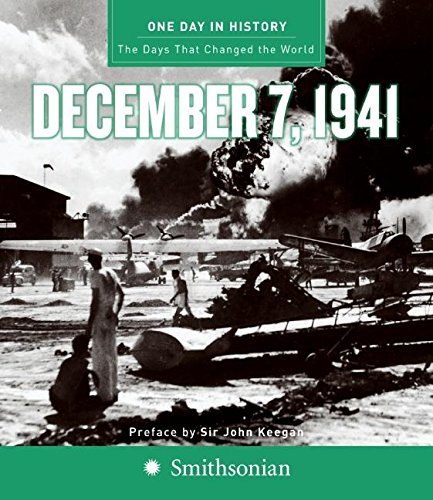
One Day in History: The Days that Changed the World, December 7, 1941
$24.95
by Rodney P. Carlisle



Offering a unique approach to history, this series of individual encyclopedias will delineate and explain the people, places, events, chronology, and ramifications of pivotal days in history. One Day in History: December 7, 1941 will provide a comprehensive and engaging overview of this date in history as well as an examination of the theme related to the date—the attack on Pearl Harbor and World War II. This volume will cover all aspects of December 7, 1941, including background information explaining what led to the date's events and post-date analysis discussing the effects and consequences of the day's events. Dr. Rodney P. Carlisle is a professor emeritus of Rutgers University. He received his AB degree from Harvard College and his PhD from the University of California, Berkeley. He most recently served as general editor of the award-winning Encyclopedia of Politics: The Left and Right (2005) and authored The Iraq War (2004). One Day in History: December 7, 1941 By Rodney Carlisle HarperCollins Publishers, Inc. Copyright ©2006 Rodney Carlisle All right reserved. ISBN: 0061120340 Chapter One A Aircraft Carriers The weapon that won the day at Pearl Harbor for Japan never sailed within sight of the Hawai'ian Islands. When Vice Admiral Chuichi Nagumo launched the first of 353 planes on the morning of December 7, it represented the apotheosis of Japanese naval power and the triumph of 30 years of naval design and experimentation. The idea of launching and recovering aircraft from ships dates back to 1910, when American aviator Eugene Ely's 50-horsepower Curtiss biplane took off from a temporary 57-foot platform on the light cruiser USS Birmingham , lying at anchor in Hampton Roads, Virginia. On January 18, 1911, Ely became the first man to land on a warship when his biplane slapped down on a 102-foot platform on the armored cruiser USS Pennsylvania , in San Francisco Bay. The French, British, German, and American navies preferred seaplanes, which could be stored in protected hangars, shot from catapults, or lowered by cranes into the water before take-off. The Germans also preferred their massive Zeppelins, with vast ranges. The Royal Navy shot Short biplanes from battleships in 1912, mounting guns and radio sets on them, and on July 28, 1914, Squadron Commander Arthur Longmore launched the first aerial torpedo. The British converted three fast cross-channel steamers into seaplane tenders, and on Christmas Day 1914 their Short biplanes launched the first aircraft-carrier attack in history, raiding the German bases at Cuxhaven and Wilhelmshaven. The following year, the converted steamer HMS Ben-my-Chree 's seaplanes torpedoed and sank a Turkish transport in the Gallipoli campaign. In 1915, the Royal Navy converted the Isle of Man packet USS Vindex to carry two Bristol Scout fighters. They saw their first action in 1916, when the pilot dropped Ranken incendiary darts on a Zeppelin. As World War I droned on, the Royal Navy kept trying by converting the cruiser USS Yarmouth to accommodate the Sopwith Pup fighter. One of USS Yarmouth 's Pups was the first to shoot down an enemy aircraft, incinerating the Zeppelin L-22 on August 21, 1917, with incendiary bullets. Success in hand, the Royal Navy converted the battle cruiser HMS Furious into the aircraft carrier role, removing her forward 18-inch gun turret and replacing it with a flight deck and a hangar. She hurled six Sopwith Camels at the Tondern Zeppelin base on July 18, 1918. Still, the Royal Navy was not through with aircraft carriers. They converted a liner into the carrier HMS Argus , the first carrier with a full-length unobstructed flight deck. The carrier made her trials in October 1918, and was operational before the Armistice. The HMS Argus was the first modern carrier, replete with arresting ropes and a hangar deck below the flight deck, but funnel gases spewing over the stern still made deck landings a tricky affair. The Royal Navy's answer was deck-landing trials with a temporary superstructure erected on HMS Argus 's starboard flight deck, representing masts, bridge, and funnel. Pilots reported no problem landing with this design, and the standard look of aircraft carriers was born. The success of British carriers inspired the Americans and the Japanese. The Americans converted the collier USS Jupiter into the small carrier USS Langley . She looked like USS Argus , and her funnels were on hinges, so they could flip down during flight operations. The Japanese, however, beat everybody. Their Naval Air Service had begun training in 1912 and operated seaplanes from the tender Wakamiya against the German colony of Tsingtao. They launched the first carrier built from the keel up, the Hosho , on November 13, 1921, putting her in operation the following year, beating Britain'sHMS Hermes into service. At 7,420 tons displacement, with a flight deck 500 feet, Hosho had horizontal funnels and no bridge. Sh