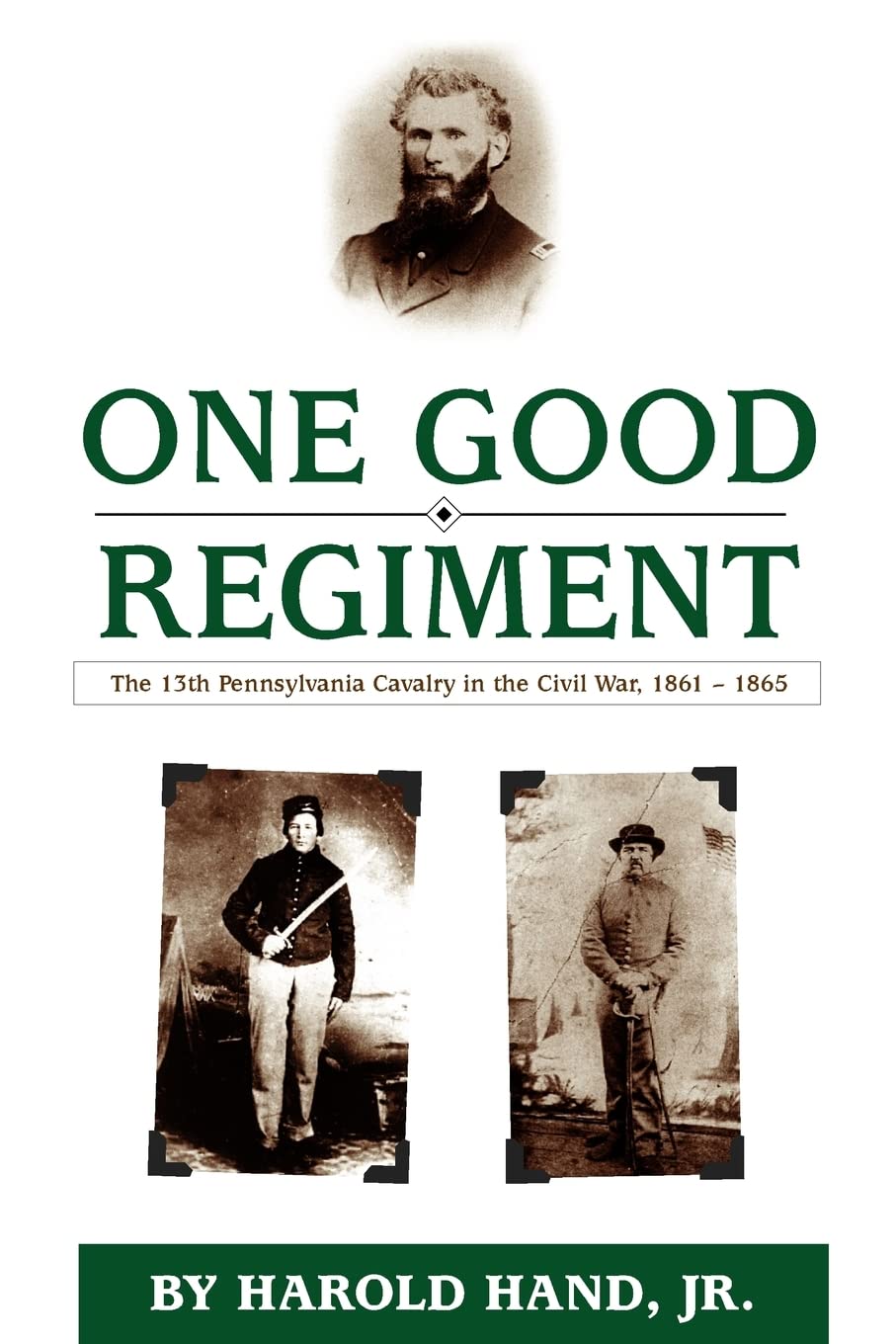



A historical non-fiction account of the 117th Pennsylvania volunteer regiment in the American Civil War of 1861 to 1865. This is the regimental history of the unit much better known as the 13th Pennsylvania Cavalry. Harold "Sonny" Hand was born in New Jersey in 1952, where he attended local schools and played in local bands until his musical inclinations delivered him to the Berklee College of Music in Boston, Massachussetts. From 1970 until the present time he has played drums and percussion in every style of music imaginable, including nightclubs, casinos, percussion ensembles, jazz, rock, and country & western. He has taught drums and percussion privately and in studios since 1972, and spent seven years on the faculty of Atlantic Community College in Mays Landing, New Jersey. Leaving the family construction business in 1983 he was employed by a Fortune 500 corporation, transferring to Northern Nevada in 1991. Sonny continues teaching and performing music in Nevada, and is a percussionist in the Ruby Mountain Symphony Orchestra. Since 1990, Sonny has been a Civil War reenactor and living historian, bringing hands-on Civil War education to the general public and into elementary and high school classrooms. Reenacting battles and encampments has helped the author to understand more accurately the life of the Civil War soldier, as well as ensuring a more authentic regimental history of the 13 th Pennsylvania Cavalry. The author currently lives in Spring Creek, Nevada, with his wife Jacqueline and their son Jonathan, who was born in 1992. "THE REGIMENT" August 30 th , 1861, to September 21 st , 1862. By 1861 the Irish people had been protesting English dominance over Ireland for hundreds of years. After a bloody war with Ireland in 1801, England had abolished the Irish Parliament and placed Ireland under supreme rule of the United Kingdom of Britain. Into this environment Thomas Francis Meagher was born to a wealthy family in Waterford on August 8 th , 1823. Meagher became active in the fight for Irish freedom when barely out of his teens. Then, Ireland was struck with a potato famine in 1845 that caused the death of an estimated 750,000 people. Potatoes were a primary food of the poor working class, and with the population already unhappy and now very desperate for food, violence became common. Meagher was arrested in 1848 by the British government, tried and sent into exile in Tasmania, near the Australian mainland, to prevent him from causing more trouble in Ireland.5 By 1850 hundreds of thousands of the Irish people were fleeing the English domination, poverty, and sickness in their homeland in search of a better life, and many of them sailed to America. Between 1841 and 1861 the United States population had swelled from an influx of over 4,300,000 immigrants, most of them arriving from Ireland, Germany, Great Britain, and France. In 1860 about 13 of every 100 people in the United States had recently come from another country. Government control of immigration did not begin until around 1890, and by that time many brave souls had traveled to America, and settled primarily near the large and industrious northern cities like Boston, New York, and Philadelphia. Thomas Meagher escaped from his exile in 1852 and arrived in New York City in May of the same year. Thousands of cheering Irishmen welcomed his arrival. Meagher had been a hero in Ireland, and now he was an instant celebrity. He quickly became an American citizen and then a lawyer in 1855. Meagher was a popular speaker, and founded a newspaper in 1856 called the Irish News. Although a confirmed Democrat with sympathies for the south as the Civil War began in 1861, Meagher raised and led a company of Irish Zouaves which was attached to the 69 th New York Infantry, and he served at the First Battle of Bull Run. After the battle it seemed that the war would not be a short one, and Meagher contacted the United States Government in an attempt to obtain authority to raise a larger body of Irish troops. On August 30 th , 1861, he was notified, in part: "You are... authorized to arrange with the colonels commanding of four other regiments to be raised to form a brigade, the brigadier-general for which will be designated hereafter by the proper authority of government."6 Colonel Meagher was thus given permission to form his own "Irish Brigade" of infantry, and as was customary at the time, a battalion of dragoons (cavalry) would be attached to the brigade.