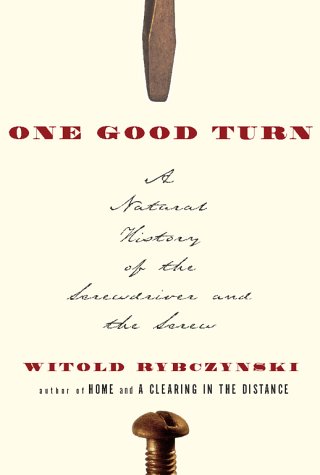
One Good Turn: A Natural History of the Screwdriver and the Screw
$16.75
by Witold Rybczynski



A fascinating history of one humankind's simplest but most essential tools traces the history of the screwdriver from a sketch in da Vinci's pad to a later patent and mass production. By the author of A Clearing in the Distance. In 1999, an editor of the New York Times Magazine approached Witold Rybczynski, the well-known student of architecture and urban design, and asked him to write a short essay on the best and most useful common tool of the past millennium. Rybczynski took the assignment, but when he began to look into the history of the items in his workshop--hammers and saws, levels and planes--he found that almost all of them had pedigrees that extended well into antiquity. Nearly ready to admit defeat, he asked his wife for ideas. Her answer was inspired: "You always need a screwdriver for something." True enough. And, Rybczynski discovered, the screwdriver is a relative newcomer in humankind's arsenal of gadgetry, an invention of the late European Middle Ages and the only major mechanical device that the Chinese did not independently invent. Leonardo da Vinci got to it early on, of course, as he did so many other things, designing a number of screw-cutting machines with interchangeable gears. Still, it took generations for the screw (and with it the screwdriver and lathe) to come into general use, and it was not until the modern era that such improvements as slotted and socket screws came into being. Rybczynski's explorations into that lineage, here expanded to book length, are highly entertaining, and sure to engage readers interested in the origins of everyday things. --Gregory McNamee What a delightful book! Who would have guessed that something as ordinary and useful as the screwdriver and the screw would also be so fascinating. When asked by the New York Times Magazine to write an essay on the best tool of the past thousand years, cultural historian Rybczynski (A Clearing in the Distance) struggled to find one, as most tools are far older, until he hit upon the screwdriver and the screw (although these instruments also may have mysterious origins that precede the millennium). In his trademark clear, elegant prose, Rybczynski traces the history of the screwdriver and screw from Hero's screw press and Archimedes' water screw to the 20th century's Phillips head. Home craftspeople, artists, history buffs, and engineers will delight in the story he tellsDhow such humble tools influenced society. Rybczynski points out that in the hands of mechanical geniuses like Henry Maudslay (1771-1831), the ability to fully exploit the screw led directly to precision tool making and the resulting enormous strides in building steam engines, railroads, bridges, etc. In writing this book, Rybczynski draws from art, literature, history, and engineering; readers will find themselves checking, as did Rybczynski, the details of illustrations and paintings for further clues. Highly recommended for all collections. -DMichael D. Cramer, Raleigh, NC Copyright 2000 Reed Business Information, Inc. Rybczynski, a professor of urbanism at the University of Pennsylvania, has written best-selling books on such subjects as domestic comfort, building his own home and Frederick Law Olmsted. He felt a bit let down when the Sunday magazine of the New York Times asked him to write an article about "the best tool" of the second millennium. But he is good with tools and interested in them, and so he took on the assignment. Many tools, he soon found, predate the second millennium. Consulting William Louis Goodman's History of Woodworking Tools, published in 1964, he read somewhat disbelievingly that the screwdriver did not appear until the 19th century. That set him off on a search for earlier references to this "laughably simple tool." The result is this splendid account of a number of tools, of the evolution of the screw and finally of his discovery that the "turnscrew" is indeed much older than Goodman thought. His search led him eventually to the 15th-century Medieval Housebook, where he found a drawing of a screw-turning lathe with a puzzling tool resembling a chisel lying on a workbench. "One day, while I am puzzling over the drawing again, I realize that the blunt end [of the tool] is exactly the same size as the slot in the head of the cutter. Of course. It's not a chisel, it's used to adjust the cutter. It's a screwdriver. Eureka! I've found it. The first screwdriver." EDITORS OF SCIENTIFIC AMERICAN As much as Frederick Law Olmstead, the hero of Rybczynski's acclaimed previous effort ( A Clearing in the Distance , 1999), changed the face of America, the subject of his new study has changed the world.As the year 2000 approached, Rybczynski was asked to write a short essay on the "best tool" of the millennium for the New York Times Magazine . This assignment sent him off in search of a worthy topic: his first choices turned out to be much more ancient than he had expected, and, after considerable digging, he found himse