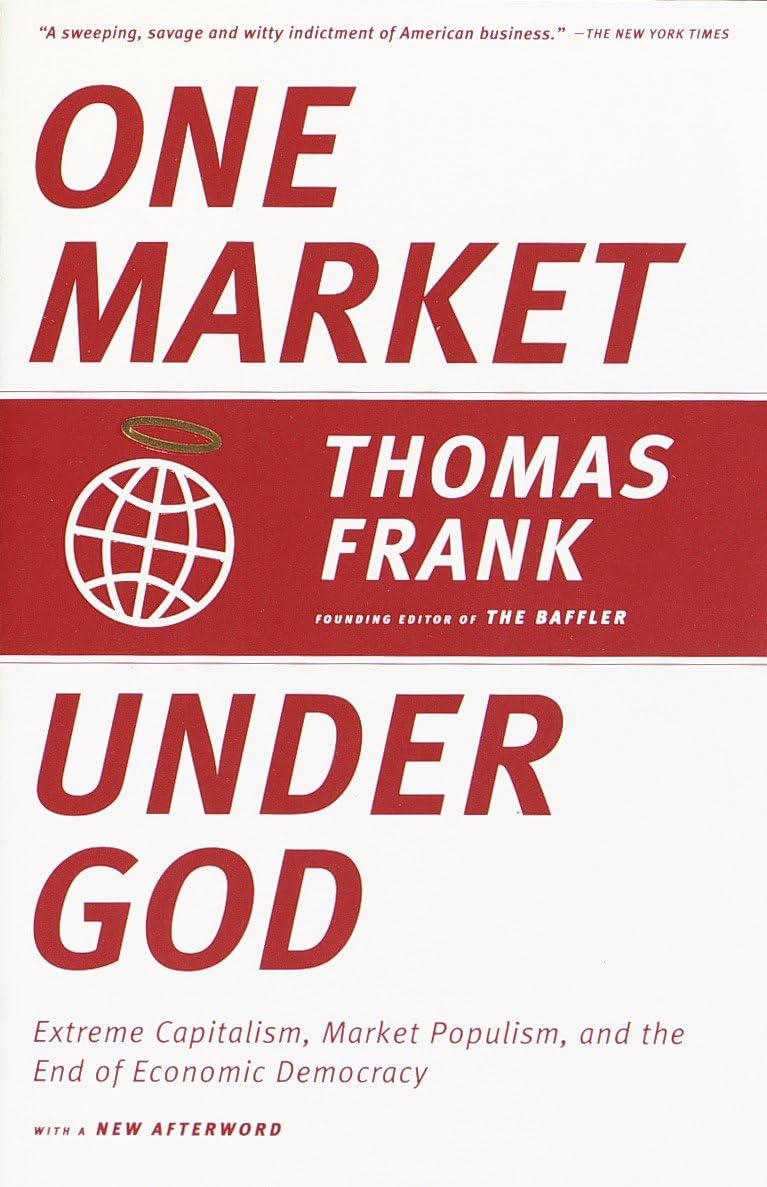
One Market Under God: Extreme Capitalism, Market Populism, and the End of Economic Democracy
$13.28
by Thomas Frank



In a book that has been raising hackles far and wide, the social critic Thomas Frank skewers one of the most sacred cows of the go-go '90s: the idea that the new free-market economy is good for everyone. Frank's target is "market populism"—the widely held belief that markets are a more democratic form of organization than democratically elected governments. Refuting the idea that billionaire CEOs are looking out for the interests of the little guy, he argues that "the great euphoria of the late nineties was never as much about the return of good times as it was the giddy triumph of one America over another." Frank is a latter-day Mencken, as readers of his journal The Baffler and his book The Conquest of Cool know. With incisive analysis, passionate advocacy, and razor-sharp wit, he asks where we are headed—and whether we're going to like it when we get there. "A sweeping, savage and witty indictment of American business." -- The New York Times "This book will infuriate businesspeople-which is precisely why they should read it." -- Harvard Business Review In a book that has been raising hackles far and wide, the social critic Thomas Frank skewers one of the most sacred cows of the go-go '90s: the idea that the new free-market economy is good for everyone. Frank's target is "market populism"--the widely held belief that markets are a more democratic form of organization than democratically elected governments. Refuting the idea that billionaire CEOs are looking out for the interests of the little guy, he argues that "the great euphoria of the late nineties was never as much about the return of good times as it was the giddy triumph of one America over another." Frank is a latter-day Mencken, as readers of his journal "The Baffler and his book "The Conquest of Cool know. With incisive analysis, passionate advocacy, and razor-sharp wit, he asks where we?re headed-and whether we're going to like it when we get there. Thomas Frank is a founding editor of The Baffler . He lives in Chicago. Getting to Yes The Architecture of a New Consensus American industry--the whole capitalist system--lives in the shadow of a volcano. That volcano is public opinion. It is in eruption. Within an incredibly short time it will destroy business or it will save it. --PR man Carl Byoir, 1938 I am a revolutionary, as you may know. --John S. Reed, CEO of Citicorp, 1999 Let Us Build Us a Bill Gates It was the age of the focus group, of the vox populi transformed into flesh, descended to earth and holding forth majestically in poll results, in town hall meetings, in brand loyalty demographics, in e-mail bulletin boards, in website hits, in browser traffic. The people's voice was heard at last, their verdict printed in a full-color chart on page one. The CEO was down from his boardroom and taking questions at the empowerment seminar; the senator was pointing out a family farmer right there in the audience; the first lady was on a "listening tour," the anchorman was keeping an anxious eye on the chat-room. The president himself was "putting people first"; was getting down at a "people's inaugural"; was honoring our values at "town meetings"; was wandering among us in a humble tour bus; was proving his affection for us with heroic feats of consumption--an endless succession of Big Macs, apple pies entire. For all that, the formalities of democracy seemed to hold little charm for We the People in the 1990s. Election turnouts dwindled through the decade, hitting another humiliating new low every couple of years. Any cynic could tell you the reason why: Politics had once again become a sport of kings, with "soft money" and corporate contributions, spun into the pure gold of TV advertising, purchasing results for the billionaires' favorites as effectively as had the simple payoffs of the age of boodle. For those who could show us the money, to use one of the era's favorite expressions, there were vacancies in the Lincoln Bedroom, coffee klatches with the commander-in-chief, special subsidies of their very own. We voted less and less, and the much-discussed price tags of electoral victory soared like the Nasdaq. Maybe the amounts our corporate friends were spending to court us should have been a source of national pride; maybe those massive sums constituted a sort of democratic triumph all by themselves. Certainly everything else that money touched in the nineties shined with a kind of populist glow. In the eighties, maybe, money had been an evil thing, a tool of demonic coke-snorting vanity, of hostile takeovers and S and L ripoffs. But something fundamental had changed since then, we were told: Our billionaires were no longer slave-driving martinets or pump-and-dump Wall Street manipulators. They were people's plutocrats, doing without tie and suit, chatting easily with the rank-and-file, building the new superstore just for us, seeing to it that the customer was served, wearing name tags on their work-shirts, pushing the