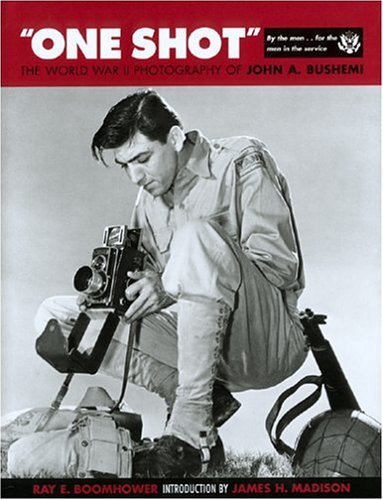



American GIs who participated in the invasions of such far-flung Pacific Ocean locations as New Georgia, Makin, Tarawa, Kwajalein, and Eniwetok during World War II could always count on a blistering reception from the Japanese forces defending those isles. They could also depend on their efforts being documented for their fellow soldiers and folks back home by a good-natured, talented photographer from Gary, Indiana: John A. Bushemi. Assigned to Yank, the weekly magazine written by and for enlisted men, Bushemi specialized in "photography from a rifles length vantage point," according to his colleague Merle Miller. His work with his ever-present Speed Graphic camera earned Bushemi the distinction of being the "outstanding combat photographer" for the magazine, noted its managing editor Joe McCarthy. That distinction came as no surprise to those who knew Bushemi in Gary, where he had received numerous awards for his work as a photographer for the Gary Post-Tribune. While working for the newspaper, he had earned the nickname "One Shot" for his uncanny ability to capture even the fastest action with just one click of his cameras shutter. Written by Hoosier historian and writer Ray E. Boomhower, and featuring an introduction by Indiana University professor of history James H. Madison, "One Shot": The World War II Photography of John A. Bushemi examines the life of this son of Sicilian immigrants who worked in Garys steel mills for a time to earn enough money to buy his first camera. The book features Bushemis work, from his early days photographing soldiers training at the Field Artillery Replacement Center at Fort Bragg in North Carolina to his frontline assignments among the grizzled American forces who engaged in the bitter fighting against the Japanese. It also tells the story of his friendship with best-selling author Marion Hargrove, whose book See Here, Private Hargrove made Bushemi a well-known figure to the home-front audience and GIs around the world. Covering the invasion of Eniwetok in the Marshall Islands on Febraury 19, 1944, Bushemi and other correspondents became the target for a series of Japanese knee-mortar shells. Shrapnel from the shells hit and mortally wounded the photographer. As navy surgeons frantically attempted to save Bushemis life onboard a transport ship, the photographer gave his epitaph, telling Miller: "Be sure to get those pictures back to the office." World War II caught Bushemi (1917-44) at the start of a promising photojournalism career. Fortunately, his talent was already so obvious that he was recruited by the public relations office of the Fort Bragg, North Carolina, artillery training center, and shortly after by Yank, the army magazine for enlisted personnel. His first assignments captured the life of the Fort Bragg trainee, but Yank put him into the thick of the Pacific theater. He photographed combat and its heroes in the Solomon Islands and at Kwajalein and Eniwetok, where he became the second Yank fatality of the war. He carried a big flash camera for his best work, and he was famously fearless and famously convivial, the kind of guy everybody knows and likes. Boomhower's biographical sketch does him proud, but, of course, the photos do better. Spontaneously but professionally composed--Bushemi wasn't called "One Shot" for nothing--and exceptionally well calculated in terms of focus and lighting, they are the kind of pictures that have become iconic of WWII. Ray Olson Copyright © American Library Association. All rights reserved Used Book in Good Condition