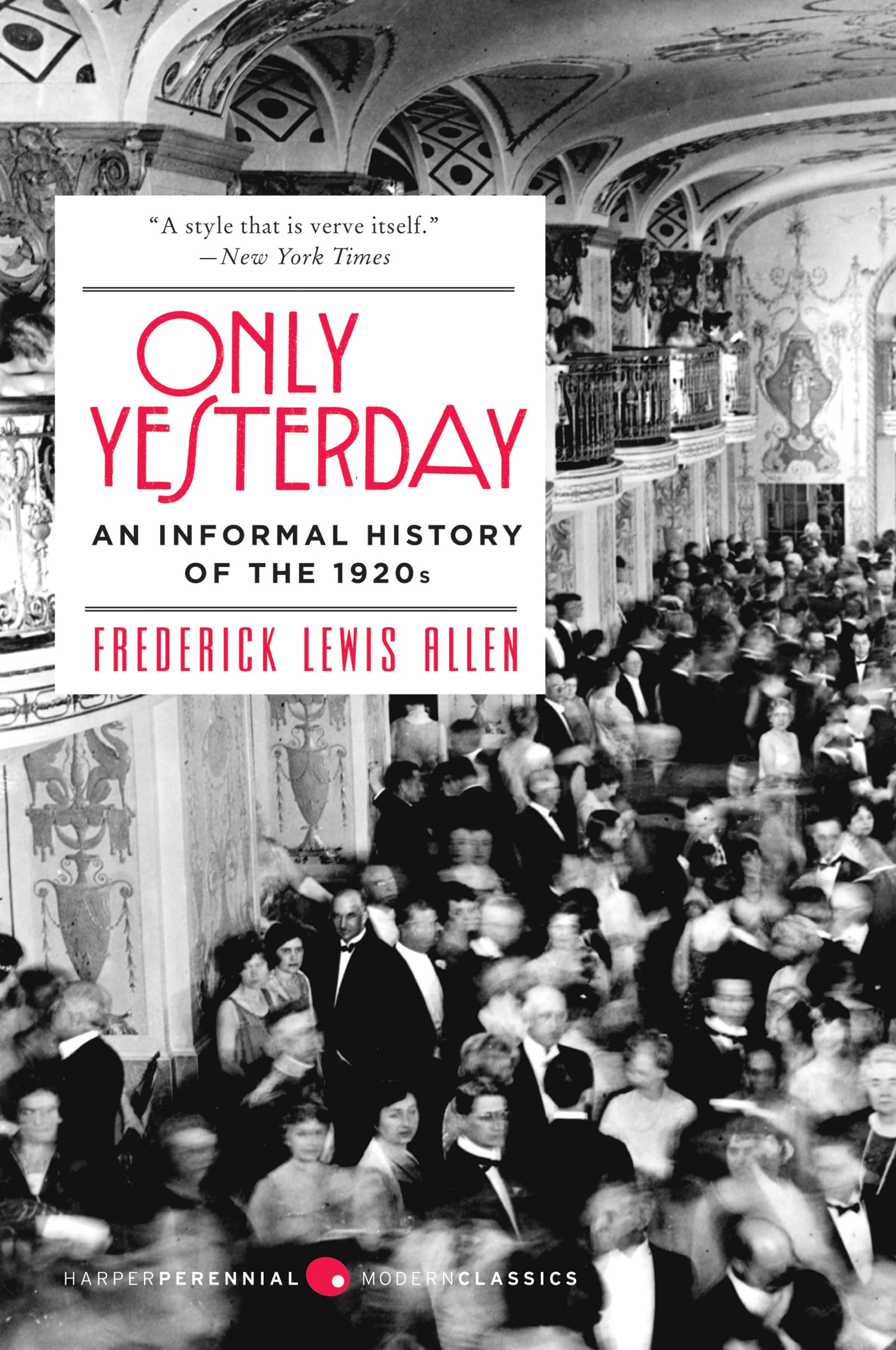
Only Yesterday: An Informal History of the 1920s – A Classic Chronicle of Scandal, Prosperity, and the Great Depression (Harper Perennial Modern
$11.39
by Frederick Lewis Allen



Prohibition. Al Capone. The President Harding scandals. The revolution of manners and morals. Black Tuesday. These are only an inkling of the events and figures characterizing the wild, tumultuous era that was the Roaring Twenties. Originally published in 1931, Only Yesterday traces the rise if post-World War I prosperity up to the Wall Street crash of 1929 against the colorful backdrop of flappers, speakeasies, the first radio, and the scandalous rise of skirt hemlines. Hailed as an instant classic, this is Frederick Lewis Allen's vivid and definitive account of one of the twentieth century's most fascinating decades, chronicling a time of both joy and terror--when dizzying highs were quickly succeeded by heartbreaking lows. "A perfectly grand piece of historical record and synthetic journalism." -- Chicago Daily Tribune Only Yesterday deals with that delightful decade from the Armistice in November 1918 to the panic and depression of 1929-30. Here is the story of Woodrow Wilson's defeat, the Harding scandals, the Coolidge prosperity, the revolution in manners and morals, the bull market and its smash-up. Allen's lively narrative brings back an endless variety of half-forgotten events, fashions, crazes, and absurdities. Deftly written, with a humorous touch, Only Yesterday traces, beneath the excitements of day-to-day life in the 20s, those currents in national life and thought which are the essence of true history. Frederick Lewis Allen was born in Boston in 1890 and graduated from Harvard in 1912. He served on the editorial staffs of the Atlantic Monthly and Century magazines and was editor in chief of Harper's magazine from 1941 until his death in 1954 Only Yesterday An Informal History of the 1920's By Allen, Frederick Lewis Perennial Copyright © 2004 Frederick Allen All right reserved. ISBN: 0060956658 Chapter One Prelude: May, 1919 If time were suddenly to turn back to the earliest days of the Post-war Decade, and you were to look about you, what would seem strange to you? Since 1919 the circumstances of American life have been transformed--yes, but exactly how? Let us refresh our memories by following a moderately well-to-do young couple of Cleveland or Boston or Seattle or Baltimore--it hardly matters which--through the routine of an ordinary day in May, 1919. (I select that particular date, six months after the Armistice of 1918, because by then the United States had largely succeeded in turning from the ways of war to those of peace, yet the profound alterations wrought by the Post-war Decade had hardly begun to take place.) There is no better way of suggesting what the passage of a few years has done to change you and me and the environment in which we live. From the appearance of Mr. Smith as he comes to the breakfast table on this May morning in 1919, you would hardly know that you are not in the nineteen-thirties (though you might, perhaps, be struck by the narrowness of his trousers). The movement of men's fashions is glacial. It is different, however, with Mrs. Smith.She comes to breakfast in a suit, the skirt of which--rather tight at the ankles--hangs just six inches from the ground. She has read in Vogue the alarming news that skirts may become even shorter, and that "not since the days of the Bourbons has the woman of fashion been visible so far above the ankle"; but six inches is still the orthodox clearance. She wears low shoes now, for spring has come; but all last winter she protected her ankles either with spats or with high laced "walking-boots," or with high patent-leather shoes with contrasting buckskin tops. Her stockings are black (or tan, perhaps, if she wears tan shoes); the idea of flesh-colored stockings would appall her. A few minutes ago Mrs. Smith was surrounding herself with an "envelope chemise" and a petticoat; and from the thick ruffles on her undergarments it was apparent that she was not disposed to make herself more boyish in form than ample nature intended. Mrs. Smith may use powder, but she probably draws the line at paint. Although the use of cosmetics is no longer, in 1919, considered prima facie evidence of a scarlet career, and sophisticated young girls have already begun to apply them with some bravado, most well brought-up women still frown upon rouge. The beauty-parlor industry is in its infancy; there are a dozen hair-dressing parlors for every beauty parlor, and Mrs. Smith has never heard of such dark arts as that of face-lifting. When she puts on her hat to go shopping she will add a veil pinned neatly together behind her head. In the shops she will perhaps buy a bathing-suit for use in the summer; it will consist of an outer tunic of silk or cretonne over a tight knitted undergarment--worn, of course, with long stockings. Her hair is long, and the idea of a woman ever frequenting a barber shop would never occur to her. If you have forgotten what the general public thought of short hair in those days, listen to the