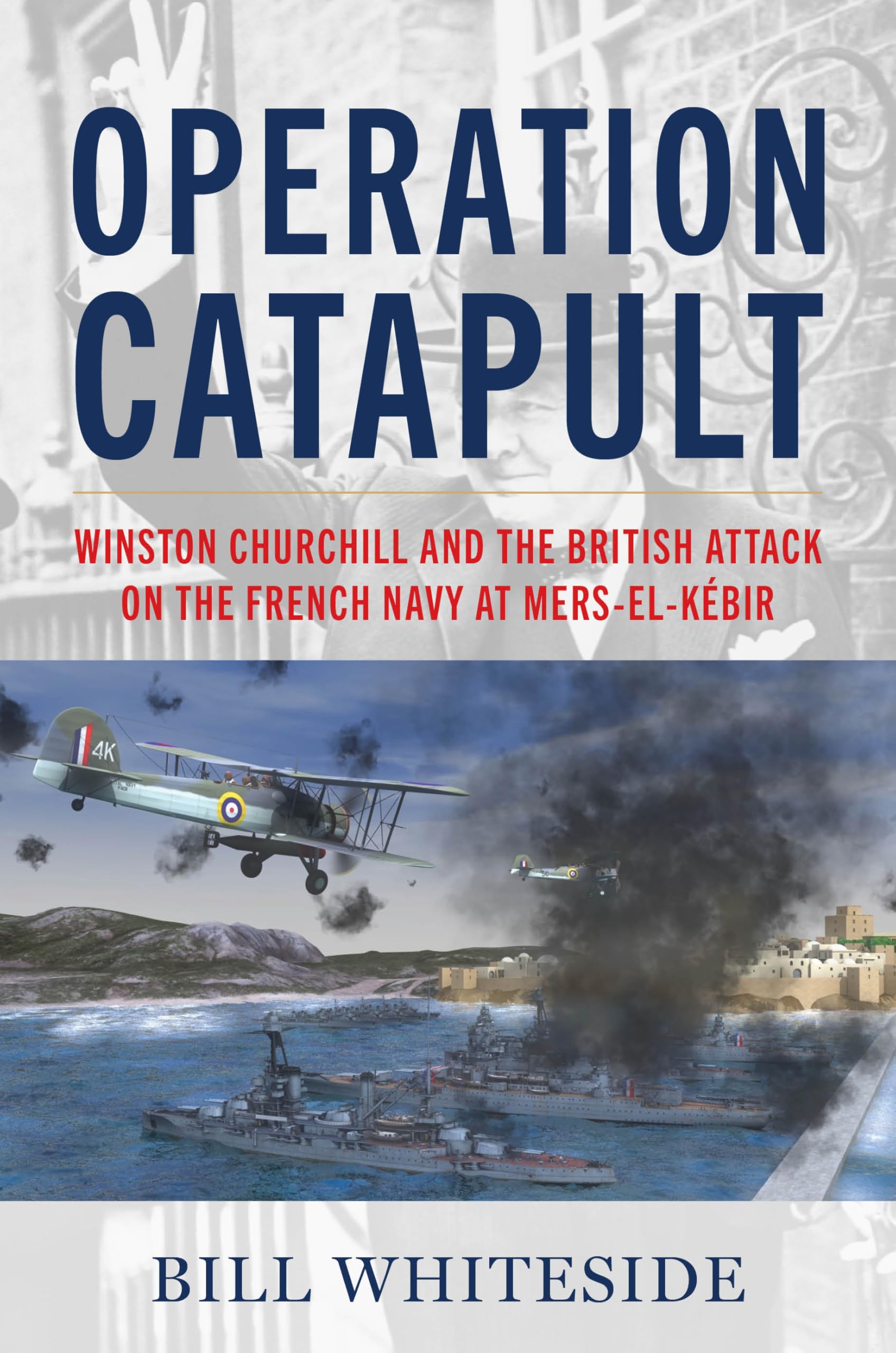
Operation Catapult: Winston Churchill and the British Attack on the French Navy at Mers-el-Kébir
$44.95
by Bill Whiteside



In July 1940, just weeks after France signed an armistice with Germany, Winston Churchill made one of World War II’s most shocking and controversial decisions: he ordered the Royal Navy to open fire on the French fleet at Mers-el-Kébir, killing more than 1,200 of Britain’s recent allies. The Associated Press called it “the strangest of all naval actions in the world’s history.” Churchill feared that Hitler would seize the powerful French fleet and turn it against Britain, so when French commanders refused British demands to move their ships to Allied ports, he gave the order to strike. The bombardment stunned the world, strained relations between Britain and France, and resonated through Churchill’s speech to Parliament, which, according to one observer, “echoed like no other ever heard in its ancient halls.” The fallout reached far beyond the Algerian coast. In Alexandria, British and French admirals negotiated a fragile truce, but trust between the two navies was shattered. Many Royal Navy officers were tormented by the attack, forced to fire on men they had fought beside only weeks earlier. Even Churchill, who deeply admired France, was anguished by his decision. Through the intertwined stories of French admiral Jean Louis Xavier François Darlan and British vice admiral Sir James Somerville―leaders tested by loyalty, duty, and the chaos of war―this dramatic episode reveals the tension, sacrifice, and unflinching resolve that defined Churchill’s wartime leadership. “Operation Catapult has all the vital ingredients – action, diplomacy, Winston Churchill, betrayal, heroics. It’s a must addition to every Churchillian’s library.” ― Paul Reid, co-author of The Last Lion: Winston Spencer Churchill: Defender of the Realm, 1940-1965 “ Operation Catapult chronicles a stranger-than-fiction episode of World War II when committed allies became mortal enemies. With commendable clarity and minute-to-minute precision, Bill Whiteside details exactly what happened between the British and French navies in 1940 at the port of Mers-el-Kébir in Algeria. This account of crisscrossing conundrums―strategic, political, and ethical―is a lasting and compelling contribution to military history and to public understanding.” ― Robert Schmuhl, author, Mr. Churchill in the White House: The Untold Story of a Prime Minister and Two Presidents “After France fell to Germany in 1940, British leaders feared that a Nazi-controlled French Navy ―long an ally of the British―now posed a significant threat. Their solution― an attack on the French fleet stationed in Algeria―has now been captured in exquisite and kaleidoscopic detail by Bill Whiteside with Operation Catapult , a crucial work of naval (and diplomatic) history.” ― Craig Nelson, historian and New York Times best-selling author “Bill Whiteside’s Operation Catapult brings to the forefront one of World War II’s most remarkable events: the British attack on the French Fleet in July 1940 at Mers el-Kébir, Algeria. This fair and well-written account balances well the fraught emotions and black-and-white judgements that cloud many histories and its context-rich narrative provides a lesson on the way war and politics can cause the swiftest, the most surprising shifts, in alliances―a lesson policymakers of today would be well to keep in mind.” ― Vincent P. O’Hara, naval historian and author of Greatest Naval War Ever Fought , Torch , and Struggle for the Middle Sea "This well-researched, well-written and truly fascinating book pours fresh light onto Winston Churchill’s thoughts and actions as he had to make one of the toughest judgement calls of his career, one on which the fate of his country might rest. A lifelong Francophile, he had to decide whether or not to sink the French fleet. Bill Whiteside has put his dilemma into starker (and better informed) perspective than any other historian writing today.” ― Andrew Roberts, author of Churchill: Walking with Destiny Bill Whiteside , a member of the International Churchill Society, is a writer and researcher focused on Winston Churchill and the British Royal Navy. After a 30-year career in sales and marketing, he shifted his focus to history, uncovering a little-known naval clash during Churchill's second month as Prime Minister. This discovery led to his book and numerous articles on the subject. Whiteside holds a BS in management from the University of Notre Dame and lives in Lancaster, Pennsylvania.