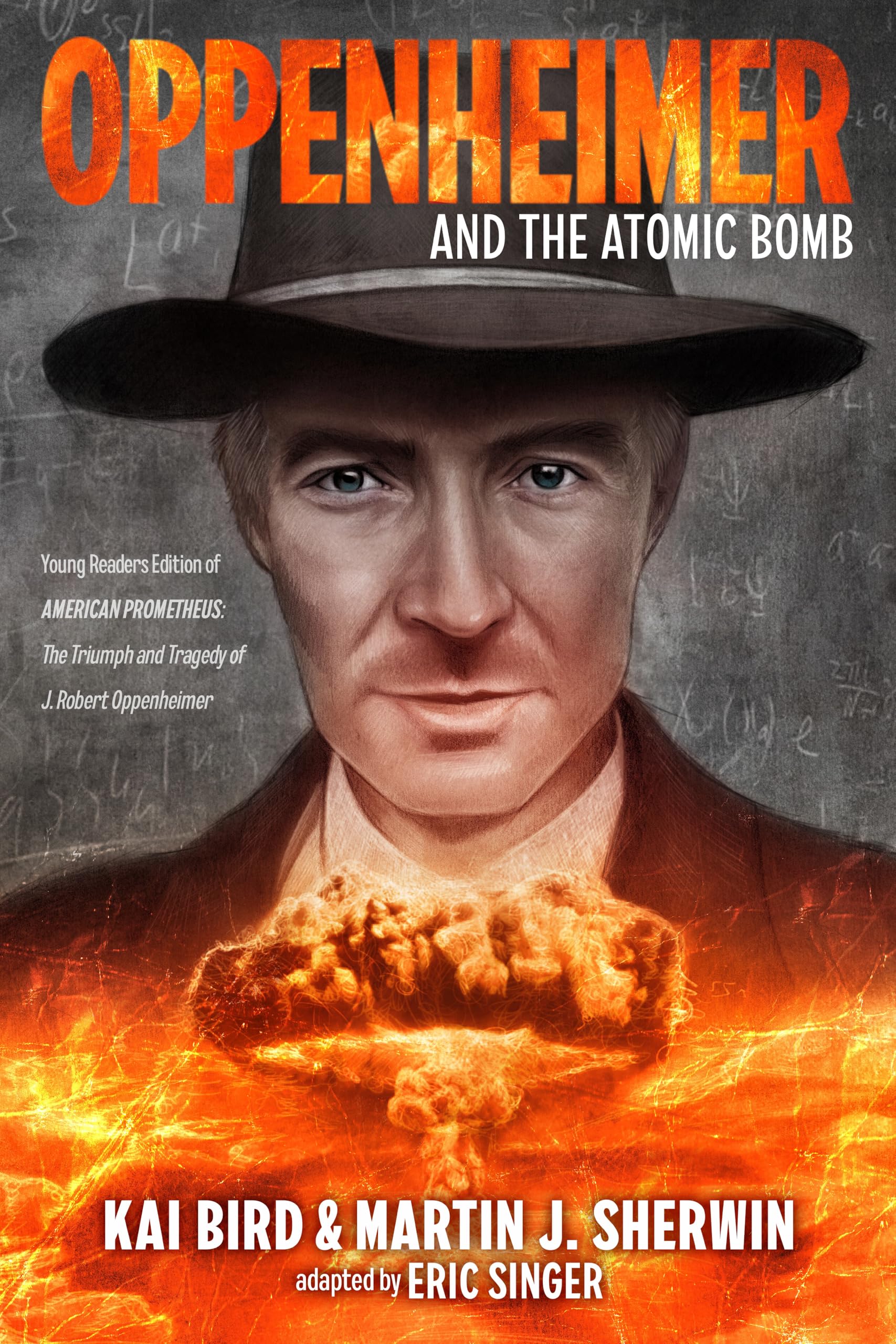
Oppenheimer and the Atomic Bomb: Young Readers Edition of AMERICAN PROMETHEUS: The Triumph and Tragedy of J. Robert Oppenheimer
$9.99
by Eric S. Singer



A young readers edition of the #1 New York Times bestselling, Pulitzer Prize-winning book American Prometheus was the inspiration for the blockbuster film, Oppenheimer . This brand-new edition introduces the next generation to one of the twentieth century's most iconic and complex global figures. J. Robert Oppenheimer was a brilliant physicist who led the American effort to build the atomic bomb during World War II, and who later found himself confronting the moral consequences of the revolutionary weapon he helped create. Readers of all ages will witness the rise and fall of a scientific and historical icon in this masterful new edition. Exploring his childhood, his secret work on the bomb, his central role in the Cold War, and his tragic downfall, this quintessential biography is history at its finest. Filled with dozens of photographs and updated information, this riveting and deeply informative account is now available to a middle and high school audience. ★ "[A] superb adaptation....An undivided pleasure to read, excellent for classroom use as well as independent reading." — Booklist (starred review) “An accessible, vivid, and suspenseful account of the troubled life of the father of the atomic bomb.”— Science Magazine "A meticulous account of the rise and fall of a brilliant scientist." — Kirkus Reviews "A strong choice for nonfiction shelves and as a curricular tie-in due to the significance of the subject’s contribution to science and world history." —School Library Journal "[A] cohesive, entirely accessible portrait of a complex, often reticent man whose life’s work left a mark both on the physical and scientific worlds." —BCCB KAI BIRD is an award-winning historian and journalist and current Executive Director of the Leon Levy Center for Biography. He won the Pulitzer Prize for Biography for American Prometheus: The Triumph and Tragedy of J. Robert Oppenheimer (co-authored with Martin J. Sherwin), which was adapted into the Academy Award-winning film Oppenheimer . His work has been honored with the BIO Award for his significant contributions to the art and craft of biography. He has also written about the Vietnam War, Hiroshima, nuclear weapons, the Cold War, the Arab-Israeli conflict, and the CIA. He lives in New York City and Washington, D.C. MARTIN J. SHERWIN (1937–2021), distinguished historian and writer. After twenty years of research, he joined with Kai Bird to complete the award-winning biography, American Prometheus: The Triumph and Tragedy of J. Robert Oppenheimer. Sherwin served on the faculty of the University of California at Berkeley, Princeton University, the University of Pennsylvania and Dartmouth College. He founded the Nuclear Age History and Humanities Center at Tufts University. In the last decade of his life, he was a University Professor at George Mason University and worked with the Wilson Center's History & Public Policy Program in Washington, DC, to develop the "Nuclear Boot Camp,” a program to support young scholars of nuclear history. PROLOGUE August 6, 1945 8:15 a.m. Hiroshima, Japan Ten-year-old Toshio Nakamura woke from a short night’s sleep. He was home in Hiroshima, Japan, eating peanuts as he sat on his bedroll. Suddenly, without warning, an enormous FLASH bathed the space around him in a blinding white light. Before he knew it, he and his two younger sisters, Myeko and Yaeko, were in the air—a violent blast blew them clear across the room. Toshio landed on top of Myeko, whose legs were pinned under a piece of fallen timber. She was crying, “Mother, help me!” With a mother’s reflex, Mrs. Hatsuyo Nakamura ran to her children, desperate to dig them out of the debris. Toshio was unharmed, but Myeko was buried up to her chest. Yaeko was still below—silent. Frantically, Mrs. Nakamura threw aside shards of broken tile and lifted the heavy pieces of timber pinning her two daughters. She quickly freed Myeko. Then she saw Yaeko’s arm. She tugged. “ Itai! It hurts!” Yaeko wailed. Relieved that her children were unharmed, Mrs. Nakamura yelled back, “There’s no time now to say whether it hurts or not.” Then she jerked Yaeko up, freeing her from the remains of their collapsed house. The Nakamuras went out to the street. They gasped in disbelief, for in front of them lay a scene of utter destruction. All the houses on their block had been reduced to piles of rubble, just like theirs. As they would later find out, the four-engined American B-29 Superfortress Enola Gay had just dropped on their city the first atomic bomb ever used in war. The bomb exploded two thousand feet over Hiroshima’s main shopping district, and in less than a second, the temperature at ground zero reached seven thousand degrees Fahrenheit. People as far away as one half mile instantly turned to water vapor. Statues melted, roof tiles fused together, and buildings caught fire or exploded with unimaginable ferocity. At least eighty thousand people died immediately.