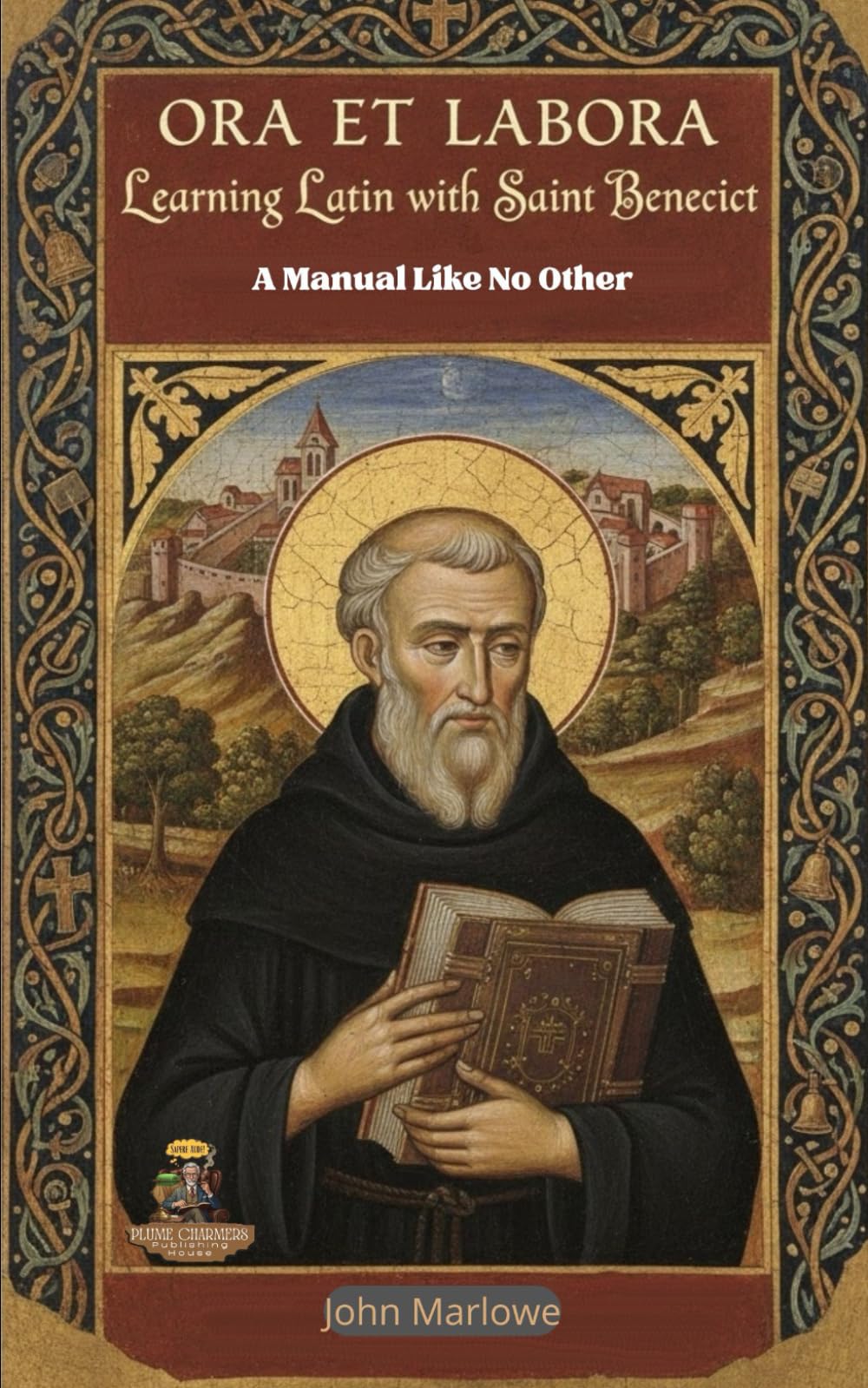



The Living Word and the Labored Hand The Invitation Welcome, seeker of wisdom and student of the ancient tongue. You hold in your hands (or perhaps in your digital scriptorium) a book that does not merely teach a language, but invites you into a way of life. Ora et Labora: Learning Latin with Saint Benedict is not a dry collection of paradigms and vocabulary lists. It is a journey through the stone corridors, the sun-drenched gardens, and the silent chapels of a sixth-century monastery. Here, the Latin language is not a "dead" relic to be dissected, but a "living" breath used to govern a community of souls. The Vision: A Manual Like No Other Most textbooks approach Latin through the lens of Roman generals and pagan poets. While there is much to be gained from Caesar and Cicero, their world is one of conquest and rhetoric. This manual offers a different path. We learn Latin through the Regula Sancti Benedicti (The Rule of Saint Benedict)—a text that for fifteen hundred years has served as the blueprint for Western civilization. By focusing on the Rule, you will learn a language of interiority, community, and service . You will discover that Latin is not just for grand orations, but for the kitchen, the dormitory, and the field. This is a handbook for the "beginner" ( Inchoatio ), designed to take the intimidation out of grammar by grounding it in a story of human struggle and spiritual triumph. The Method: The "Benedictine" Way of Learning This book employs a unique pedagogy we call the Method of Ruminatio . In the monastic tradition, to "ruminate" means to chew the Word until its sweetness is released. Our method is built on three pillars: Contextual Immersion (The Architecture): Each chapter is a physical "room" in the monastery. You do not learn the Dative case in a vacuum; you learn it while discussing how the Iunior gives respect to the Senior . The grammar is always at the service of the scene. - Linguistic Lectio (The Depth): We treat grammar as a spiritual discipline. A deponent verb is not just a grammatical anomaly; it is a lesson in humility—an active heart hiding beneath a passive form. We parse sentences not just to decode them, but to meditate on their weight. - The Vocabulary of Life: Instead of learning words for "war" and "slaughter," you will master the vocabulary of Pax (Peace), Silentium (Silence), and Humilitas (Humility). You will build a lexicon that speaks to the modern soul's need for order and tranquility. The Journey Ahead From the opening call of the Prologue (Ausculta, o fili—Listen, O son) to the final instructions on the Abbot’s responsibility, this book covers the essentials of Latin grammar: the five declensions, the four conjugations, the mysteries of the subjunctive, and the precision of the passive voice. You will not find here the frantic pace of the modern world. Instead, we follow the Mensura (measure) of the monastery. We move slowly, we repeat often, and we find joy in the "labor of the pen." Whether you are a student of history, a seeker of faith, or simply a lover of languages, this manual will provide you with a "little rule" for mastering Latin that will nourish your mind as much as your spirit. Veni et Vide. (Come and see.) Let us step across the threshold together.