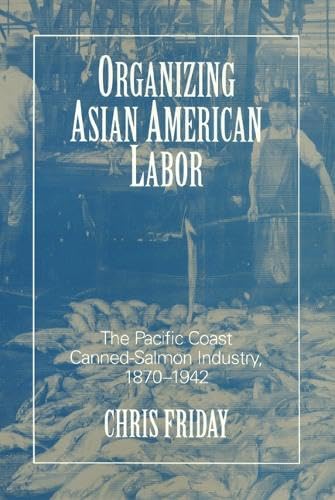
Organizing Asian-American Labor: The Pacific Coast Canned-Salmon Industry, 1870-1942 (Asian American History & Cultu)
$34.95
by Chris Friday



Between 1870 and 1942, successive generations of Asians and Asian Americans predominantly Chinese, Japanese, and Filipino formed the predominant body of workers in the Pacific Coast canned-salmon industry. This study traces the shifts in the ethnic and gender composition of the cannery labor market from its origins through it decline. "Very thoroughly researched in traditional and non-traditional sources, well-organized, and gracefully written, the volume will be of particular value of readers interested in immigration, ethnicity, labor, and the American West." — Choice "An important book, addressing a major topic in ethnic, industrial, labor, and Western history with extraordinary rich coverage of the Chinese and Japanese and Filipinos in the Pacific Coast canned-salmon industry. The research can only be described as awesome, quite extraordinary....This is a book which carries historical riches of value not only within but beyond the boundaries of this specific topic." — Robert Kelley , University of California, Santa Barbara Asian and Asian American workers resist oppression and shape their own lives Outstanding Book in History Award, Association for Asian American Studies "Very thoroughly researched in traditional and non-traditional sources, well-organized, and gracefully written, the volume will be of particular value of readers interested in immigration, ethnicity, labor, and the American West." Choice "An important book, addressing a major topic in ethnic, industrial, labor, and Western history with extraordinary rich coverage of the Chinese and Japanese and Filipinos in the Pacific Coast canned-salmon industry. The research can only be described as awesome, quite extraordinary....This is a book which carries historical riches of value not only within but beyond the boundaries of this specific topic." Robert Kelley, University of California, Santa Barbara Between 1870 and 1942, people of Chinese, Japanese, and Filipino ancestry toiled in the salmon canneries on coastal bays and streams from central California to western Alaska. Successive generations of Asian immigrants and Asian Americans formed the predominant body of workers in an industry that played a central role in the economic growth of the western states and territories. This book traces the shifts in the ethnic and gender composition of the cannery labor market from its origins through its decline and examines the workers' creation of work cultures and social communities. Resisting the label of cheap laborer, these Asian American workers established formal and informal codes of workplace behavior, negotiated with contractors and recruiters, and formed alliances to organize the workforce. Whether he is discussing Japanese women workers' sharing of child care responsibilities or the role of Filipino workers in establishing the Cannery Workers and Farm Laborers Union, Chris Friday portrays Asian and Asian American workers as people who, while enduring oppressive restrictions, continually attempted to shape their own lives. Chris Friday is Assistant Professor of History at Western Washington University. Used Book in Good Condition