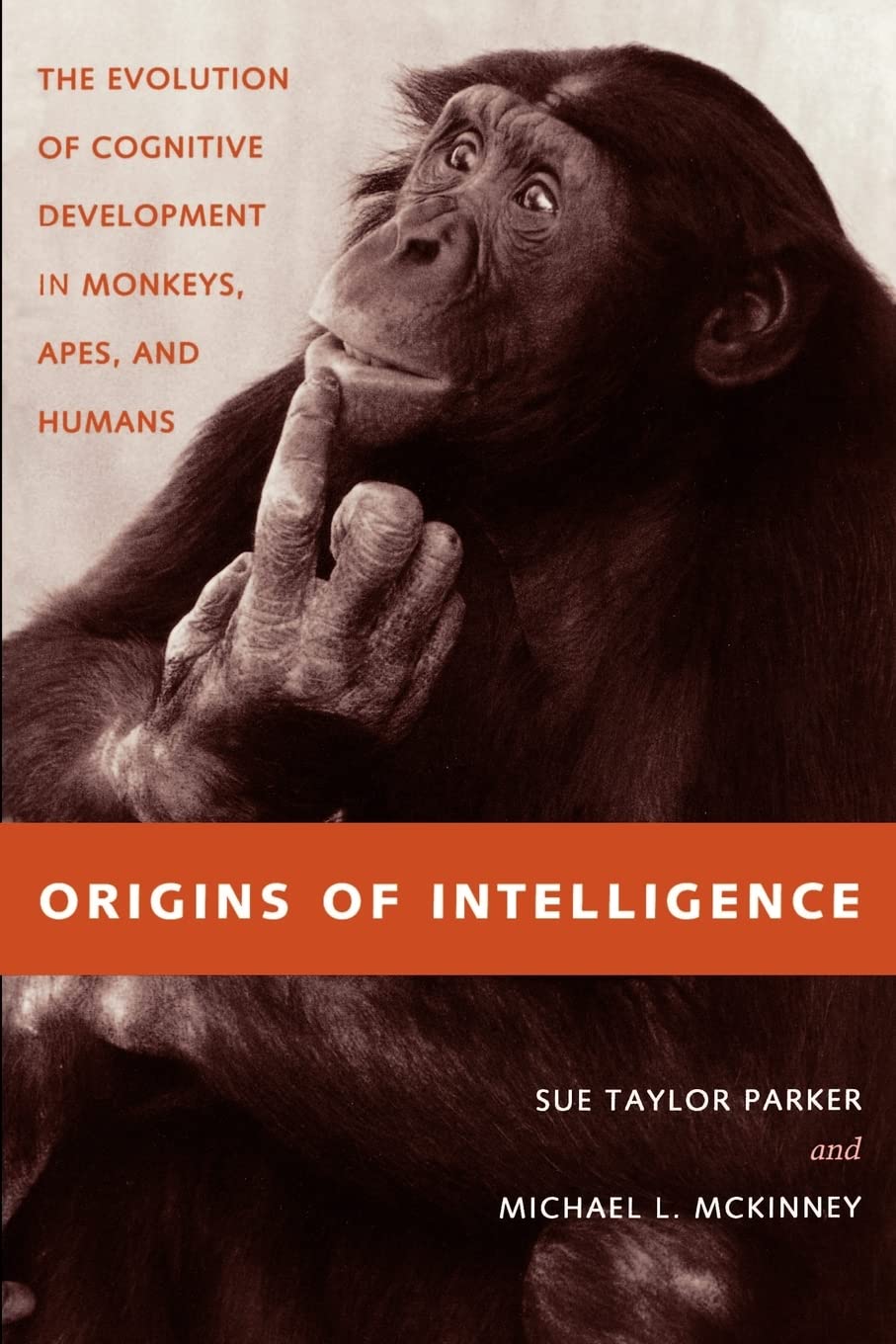
Origins of Intelligence: The Evolution of Cognitive Development in Monkeys, Apes, and Humans
$35.95
by Prof Sue Taylor Taylor Parker



Selected by Choice Magazine as an Outstanding Academic Title Since Darwin's time, comparative psychologists have searched for a good way to compare cognition in humans and nonhuman primates. In Origins of Intelligence, Sue Parker and Michael McKinney offer such a framework and make a strong case for using human development theory (both Piagetian and neo-Piagetian) to study the evolution of intelligence across primate species. Their approach is comprehensive, covering a broad range of social, symbolic, physical, and logical domains, which fall under the all-encompassing and much-debated term intelligence. A widely held theory among developmental psychologists and social and biological anthropologists is that cognitive evolution in humans has occurred through juvenilization—the gradual accentuation and lengthening of childhood in the evolutionary process. In this work, however, Parker and McKinney argue instead that new stages were added at the end of cognitive development in our hominid ancestors, coining the term adultification by terminal extension to explain this process. Drawing evidence from scores of studies on monkeys, great apes, and human children, this book provides unique insights into ontogenetic constraints that have interacted with selective forces to shape the evolution of cognitive development in our lineage. The authors' elegant theory and comprehensive empirical synthesis of how the development of human intelligence and brain evolved opens up cascading heuristic avenues for creatively answering one of the great questions in the human history of ideas. ―Jonas Langer, Human Development [ Origins of Intelligence is] worthy of a prominent place on the researcher's shelf . . . A handy source of information on comparative cognitive abilities related to life history and brain variables. ―James Anderson, Journal of the Royal Anthropological Institute Parker and McKinney's attempt to address the Origins of Intelligence is to be welcomed. Although the 'glittering prize' for unraveling the evolutionary history of modern human intelligence is probably still unclaimed, the authors' broad integration of ontogenetic, comparative, and evolutionary evidence is an approach that holds much promise. If you are interested in the evolution of primate cognition (whether a primatologist, paleoanthropologist, psychologist, etc.) you should read Origins of Intelligence . ―Melissa A. Panger, Journal of Human Evolution A fascinating and elegantly crafted book. Seminal reading for anyone interested in how our cognitive development is inextricably linked with our evolutionary heritage. The authors argue clearly and convincingly that recapitulation is alive and well in the evolution of our brain. ―Kenneth J. McNamara, Department of Earth & Planetary Sciences, Western Australian Museum A fascinating and elegantly crafted book. Seminal reading for anyone interested in how our cognitive development is inextricably linked with our evolutionary heritage. The authors argue clearly and convincingly that recapitulation is alive and well in the evolution of our brain. -- Kenneth J. McNamara Sue Taylor Parker is a professor of anthropology at Sonoma State University in Rohnert Park, California. Her works include "Language" and Intelligence in Monkeys and Apes, Self-Awareness in Animals and Humans, Reaching into Thought , and Naming Our Ancestors . Michael L. McKinney is an associate professor of geological sciences at the University of Tennessee in Knoxville and author of several books, including Heterochrony .