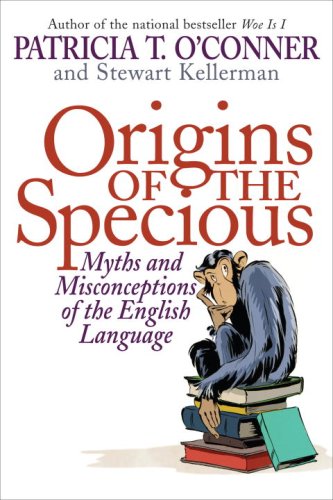
Origins of the Specious: Myths and Misconceptions of the English Language
$12.51
by Patricia T. O'Conner



Do you cringe when a talking head pronounces “niche” as NITCH? Do you get bent out of shape when your teenager begins a sentence with “and,” or says “octopuses” instead of “octopi”? Do you think British spellings are more “civilised” than the American versions? Would you bet the bank that “jeep” got its start as a military term and “SOS” as an acronym for “Save Our Ship”? If you answered yes to any of those questions, you’re myth-informed. Go stand in the corner–and read this book! In Origins of the Specious , word mavens Patricia T. O’Conner and Stewart Kellerman explode the misconceptions that have led generations of language lovers astray. They reveal why some of grammar’s best-known “rules” aren’t–and never were–rules at all. They explain how Brits and Yanks wound up speaking the same language so differently, and why British English isn’t necessarily purer. This playfully witty yet rigorously researched book sets the record straight about bogus word origins, politically correct fictions, phony français, fake acronyms, and more. English is an endlessly entertaining, ever-changing language, and yesterday’s blooper could be tomorrow’s bon mot–or vice versa! Here are some shockers: “They” was once commonly used for both singular and plural, much the way “you” is today. And an eighteenth-century female grammarian, of all people, is largely responsible for the all-purpose “he.” The authors take us wherever myths lurk, from the Queen’s English to street slang, from Miss Grundy’s admonitions to four-letter unmentionables. This eye-opening romp will be the toast of grammarphiles and the salvation of grammarphobes. Take our word for it. Inspired by answering language questions on talk radio and through email, journalists and grammar book authors O'Conner and Kellerman keep explaining the English language in ten topical chapters. While some grammar and etymology questions are familiar, other topics are happily fresh. An example of this is the first chapter, which considers authenticity, namely, whether American or British English retained more original vocabulary and pronunciation. Skillfully drawing on the Oxford English Dictionary and other research tools, the writers always present conversational prose with different kinds of wordplays. For instance, regarding using pronouns, they write, "But one word is missing…the word that I would have used instead of 'he or she' in the last sentence." Because the work aims to explain even more than guide, it emphasizes historical background more than other recently published books such as June Casagrande's Mortal Syntax and Paul Yeager's Literally, the Best Language Book Ever . With an accessible tone and full of information, this work is recommended for public libraries.—Marianne Orme, Des Plaines P.L., IL Copyright © Reed Business Information, a division of Reed Elsevier Inc. All rights reserved. Readers describing the opening chapters of this trove of linguistic lore may consider surprising an apt word. But then O’Conner and Kellerman will school them in the historical distinction between surprising and astonishing. Still, most readers will welcome the corrective schooling. After all, the authors assault illusions about language with such élan that the whole process entertains and even amuses. True, it may hurt to part with cherished but apocryphal anecdotes and folk etymologies. (Alas, we must bid farewell to the endearing story about Churchill skewering pedants who opposed sentence-ending prepositions.) But most readers will cherish the gains, as real understanding replaces the semantic superstitions obscuring common expressions (“rule of thumb”) and constructions (the double negative). But besides opening up a lexical treasury, the authors teach substantive linguistic lessons. Readers learn, for example, why Americans should shed their unwarranted sense of linguistic inferiority to the British and why the guardians of correctness must recognize the inevitability of language change. No one has ever coaxed more fun out of dictionaries. --Bryce Christensen "Every bartender in the land should have a copy of this vastly amusing and highly informative book. Then when some tipsy bore declares that posh derives from Port Out, Starboard Home, or that you must never say disinterested when you mean uninterested, he can bring it out from behind the jar of cocktail cherries, and smack him on the head with it." —Simon Winchester, author of The Professor and the Madman and The Meaning of Everything “With common sense and uncommon wit, O'Conner and Kellerman solve more mysteries than all the Law & Order series combined. Orig ins of the Specious will teach you why it is OK to bravely split an infinitive, why using "ain't" ain't so bad, and why ending a sentence with a preposition is where it's at.”—David Feldman, author of the Imponderables book series " Origins of the Specious is a witty and informative guide to the perplexities of the English language. I enjoyed