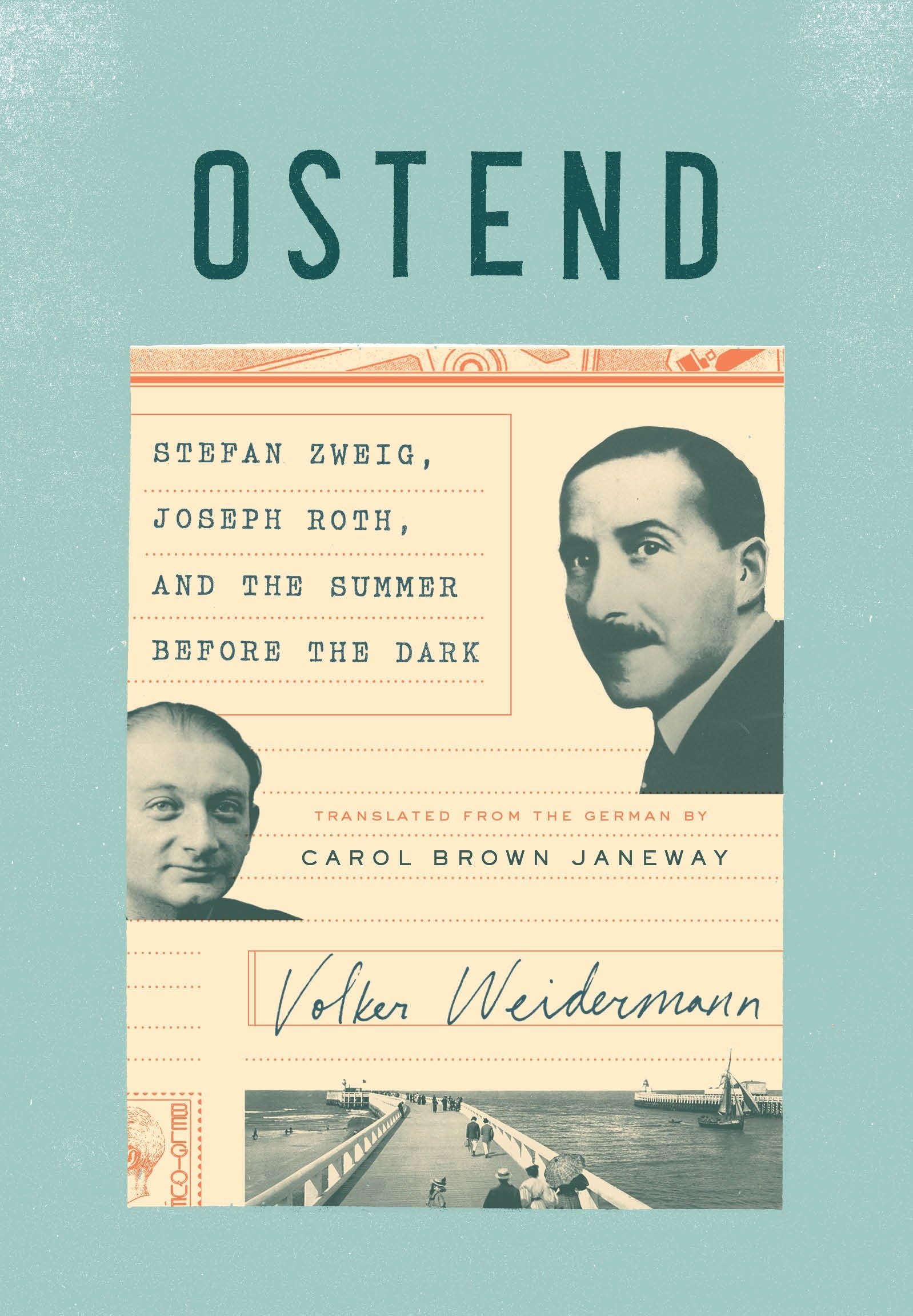
Ostend: Stefan Zweig, Joseph Roth, and the Summer Before the Dark
$16.86
by Volker Weidermann



It’s the summer of 1936, and the writer Stefan Zweig is in crisis. His German publisher no longer wants him, his marriage is collapsing, and his house in Austria—searched by the police two years earlier—no longer feels like home. He’s been dreaming of Ostend, the Belgian beach town that is a paradise of promenades, parasols, and old friends. So he journeys there with his lover, Lotte Altmann, and reunites with fellow writer and semi-estranged close friend Joseph Roth, who is himself about to fall in love. For a moment, they create a fragile haven. But as Europe begins to crumble around them, the writers find themselves trapped on vacation, in exile, watching the world burn. In Ostend, Volker Weidermann lyrically recounts “the summer before the dark,” when a coterie of artists, intellectuals, drunks, revolutionaries, and madmen found themselves in limbo while Europe teetered on the edge of fascism and total war. Ostend is the true story of two of the twentieth century’s great writers, written with a novelist’s eye for pacing, chronology, and language—a dazzling work of historical nonfiction. (Translated from the German by Carol Brown Janeway) “ Ostend might appeal to fans of The Grand Budapest Hotel and Wes Anderson’s other movies. . . . it boasts a cinematic quality that invites readers to imagine it as a movie with heaps of alcohol, sex, and intrigue.” — The New York Journal of Books “Potent and melancholy. . . . Weidermann has combed letters, books, diaries, and reminiscences and used them to tell his sad tale as if it were a novel.”—Michael Prodger, The Times (London) “Lovely. . . . The late Carol Brown Janeway, translator of Bernhard Schlink’s ‘The Reader,’ has translated Weidermann’s lean, elegant, sometimes impressionistic prose gorgeously from the German. . . . a tribute and an elegy.” —Julia M. Klein, Forward “A fascinating story, brilliantly told.” —David Herman, The Jewish Chronicle “Dazzling. . . . Graceful. For such a slim book to convey with such poignancy the extinction of a generation of ‘Great Europeans’ is a triumph.” — The Sunday Telegraph “Light on its feet, a reverie in a way. . . . [Weidermann] writes the book as a novel, almost, recreating scenes and channeling characters' thoughts . . . I enjoyed getting lost in the book’s melodies.” —Jennifer Senior, The New York Times “Weidermann evokes a remarkable sense of spirit and place . . . . Ostend is a beautiful jewel of a book; an all-too-brief breath of the rarefied air of another era. If that summer at Ostend revitalized Zweig and Roth and all the others against the coming of the dark, so too Weidermann’s stirring account of it revitalizes the contemporary reader 80 years later.” —Popmatters “Like Wes Anderson’s Zubrowska in The Grand Budapest Hotel. . . . at once haunting and ornamental: an antique music-box of melancholic atmosphere. . . . A meditation on the act of creation, one that explores how we make refuges out of our own pasts.” —Tara Isabella Burton, The New Republic "A triumph." — The Telegraph (Five stars) “This is a marvelous book about many things — politics, love, identity, belonging — but at its heart is the story of a great and troubled friendship between two great and troubled writers. . . . Summer Before the Dark is literary biography at its best. Faithful to facts, it reads like a novel. With its elegiac atmosphere, extreme personalities, tense political backdrop and tragic central relationships, it would make a terrific film — Death in Venice with more sex, more booze, more action and considerably more conversation.” —Rebecca Abrams, Financial Times “Volker Weidermann magically evokes the mood of these artistic refugees as the sun set on the civilized order of Europe. . . . “Ostend,” which has been marvelously translated by Carol Brown Janeway, abounds in poetry and deadpan understatement. . . .The dissonance between the writers’ languid summer and the utter ruthlessness of what awaits gives “Ostend” a dream-like quality. The book is as transporting as fiction—I had to remind myself that it wasn’t as I read. Partly this is due to the level of detail. Mr. Weidermann knows which café each writer favored, what they drank, which manuscripts they read aloud. It could be Hemingway.” —Roger Lowenstein, The Wall Street Journal “Resonant. . . . As Europe tumbles towards darkness, the writers in Ostend create a haven for love and literature - one they know is doomed - that Weidermann evokes with skill and delicacy.” — The Sunday Times “Ostend reads as a time capsule that Weidermann has sorted through for us, and organized. . . . Remarkable.” —Michelle Frost, Cleaver Magazine “Breezier and more brightly written than a study of two profound minds in torment on the eve of global disaster should reasonably be; an enthralling, juicy read.” — Big Issue “A sign of how far [the revival of Zweig and Roth's work] has succeeded... a work of popular history very much