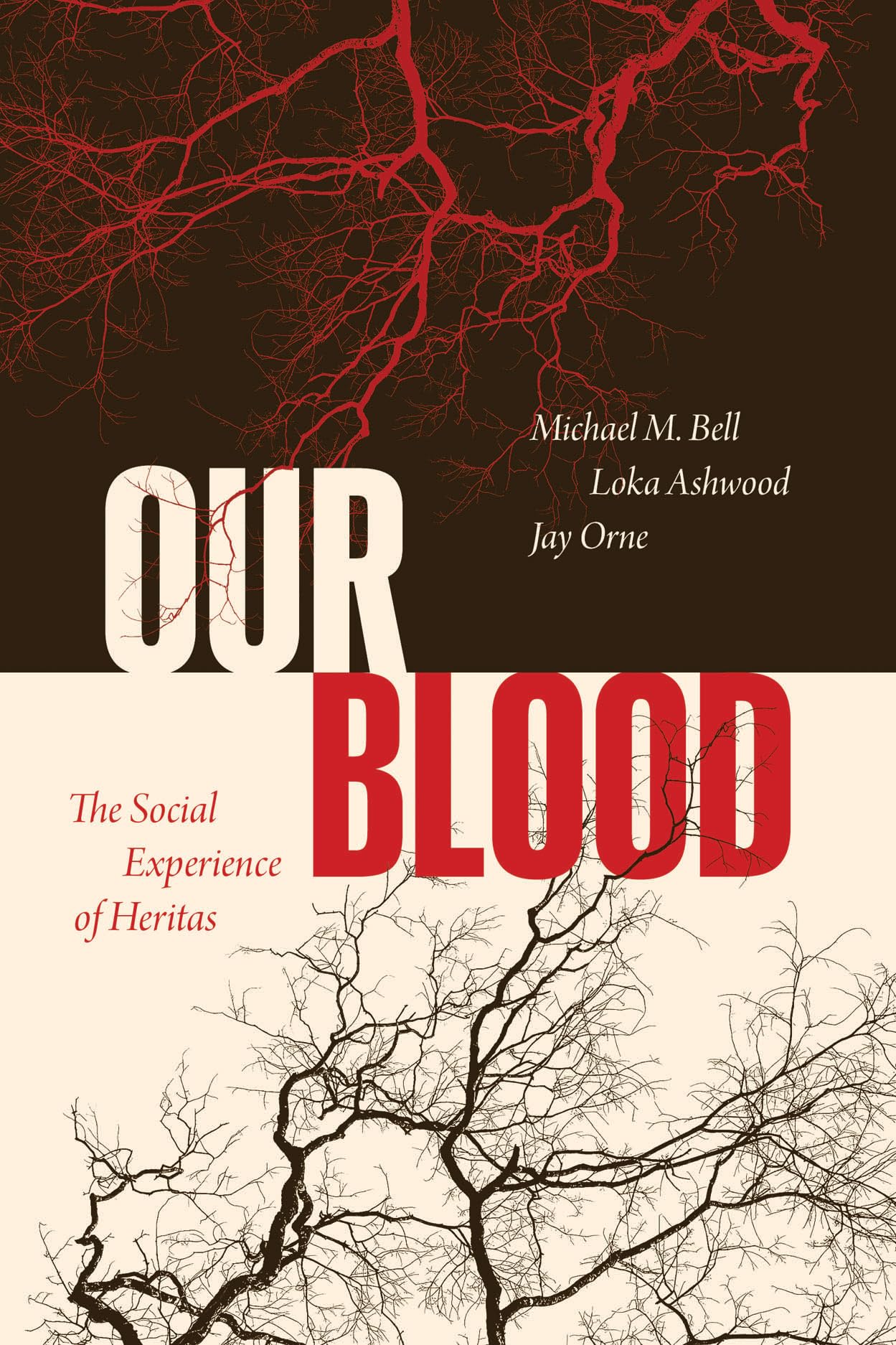



Who are we, where do we come from, and why does it matter? From whom do I come? Our Blood describes the central importance of our sense not just of our heritage, but our embodied heritage: that our past is in our bodies and runs in our blood, and that our embodied past is central to our futures. Deeply felt heritas , as Michael M. Bell, Loka Ashwood, and Jay Orne call it, can be a source of great love and kindness for one another. But it can also be a beautiful horror, the source of some of our greatest hate and meanness towards one another. We think of our embodied heritage as natural and historical facts, beyond our choice, and therefore free of manipulation for social gain. We think of it as spirited presences in our bodies that we did not choose. We think of its origins as external to us, whether we are talking about family, class, caste, places, things, ethnoraciality, or our professions. We think of it as legitimate and rightful, therefore. But we do choose. We do select. Bell, Ashwood, and Orne argue that greater awareness of heritas’s social origins and social selectivity can help us cultivate a wider sense of mutual care and ease the divisiveness of our time. Ultimately, Our Blood asks us all to consider heritas, and in doing so, to perhaps even reconsider our very selves. "Our Blood is a highly original, inventive, and provocative book that elucidates a new sociological concept that the authors have coined, “heritas.” It critiques essentialist and reductionist categorizations of identity, rather emphasizing the invention of race, and capacities to convert between religions and political traditions, as well as the formation of attachments to places and territorial identities where there is no natural blood connection. As such, Our Blood is an important and timely corrective to the ways in which identity (and notions of blood) are frequently essentialized and deployed in politics today." -- Michael Woods, Aberystwyth University “Bell, Ashwood, and Orne have developed a sophisticated framework for thinking about how we experience our identities and social relationships to be organized around feelings of co-descent and shared heritage. The greatest contribution of the book is in its conceptual work and its holistic treatment of this phenomenon, and in the authors’ ability to develop the notion of ‘heritas’ across several different cases, levels of social organization, and domains of social experience.” -- Thomas DeGloma, author of 'Anonymous: The Performance of Hidden Identities' Michael M. Bell has established himself as the great interpreter of the meaning of community in our time, as well as a daring cultural and historical theorist. Here, he teams up with Macarthur “Genius” Fellow Loka Ashwood, a rising star in the study of land, environment and culture, and Jay Orne, the stellar expert in qualitative research and sexuality. Together, they take on the most difficult questions at the heart of social thought―our relation to the groups, the very soil, from which it appears we have sprung, but which, they show, we ourselves create and re-create all the time. They sensitively explore questions of heritage, essence, and freedom―of place, space, and time―that will be at the forefront of controversy in the next few years. Not to be missed. -- John Levi Martin, University of Chicago Michael M. Bell is the Philip David Lowe and Vilas Distinguished Achievement Professor of Community and Environmental Sociology at the University of Wisconsin-Madison. His most recent books are City of the Good: Nature, Religion, and the Ancient Search for What Is Right , The Cambridge Handbook of Environmental Sociology, and the 6th edition of Invitation to Environmental Sociology. Loka Ashwood is professor of community and environmental sociology at the University of Wisconsin. She is the author of For-Profit Democracy: Why the Government is Losing the Trust of Rural America and coauthor of the sixth edition of An Invitation to Environmental Sociology. She is a recipient of a prestigious 2024 MacArthur Fellowship. Jay Orne is a research scientist and prevention/harm reduction manager at the Aliveness Project, a center for people living with and at risk for HIV in Minneapolis, Minnesota. They are the author of Boystown: Sex and Community in Chicago and coauthor of Invitation to Qualitative Fieldwork: A Multilogical Approach.