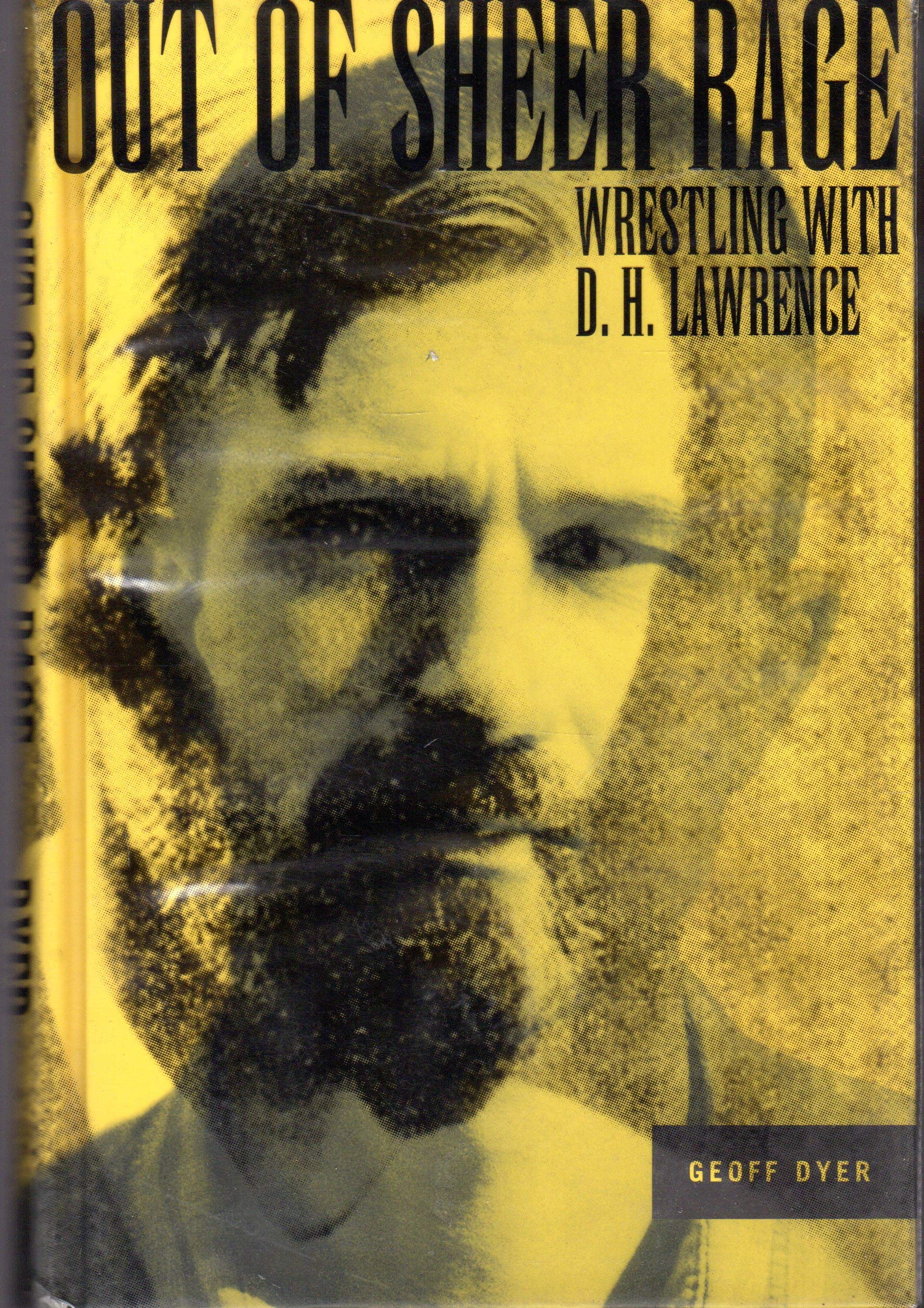



Recounts the author's experiences visiting the places D.H. Lawrence lived while actively not working on a book about Lawrence and not writing his own novel Out of Sheer Rage: Wrestling with D.H. Lawrence is the best book about not writing a book about D.H Lawrence ever written. Other people have written untraditional, even loopy tributes to the priest of love before--including boon companions Anais Nin and Henry Miller--but no one has done it with Dyer's chutzpah, or with such fantastic success. Dyer started out with the intention of writing either a sober academic study of Lawrence or a novel based on his subject's life but couldn't seem to do either. The academic study, he realized, was really just an excuse to read Lawrence's work, and the novel never even acquired a rudimentary shape in his mind. Instead, he somehow convinced his publisher to pick up the tab for his lengthy globetrotting pilgrimage, which took him from Paris to Rome to Greece to Oxford--not to mention such Lawrentian hotspots as Taos and Mexico and San Francisco. The result is an extended, often hilarious, meditation on seafood, English TV, Dyer's own creative impulses, and occasionally even Lawrence. In Lawrence's seminal prose he finds some justification for his own capricious indulgences: "What Lawrence's life demonstrates so powerfully is that it actually takes a daily effort to be free.... There are intervals of repose but there will never come a state of definitive rest where you can give up because you have turned freedom into a permanent condition. Freedom is always precarious." Yet he refuses to read Lawrence's novels, confining himself to letters, travel reportage, and other casuals. Indeed, "[o]ne gets so weary watching authors' sensations and thoughts get novelised, set into the concrete of fiction, that perhaps it is best to avoid the novel as a medium of expression." Dyer's fascination with Lawrence's minorabilia suggests not only an oblique criticism of the contemporary novel, but a promising direction for the memoir. Perhaps clean, well-lighted subjectivity is a dead end, and the future lies with eccentric, provisional works along the lines of Flaubert's Parrot and How Proust Can Change Your Life --or Out of Sheer Rage . After all, Dyer's bright (and brilliantly shambolic) book of life reminds us of why we read in the first place: to see the surprising ways one person can be brought to life by another. --Michael Joseph Gross There are well over 1000 books on D.H. Lawrence, but this one has an unconventional angle. On the first page, one is disabused of the notion that this will be yet another critical analysis or biography, perhaps brilliant, perhaps jargon-ridden, but destined to join all the others. Instead of his planned academic "Lawrence Book," Dyer (But Beautiful: A Book About Jazz, LJ 11/15/95) gives us a splendid study on procrastination, denial, rationalization, and writer's block. As he travels around Paris, Greece, Oaxaca, and other locales, he agonizes over such things as what books to bring along and which to leave behind; either way, they become excuses for not writing. There is the irony that the self-admittedly undisciplined Dyer did indeed manage to produce this book, even if not the learned tome he had intended. It deserves to be called his "Lawrence Book," and it's probably all the better for the manner in which it was written. Heartily recommended, although libraries need not purchase if they have the 1997 British edition.?Janice E. Braun, Mills Coll., Oakland, CA Copyright 1998 Reed Business Information, Inc. ...a potently distilled treatise on literature, blessedly free of the academic cant that Dyer so disdains. Dyer writes two books at once, his own life and a challenging life of D.H. Lawrence, in this unique performance. This wrestling match with Lawrence reveals the author and his subject as finely matched opponents who ultimately shake hands on the nature of life and art. Dyer's record of his time spent exhaustively studying Lawrence is both tormented and comic. He ``rages'' at his very goals and against the compulsion to write, while also tracing, intermittently, Lawrence's own life's itinerary. In a sense, the project is a doomed undertaking. For could there be any less auspicious literary pursuit than formalizing the process of going ``from making notes on Lawrence to making notes for my novel, by which I mean not working on my book about Lawrence to not working on the novel because all of the to-ing and fro-ing and note-taking actually meant that I never did any work on either . . .''? Chagrined by his ambivalence, seduced by his indecisiveness, Dyer aspires to the ``floaty indifference of contentment'' and comes to prefer Lawrence's manuscripts to the final texts. He longs for freedom, yet his gateway into Lawrence comes in a moment of raging indolence. Convinced that Lawrence's ``writing urges us back to the source,'' Dyer traces the other writer's footsteps. Taos and Oaxaca, Sar