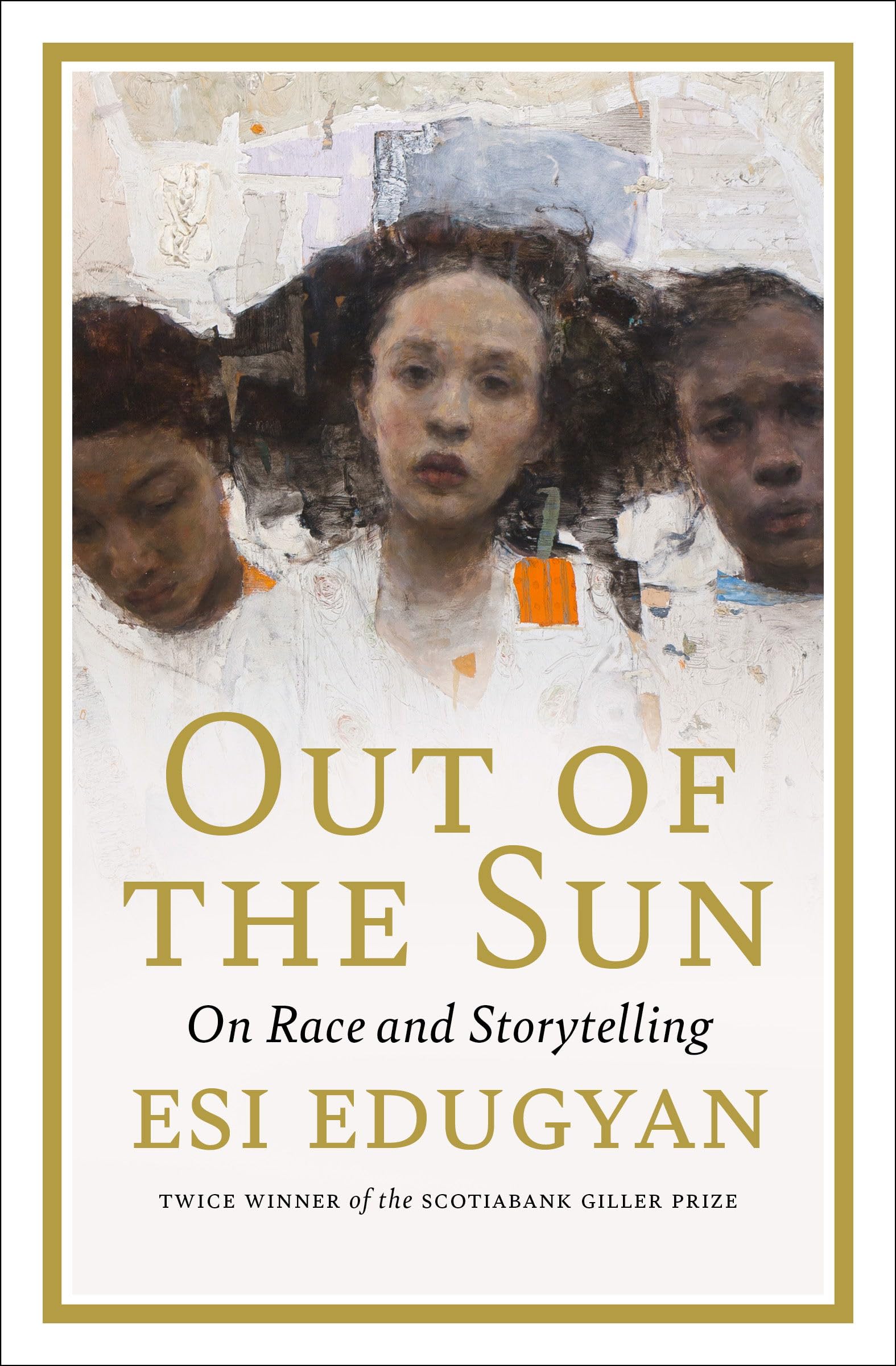



An insightful exploration and moving meditation on identity, art, and belonging from one of the most celebrated writers of the last decade. What happens when we begin to consider stories at the margins, when we grant them centrality? How does that complicate our certainties about who we are, as individuals, as nations, as human beings? Through the lens of visual art, literature, film, and the author’s lived experience, Out of the Sun examines Black histories in art, offering new perspectives to challenge us. In this groundbreaking, reflective, and erudite book, two-time Scotiabank Giller Prize winner and internationally bestselling author Esi Edugyan illuminates myriad varieties of Black experience in global culture and history. Edugyan combines storytelling with analyses of contemporary events and her own personal story in this dazzling first major work of non-fiction. “[Esi Edugyan] explores with empathy what it means to be seen, and who remains unseen, in our current identity-conscious, visibility-obsessed culture that seems to be limping toward a new aesthetic order and politics of power.” ― New York Times “In its breadth, beauty, and candour, this is a beguiling collection. And if, after reading it you leave with more questions than you started ― which might be a complaint in a lesser book ― then I suspect it has achieved its aim.” ― Guardian “These stories soar off the page with Edugyan’s poetic, personally informed narration … Out of the Sun provides an enlightening, multifaceted, and thoroughly engrossing look at what Blackness means and has meant through the centuries.” ― Irish Times “Distinguished by its erudite yet unpretentious prose and probing viewpoints, this is an essential reckoning with how history is made.” ― Publishers Weekly , STARRED REVIEW “A perfect blend of memoir and thought, pop culture and philosophy … Edugyan’s work is masterful and essential.” ― Miramichi Reader This sensitive exploration of racialized people brings ghosts of erased lives out from the shadows and lays them on top of one another in a double exposure of how othering functions in our lives. It performs a kind of haunting, throwing tender light on the fictions that divide us. -- Tessa McWatt, author of Shame on Me: An Anatomy of Race and Belonging A graduate of Johns Hopkins University and the University of Victoria, ESI EDUGYAN was raised in Calgary, Alberta. She is the award-winning and internationally bestselling author of Washington Black , which was a finalist for the Rogers Writers’ Trust Fiction Prize and the Man Booker Award and won the Scotiabank Giller Prize; Half-Blood Blues , which was a finalist for the Governor General’s Literary Award and the Man Booker Prize and won the Scotiabank Giller Prize; and The Second Life of Samuel Tyne . She is also the author of Dreaming of Elsewhere , which is part of the Kreisel Memorial Lecture Series. She has held fellowships in the U.S., Scotland, Iceland, Germany, Hungary, Finland, Spain, and Belgium. She lives in Victoria, British Columbia. CONTENTS Africa & Science Fiction The emergence of Afro-Futurism in the last decade has created a new framework to discuss Africa. How does a continent still reckoning with a fractured past envision its many futures, and how are those futures reflected in its art? This piece examines filmmaker Neill Blomkamp's District 9 , an Apartheid allegory in which robots are the despised race; novelist Nnedi Okorafor's Lagoon , in which Nigerians must contend with a UFO landing; and the fascinating true history of Zambia's 1960s space program. Europe & Portraiture How have various forms of European portraiture sought to depict people of African descent throughout the ages? How have Black artists engaged with art forms rooted in European traditions? This essay explores Black figures depicted in Dutch, German, and French oil portraiture, seeking to name and contextualize the sitters. Who were these men and women, and how did they situate themselves within cultures in which they were perceived as "other"? Figures discussed include Angelo Solimon, a brilliant Viennese courtier; Sarah Forbes Bonetta, Queen Victoria's African goddaughter; and George Bridgetower, the violin prodigy for whom Beethoven originally wrote "The Kreutzer Sonatas." America & the Body as Art The construction of race in America was predicated on arbitrary classifications and a mandate to restrict the social and geographical mobility of people of African descent. Using the classic 1934 Claudette Colbert film Imitation of Life as an entrance, this piece looks at racial passing as a form of resistance to those restrictions on freedom. The essay also examines passing through an opposing perspective, looking at cases of "Blackfishing," white-to-Black passing, and its fallacy of White Empathy. The piece explores such figures as John Howard Griffin, author of Black Like Me , Ray Sprigle, Rachel Dolezal, and Jessica Krug. Canada & the Western