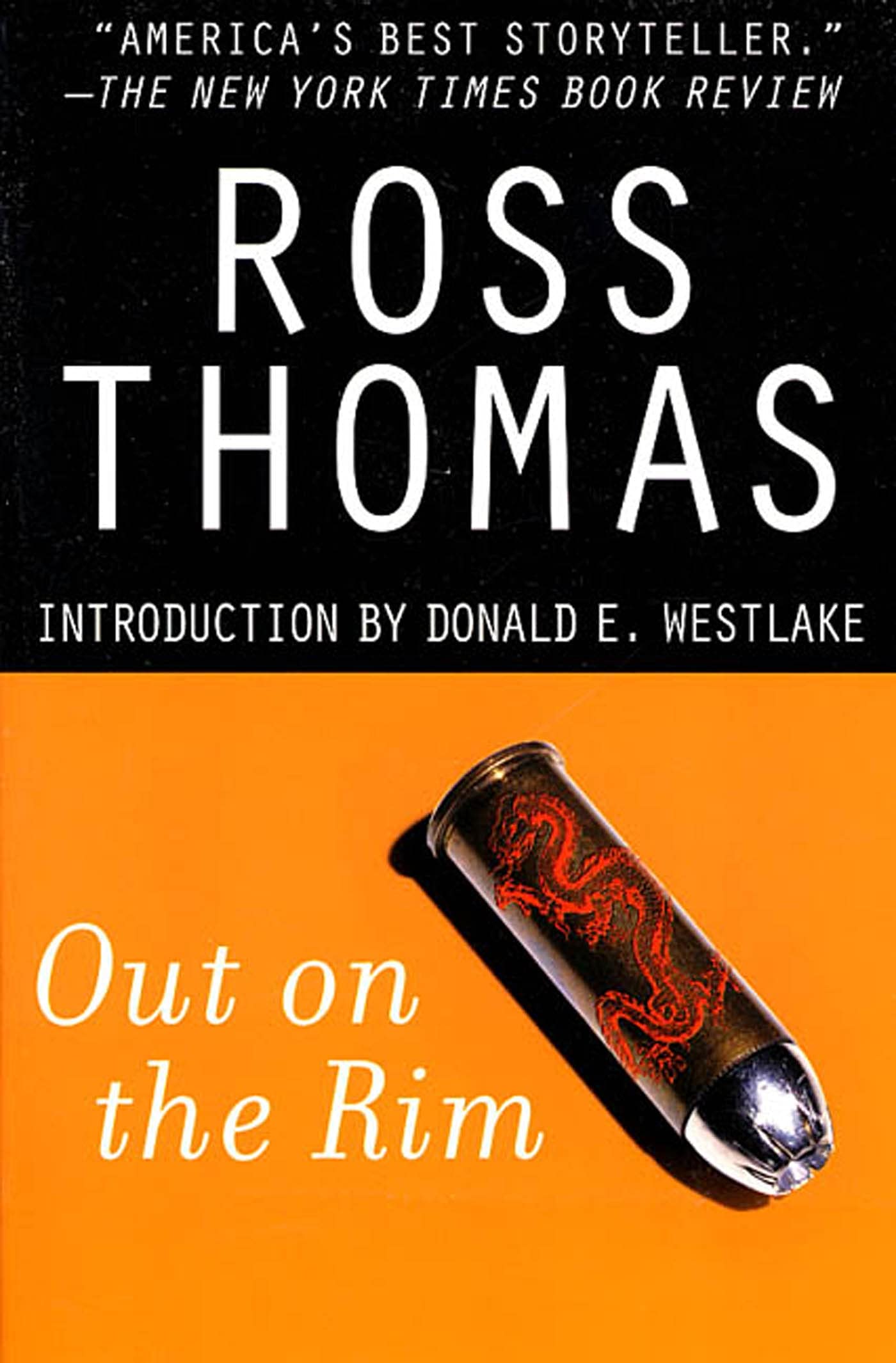



Would you be wary if someone gave you the assignment of delivering five million dollars to a Philippine terrorist―never mind from whom or why? Booth Stallings, a terrorism expert just fired from his job at a bashful organization that never admitted its mount in the Washington merry-go-round, is wary. So wary that he cuts in con man "Otherguy" Overby, who in turn involves Artie Wu, pretender to the throne of China, and his partner, Quincy Durant. Obviously, good patriots don't want to hand over all that money to bad guys. Better they keep it for themselves. Which inevitably raises the question: Who among them will end up with the money? “America's best storyteller.” ― The New York Times Book Review “Fuse the dark humor of Evelyn Waugh with the knack for chicanery and suspense of a Graham Greene entertainment and you'll get a pretty good idea of what Thomas is up to.” ― Newsweek ROSS THOMAS is the author of over twenty-five critically acclaimed novels. His debut, The Cold War Swap , was written in under six weeks and won an Edgar Award for Best First Novel, and Briarpatch won an Edgar Award for Best Novel. He's also written under the name Oliver Bleeck. Thomas died in 1995 at the age of 69 in Santa Monica, California. Donald E. Westlake has written numerous novels during the past 40 years, under his own name and various pseudonyms--most famously Richard Stark. He is generally regarded as the greatest writer of comic mystery of all time. Many of his books have been made into movies, including The Hunter which was filmed first as the noir classic with Lee Marvin and Angie Dickinson, and then as Payback starring Mel Gibson. He has won three Edgar Allan Poe Awards, and has been named a Grand Master by the Mystery Writers of America. Out on the Rim By Ross Thomas Minotaur Books Copyright © 2003 Ross Thomas All right reserved. ISBN: 9780312290597 Out on the Rim CHAPTER 1 At three in the afternoon they summoned Booth Stallings, the terrorism expert, to the library in the foundation’s seven-story building just east of Dupont Circle on Massachusetts Avenue and fired him over a glass of fairly good Spanish sherry. It was the Ides of March, which fell on a Saturday in 1986, and exactly two months after Booth Stallings’ sixtieth birthday.The firing was done without any qualms that Stallings could detect by Douglas House, the foundation thirty-five-year-old executive director. House did it politely, of course, with no trace of acrimony, and with about the same amount of regret he might use if calling the Washington Post circulation department to put a vacation stop on his home delivery.It was the foundation’s fifty one-year old chairman, Frank Tomguy, who administered the pro forma ego massage while wearing an apologetic, even deferential air and one of his $1,100 three-piece suits. Tomguy went on and on about severe budgetary restrictions and then turned to the quality of Booth Stallings’ work, which he swore had been brilliant. No question. Absolutely, totally brilliant.Tomguy’s massage completed, Douglas House spoke of money. There would be three months’ severance pay in lieu of notice and the foundation would keep Stallings’ health insurance in force for six months. There was no talk of pension because the terrorism expert had been with the foundation only eighteen months, although that was three months longer than he had ever stuck with any other job.As the dry talk continued, Stallings lost interest and let his eyes wander around the black walnut paneled library, presumably for the last time. He eventually noticed the lengthening silence. Now that they’ve canned you so nicely and apologized so handsomely, you’re expected to say something appropriate. So he said the only thing that came to mind. “I used to live here, you know.”It wasn’t what Douglas House had expected and he shifted uneasily in his leather wingback chair, as if apprehensive that Stallings had launched into some kind of sentimental, even mawkish goodbye. But Tomguy, the chairman, seemed to know better. He smiled and asked the obvious question. “Where’s here, Booth?”“Right here,” Stallings said with a small encompassing gesture. “Before the foundation built this place in what? seventy two?—there used to be a big old four-story red sandstone mansion that got cut up into apartments during the war.” He glanced at Douglas House. “World War II.” House nodded.“I rented the third floor one in February of sixty-one,” Stallings, went on. “Partly because I could walk to work and partly because of the address — 1776 Massachusetts Avenue.” His lips stretched into what may or may not have been a small smile. “A patriot’s address.”Tomguy cleared his throat. “That walk was to the White House then, wasn’t it, Booth? And you were back from Africa or some such.”“I was just back from Stanleyville and the walk was to the old Executive Office Building, which wasn’t the White House then and still isn’t.”“Heady times, those,” Douglas