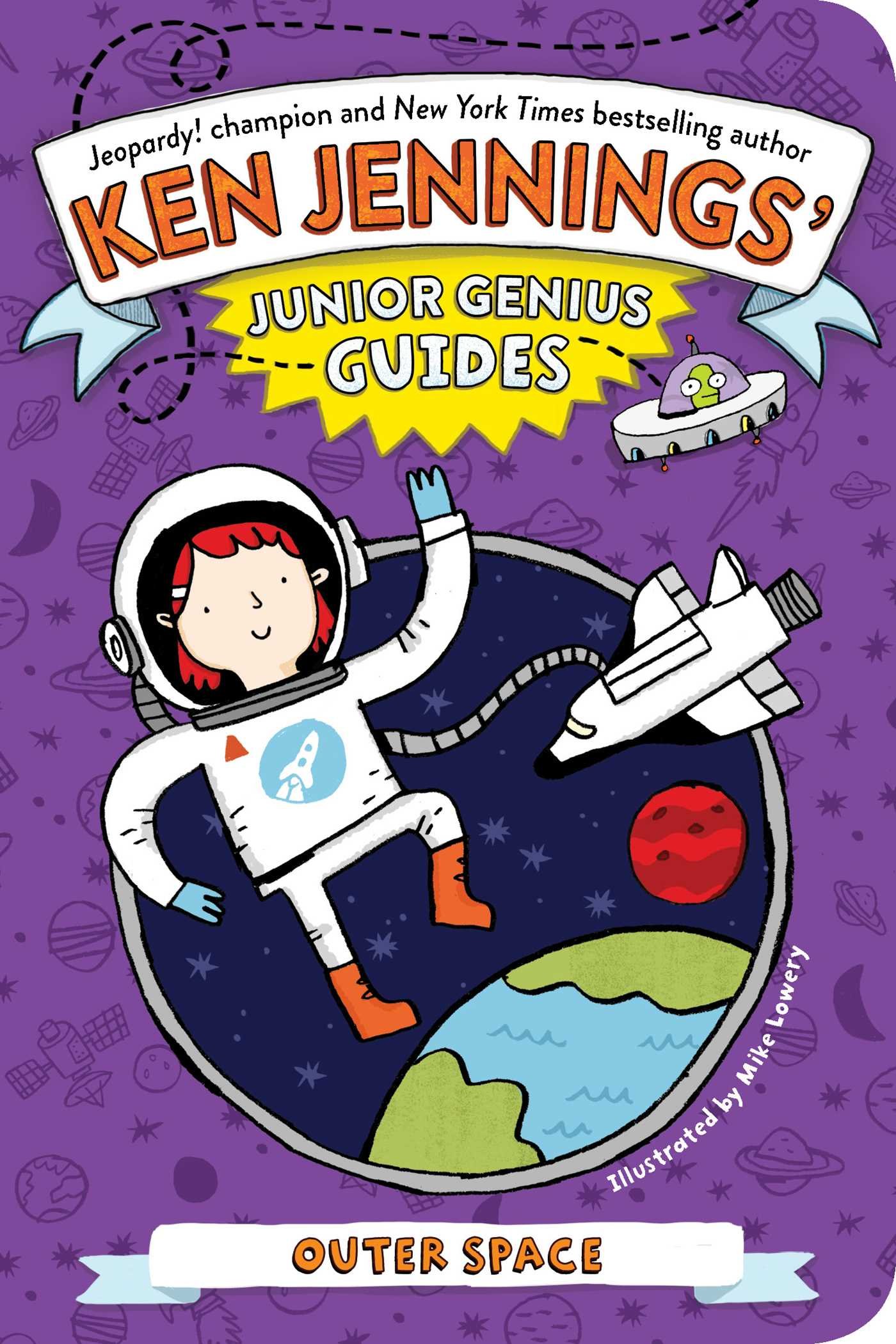



Let your inner astronaut explore outer space with this interactive trivia book from Jeopardy! champ and New York Times bestselling author Ken Jennings. With this book about space you’ll become an expert and wow your friends and teachers with out-of-this-world facts: Did you know that Mars has a volcano bigger than the state of Arizona? Or that there’s a star with a diamond the size of our moon at its core? With great illustrations, cool trivia, and fun quizzes to test your knowledge, this guide will have you on your way to whiz-kid status in no time! Ken Jennings is the New York Times bestselling author of Brainiac , Maphead , Because I Said So! , Planet Funny , and 100 Places to See After You Die . In 2020, he won the “Greatest of All Time” title on the quiz show Jeopardy! and later succeeded Alex Trebek as the show’s host. He lives in Seattle with his family. Mike Lowery is an author and bestselling illustrator who has worked on more than eighty books for children, including the Mac B., Kid Spy series with Mac Barnett, They Call Me No Sam! with Drew Daywalt, and more. He is also the creator of the Everything Awesome and Bug Scouts books. He lives in Decatur, Georgia, with his wife and kids, and his daily sketchbook can be seen at MikeLowery.com. Outer Space Our Mr. Sun Have you ever complained about the Sun, Junior Geniuses? “It’s too hot today!” “Ugh, that’s bright.” “No more sunscreen, Mom!” Well, after today’s lesson, I never want to hear you bad-mouth the Sun again! The only reason that life can exist on Earth at all, everything from figs to walruses to TV repairmen, is because of the light and warmth we get from our nearest star. This is the Sun. Wait, that’s not right. Why would the Sun need to wear sunglasses? Think about it; how would that help? Let’s try that again. No Crayons Allowed Please don’t color this drawing with a yellow crayon, Junior Geniuses. Not only would that deface this fine book, it would also be scientifically inaccurate! Sunlight only looks yellow to us because we’re seeing it through our atmosphere. From space the Sun is perfectly white! When you look at the Sun—wait, hold on. Public service announcement: The light is so intense it can literally cook the retinas in your eyes. To observe the Sun, glance and then look away. Don’t stare. There are health faddists called “sungazers” who claim they get all their nutrition from staring at the Sun a few minutes a day. But that really doesn’t work, so please don’t try this. Okay. When you briefly glance at the Sun, you’re actually looking back in time! Sunlight travels at the speed of light, which means it takes an average of eight minutes and twenty seconds for it to reach the Earth. So the Sun outside your window isn’t actually where you think it is. By the time you see it, the real Sun has moved forward two Sun-diameters in the sky. But we’re going to travel back in time even further: not eight and a half minutes but 4.5 billion years! That’s when the story of our solar system begins. A Star Is Born Over 4 billion years ago a nebula—a gigantic space-cloud of gas—collapsed on itself, possibly due to the shock wave from a nearby exploding star. As it shrank, the whirling cloud began to spin faster and faster and grow hotter and hotter. It flattened into a big pizza-shaped thing called a protoplanetary disk, and soon thereafter (just 50 million years—that’s “soon” in cosmic terms!) the middle of the disk got hot enough to light its nuclear furnace. The Sun was born! A lot of the leftover dust and gas spinning around the new baby Sun began to clump together, which is how planets form. But these weren’t the planets we know today! There were probably hundreds of little planets zooming around and smashing into each other, until they merged into bigger ones. Others collided at such high speeds (due to the immense gravity of big planets like Jupiter and Saturn) that they shattered into tiny chunks called asteroids. Today, just eight main planets survive, most of which we’ve named for different gods of Roman mythology. Pop Quiz! Since classical times, we’ve used special symbols to refer to the planets and most refer to mythology. The Venus symbol, , looks like a mirror, because she was the goddess of beauty. Mars looks like a spear and shield, , because he was the god of war. What is the Neptune symbol, , supposed to be? Spaceballs But that diagram isn’t quite accurate, because the solar system is much, much bigger than we can draw in a book. The Sun is massively bigger than everything else, for one thing. It accounts for 99.8 percent of the mass of the solar system! (Jupiter is most of the rest.) The distances between planets are even harder to imagine. Let’s pretend that a superpowerful alien has somehow shrunk the eight planets of our solar system to fit inside a baseball stadium. (This alien is apparently a big baseball fan.) The solar sy