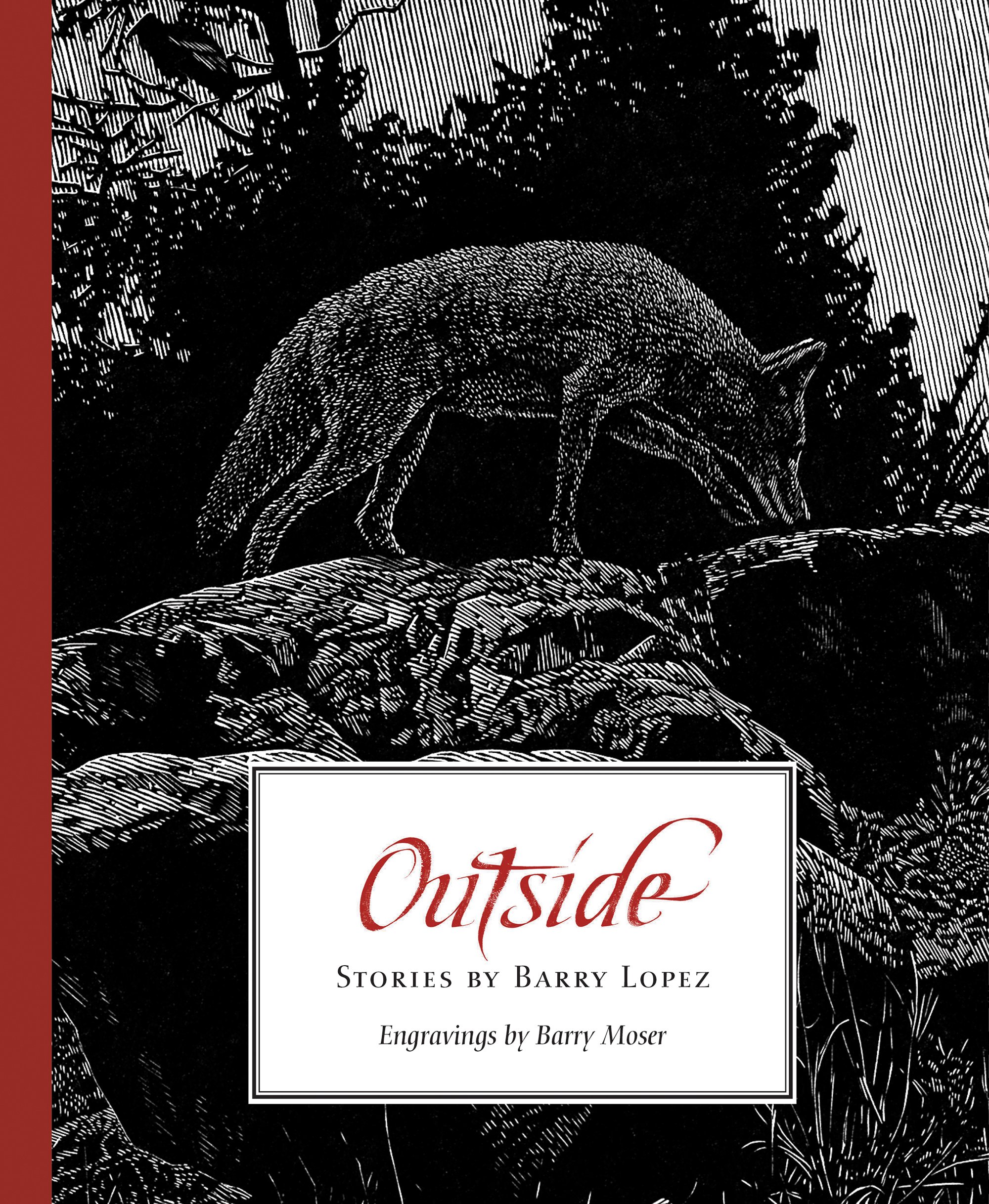



The six stories in Outside showcase Barry Lopez’s majestic talent as a fiction writer. Lopez writes in spare prose, but his narratives resonate with an uncanny power. With a reverence for our exterior and interior landscapes, these stories offer profound insight into the relationships between humans and animals, creativity and beauty, and, ultimately, life and death. Again and again, whether describing a Navajo rug possessing the essence of its maker, a boy who can change places with his half-coyote dog (named Leaves), or a teacher whose presence brings into question the meaning of friendship, Lopez portrays elemental and sacred places. His prose transcends its simplicity to enter spaces of wonder and mystery. As James Perrin Warren says in his compelling introduction, Lopez’s narrators bear witness to extraordinary patterns and purposes . . . The storyteller is vital to the community and to a healthy landscape, but the vital relationship is also reciprocal. . . . We participate, along with Lopez, in the long history of storytelling. We become part of the atmosphere in which wisdom shows itself.” "A stunning volume to be savored in a quiet, reflective mood." ― Kirkus Reviews "Lush and suggestive myths." ― Oregon Humanities "Lopez’s prose is expansive and spacious but grounded in the specific details of nature... eschews literary expectations in favor of ambiance and a deep sense of mystery, of meaning that lingers at the edges of our normal perceptions." ― Cascadia Weekly “[Barry Lopez is] a powerful storyteller.” ― Margaret Atwood “[Barry Lopez] leaves all the right things unsaid, and the silence resonates.” ― Time “[Barry Lopez] succeeds in awakening our fleeting yearning and hidden feelings.” ― Denver Post “[Barry Lopez] has magic in his words.” ― Minneapolis Star-Tribune Barry Lopez was an essayist, author, and short-story writer who traveled extensively in both remote and populated parts of the world. He is the author of Arctic Dreams , which received the National Book Award; Horizon , Of Wolves and Men , Home Ground: A Guide to the American Landscape ; and eight works of fiction, including Outside , Light Action in the Caribbean , Field Notes , and Resistance . He is the author of S yntax of the River: The Pattern Which Connects with Julia Martin. His essays are collected in two books, Crossing Open Ground and About This Life . Lopez lived in western Oregon. Barry Moser is an illustrator, printer, painter, printmaker, designer, author, essayist, and teacher. He was born in Chattanooga, Tennessee in 1940. He was educated at a military academy there, the Baylor School, then at Auburn University and the University of Tennessee at Chattanooga. He did graduate work at the University of Massachusetts at Amherst in 1970. He studied with George Cress, Leonard Baskin, Fred Becker, and Jack Coughlin. His work is represented in numerous collections, museums, and libraries in the United States and abroad, including the National Gallery of Art, the Metropolitan Museum, the British Museum, the Library of Congress, the National Library of Australia, the London College of Printing, the Pierpont Morgan Library, the Vatican Library, Harvard University, Yale University, Dartmouth College, Cambridge University, the Israel Museum, and Princeton University. The books Moser has illustrated and/or designed form a list of over 300 titles including Arion Press' Moby-Dick and the University of California Press' The Divine Comedy of Dante , and Lewis Carroll's Alice's Adventures in Wonderland . James Perrin Warren is the S. Blount Mason, Jr. Professor of English at Washington and Lee University in Lexington, VA. Warren specializes in 19th century literature and culture as well as literature of the environment. He is a member of the Environmental Studies faculty. A graduate of Auburn University, he received the Ph.D. from Yale. He is the author of John Burroughs and the Place of Nature (University of Georgia Press, 2006) and The Culture of Eloquence (Pennsylvania State University Press, 1999). "The Search for the Heron" (one of six stories in Outside I see you on the far side of the river, standing at the edge of familiar shadows, before a terrified chorus of young alders on the bank. I do not think you know it is raining. You are oblivious to the thuck of drops rolling off the rube of your neck and the slope of your back. (Above, in the sweepy cedars, drops pool at the tips of leather needles, break away, are sheered by the breeze and, thuck, hit the hollow-boned, crimson-colored shoulders of the bird and fall swooning into the river.) Perhaps you know it is raining. The intensity of your stare is then not oblivion, only an effort to spot between the rain splashes in the river (past your feet, so well-known, there beneath the hammered surface, like twigs in the pebbles) the movement of a trout. I know: your way is to be inscrutable. When pressed you leave. This is no more une