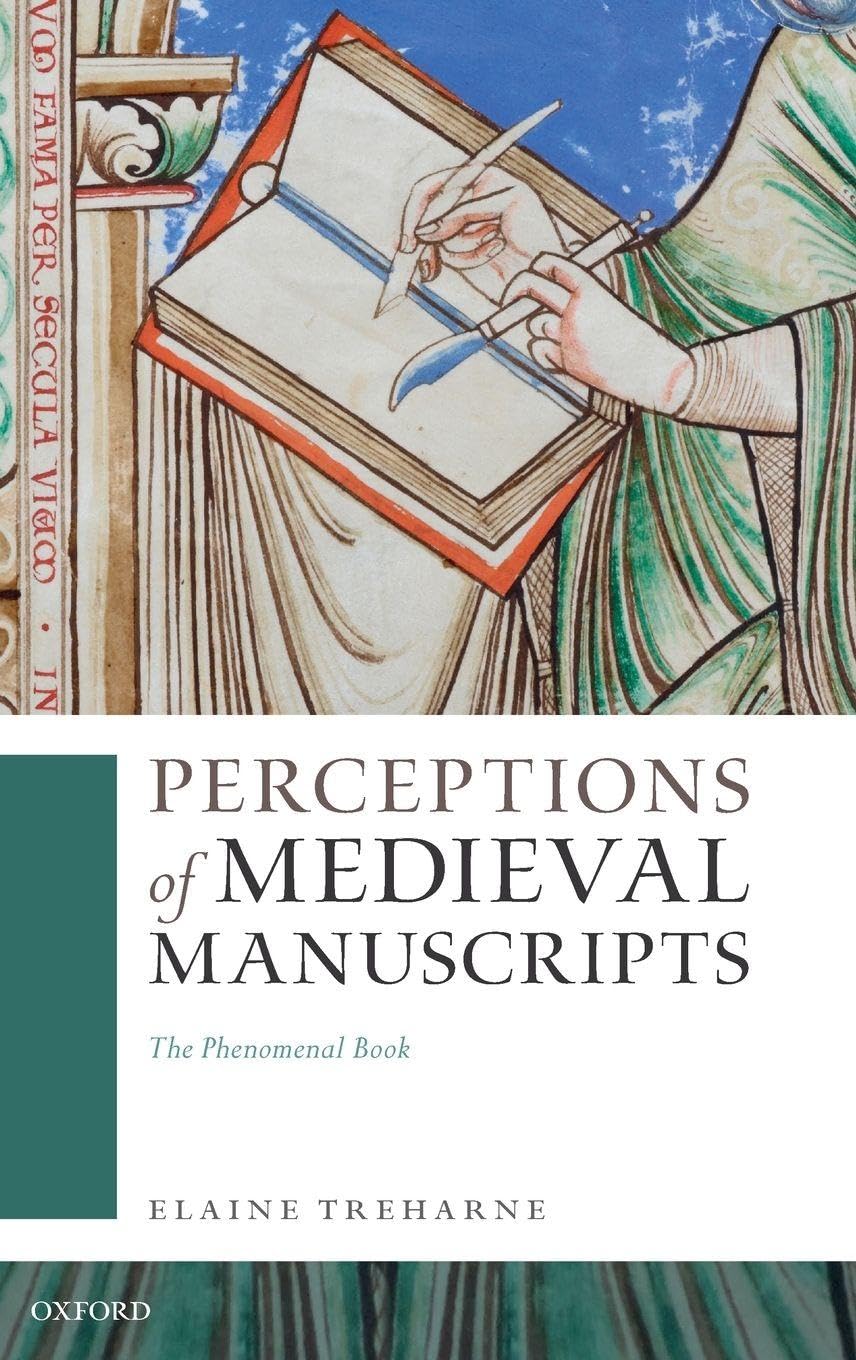



Perceptions of Medieval Manuscripts takes as its starting point an understanding that a medieval book is a whole object at every point of its long history. As such, medieval books can be studied most profitably in a holistic manner as objects-in-the-world. This means readers might profitably account for all aspects of the manuscript in their observations, from the main texts that dominate the codex to the marginal notes, glosses, names, and interventions made through time. This holistic approach allows us to tell the story of the book's life from the moment of its production to its use, collection, breaking-up, and digitization--all aspects of what can be termed 'dynamic architextuality'. The ten chapters include detailed readings of texts that explain the processes of manuscript manufacture and writing, taking in invisible components of the book that show the joy and delight clearly felt by producers and consumers. Chapters investigate the filling of manuscripts' blank spaces, presenting some texts never examined before, and assessing how books were conceived and understood to function. Manuscripts' heft and solidness can be seen, too, in the depictions of miniature books in medieval illustrations. Early manuscripts thus become archives and witnesses to individual and collective memories, best read as 'relics of existence', as Maurice Merleau-Ponty describes things. As such, it is urgent that practices fragmenting the manuscript through book-breaking or digital display are understood in the context of the book's wholeness. Readers of this study will find chapters on multiple aspects of medieval bookness in the distant past, the present, and in the assurance of the future continuity of this most fascinating of cultural artefacts. "Treharne offers a useful...introduction to the manuscript book as object." -- T. M. Izbicki, CHOICE "Like the rest of Treharne's trenchant and feeling work on manuscripts, this book is not to be ignored, but rather, as she suggests for medieval codices, held in close contact,imagined in a community of voices past and present, and allowed to speak for itself in all its multiplicity." -- Rachel A. Wilson, Medieval Studies, Yale University, Comitatus "...conclusion issues a vital plea not simply for thick description of and detailed metadata on these digital objects but also-critically-for expert engagement with the public in articulating the perspective on manuscripts that these digitized objects present." -- Sonja Drimmer, Manuscript Studies "Elaine Treharne shows her unparalleled expertise in manuscript research, early textuality and other related areas in Perceptions of Medieval Manuscripts . The volume's wide ambit testifies to it being the product of long reflection and work...it is an outstanding and welcome contribution to the ample field of Medieval Studies and will be of interest not only to scholars and students but also to general readers, who may feel curious to peruse inspiring academic books like the one reviewed here." -- Laura Esteban-Segura, University of Málaga, Journal of the Spanish Society for Medieval English Language and Literature "Irrespective of whether or not it achieves the ambitious program proposed in the introduction, what it does so meticulously, and with authority, will not soon be surpassed." -- Stephen G. Nichols, Speculum: A Journal of Medieval Studies " Perceptions of Medieval Manuscripts , or to its engaging commentary on a fascinating array of manuscripts. Irrespective of whether or not it achieves the ambitious program proposed in the introduction, what it does so meticulously, and with authority, will not soon be surpassed." -- Stephen G. Nichols, Speculum 99/4 " Perceptions of Medieval Manuscripts explores thehuman experience as an integral part of the historyand identity of a book." -- E. Hauwaerts, Scriptorium "How does the manuscript present itself to its sponsors, to the artisans who make it, to its readers, to its users, to its conservators, to its destroyers, and how do they represent it to themselves? To similar questions, and to a multitude of other related questions, the author provides detailed, enlightening and sometimes surprising answers, supported by the study of Anglo-Saxon manuscripts." -- Antoine Brix, Le Moyen Âge Elaine Treharne, Roberta Bowman Denning Professor of Humanities and Professor of English, Stanford University Elaine Treharne is Roberta Bowman Denning Professor of Humanities, Professor of English, and Robert K. Packard University Fellow in Undergraduate Education at Stanford University. She is a medieval literature and manuscript specialist, with expertise in the long history of human communication and archival studies. She has published over thirty books and sixty articles, mostly focused on Old and Middle English texts in their manuscript contexts, and also on the digital aspect of early textuality. She is interested in the record of human experience: how it is transmitted, who is reme