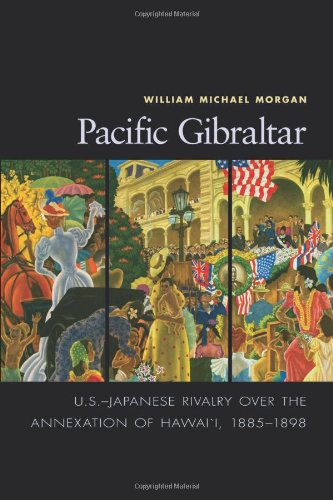
Pacific Gibraltar: U.S.-Japanese Rivalry Over the Annexation of Hawaii, 1885-1898
$28.47
by William Michael Morgan



Based a sweeping re-evaluation of new and existing sources in three countries, Pacific Gibraltar is the first detailed account in a generation of Hawaiian annexation, the initial episode of U.S. overseas imperialism. The book clarifies murky episodes in the story of annexation, such as U.S.S. Boston's mysterious return to Honolulu just in time to land troops during the Hawaiian Revolution, President Cleveland's failed attempt to restore Queen Lili'uokalani, and the growing threat to the white rebel government from burgeoning Japanese immigration. Though the U.S. annexed Hawai'i during the Spanish-American War of 1898, Hawaii was not a war spoil like the Philippines. Rather annexation was an old idea. It emerged not only from ideological and economic motives but above all from a quarter century of maturing appreciation for Hawaii's importance to defense of the west coast. When Tokyo's push to secure voting rights for its nationals scared the white oligarchy into restricting the inflow of Japanese, triggering a nasty dispute between the two countries in early 1897, the U.S. rushed to protect the strategic isles. When Japan deployed warships to Honolulu and formally opposed annexation, even before the McKinley administration endorsed it, the U.S. completed the first war plans against Japan and authorized the Navy to use force against Japanese landing parties. The Japan-U.S. crisis of 1897 put annexation on the front burner and created the votes that would pass a joint resolution of annexation the following year. This is a splendid study of the turning of Hawai`i into a U.S. stronghold in the Pacific. The interplay between the local scene what transpired in Honolulu among Hawaiians, Americans, Japanese, and others and the global picture trans-Pacific migrations, naval technology, and geopolitical interactions among the United States, Britain, Japan, and other powers is skillfully narrated, making the book the most comprehensive study to date of the emergence of Pearl Harbor as the Gibraltar of the Pacific. ----AKIRA IRIYE, Professor Emeritus, Harvard University, author of Pacific Estrangement: Japanese and American Expansion, 1897 1911 Based on highly impressive research, William Morgan has written a lucid narrative in which he carefully examines the main actors and key events, offers pointed judgments on all disputed interpretations, and makes a persuasive case for the primacy of strategic and technological considerations in the U.S. decision to annex the Hawaiian Islands. ----JOSEPH A. FRY, Distinguished Professor of History, University of Nevada Las Vegas, author of Dixie Looks Abroad: The South and U.S. Foreign Relations, 1789 1973 As Morgan deftly illustrates, Hawai`i is more than just a tropical paradise, it is the Pacific Ocean's most vital strategic location, which America and Japan tussled over long before Pearl Harbor. Just as important a story was the interaction between Hawaiian domestic politics and globalization, a dynamic we still wrestle with today. ----MICHAEL AUSLIN, author of Pacific Cosmopolitans: A Cultural History of U.S.-Japan Relations William Michael Morgan is Professor of Strategic Studies and Director of the Regional Studies Program at the Marine Corps War College. Before joining the Foreign Service of the Department of State, where he worked over thirty years, he served in the Marine Corps and then earned a PhD in history from the Claremont Graduate University Used Book in Good Condition