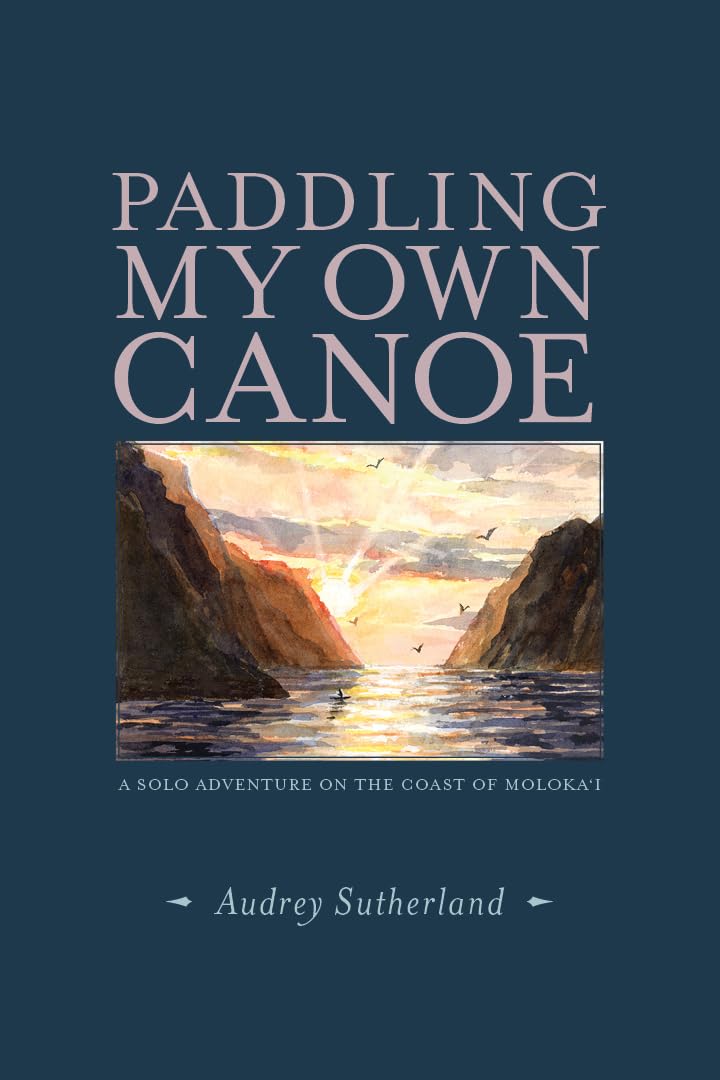
Paddling My Own Canoe: A Solo Adventure On the Coast of Molokai
$15.76
by Audrey Sutherland



Go Simple, Go Solo, Go Now In 1958, while flying from one island to another, Audrey Sutherland sees the remote and roadless northeast side of Molokai, with its spectacular sea cliffs and waterfalls. Always an adventurer, she decides that she must find a way to explore this then inaccessible area. After much study, she determines that the best way for her to navigate these treacherous sea walls is to swim while towing an inflatable kayak. This is the story of fulfilling her dream, of planning then implementing, of launching and advancing, of retreating and reconnoitering, of challenge and success. This is the story of the trip that convinced her that personal growth comes when one goes simple, goes solo, goes now. For mainlanders, a pleasant, friendly introduction to lush new scenery and a one-of-a-kind sensibility. -- Kirkus ― Kirkus The importance of this book lies in its narrative of one woman's drive to test her limits against unforgiving elements, and in the insight she gained (and shares) about herself and human nature. -- The Houston Post ― The Houston Post The most isolated and spectacular seacoast in Hawaii is on the northeast side of Molokai. . . . Audrey Sutherland set out alone . . . . Her account is first-rate adventure . . . For the armchair traveler as well as the adventurer. -- Publishers Weekly review of the first edition ― Publishers Weekly This is a splendid adventure story -- proof that the thrills of surging seas, dangerous cliffs, unknown terrain and isolation can be found in Hawaii. -- Honolulu Star Bulletin ― Honolulu Star Bulletin More than adventure, it's a human being's joyous response to, and interaction with, the forces of nature. -- Honolulu Advertiser ― Honolulu Advertiser Equal parts self-help book, environmental tract, and a reflection on one’s mortality, this book is beautifully written and an inspiration to find one’s own adventures, be they solo or with trusted partners. -- MidwestBasecamp.com It is a book that makes any traveller yearn for solitude in the wilderness and displays the beauties of going solo . -- Readers Digest UK “Audrey’s summer adventures on the north coast of Molokai, swimming, paddling, and hiking solo, continue to influence the next generations to explore outer-island, off-the-grid travel. She went simply for five decades, inspiring others to do likewise.” – Dale Hope, author of The Aloha Shirt Patagonia Audrey Sutherland grew up in California but lived in Hawai'i from 1952 until her death in 2015 at the age of 94. She raised her four children as a single mother, supporting her family by working as a school counselor. In 1962, she decided to explore the coast of Moloka'i by swimming it while towing an inflatable raft with supplies, a story told in Paddling My Own Canoe (Patagonia, 2018). Ever after she was an inveterate water traveler. She was also the author of Paddling Hawai'i . Yoshiko Yamamoto is one of the premier block printers in the Arts and Crafts style. Yamamoto's block prints are letterpress printed using hand cut blocks on acid free paper. She is the co-owner of The Arts and Crafts Press, and co-author of several books about the arts and crafts movement, published by Gibbs Smith and Chronicle. Hula'ana , in the Hawaiian language, is a place where it is necessary to swim past a cliff that blocks a passage along a coast, a sheer cliff where the sea beats. I first glimpsed the sea cliffs and waterfalls of Molokai while flying by, en route to other islands in the Hawaiian chain. There were no roads, no trails, no people, no access except by sea. Looking down on it was not enough. I wanted to be there, but i couldn't afford to hire a boat. All right, I'd have to swim. The plane window framed the head wall of one small bay, a single, though sand-foot face fro the peak to the scree at the shore. Down on corner a narrow cascade ether a white line on the gray, lichened rock, and at its base grew a jungle of pandanus trees. Along the sides of the bay the ridged arms reached out to enfold it like the paws of a giant sphinx. Under water, eroded pockets and caves tunneled through the basalt. The shallows and the depths were evident in patterns of pale jade and deep cobalt. Beyond that bay the cliffs rose even higher. The plane was flying at three thousand feet, but the top of the wall beside us disappeared into the mists above. We crossed a headland and flew low over a serrated plateau. Its top was suddenly sliced open and the gashed green walls fell aside. At the head of the cleft was another cascade, a thick foaming shaft that plunged over the brink and down to a dark pool, then twisted out to sea. Was it possible to swim around the cliffs towing a floating pack, and to come ashore for camping in the valleys? I wondered, and searched the meager reference material. The Atlas of Hawaii , since published, explains the coast very simply: "The sea cliff on the north side of East Moloka'i, one of the highest in the world