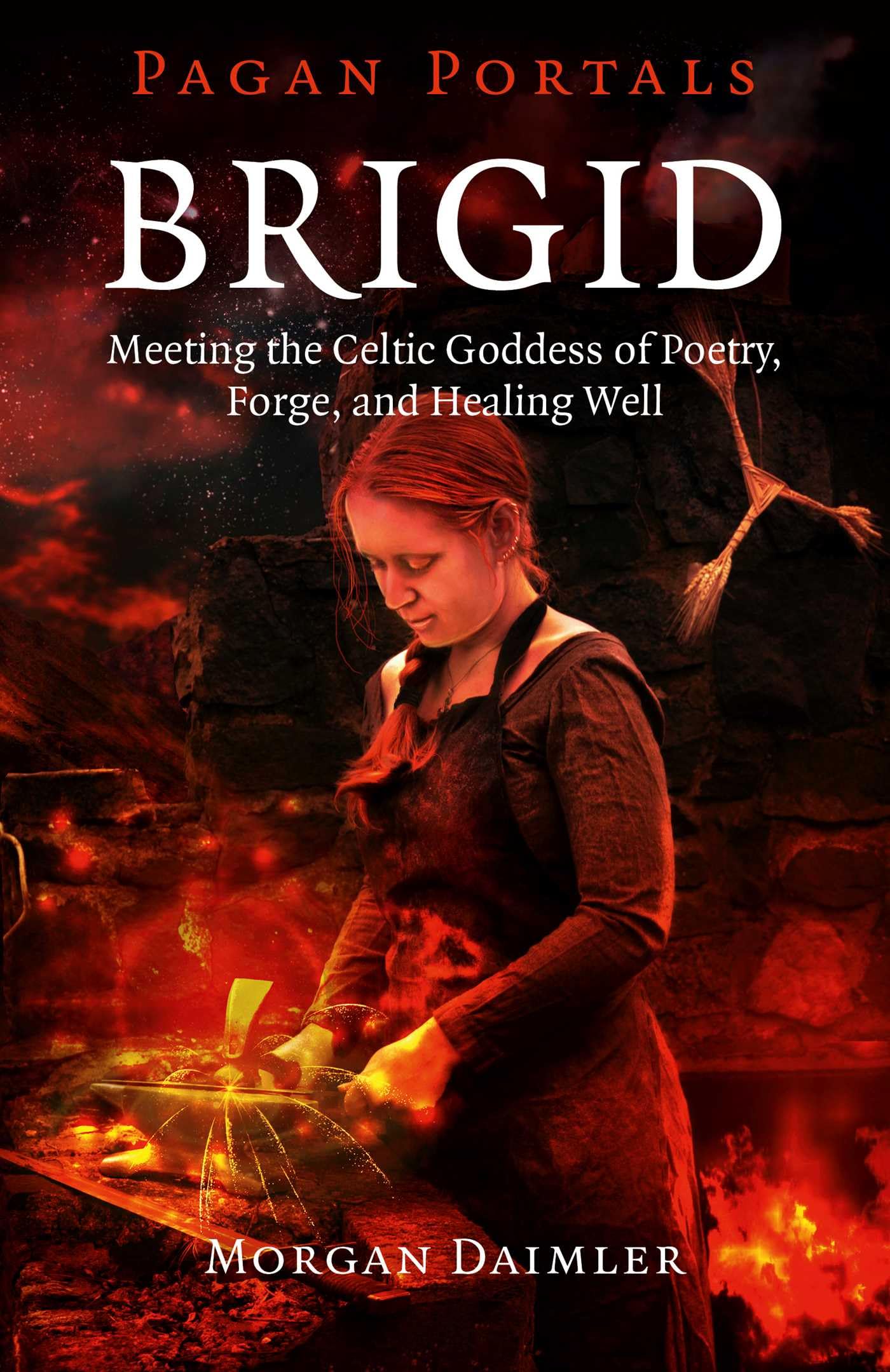
Pagan Portals - Brigid: Meeting The Celtic Goddess Of Poetry, Forge, And Healing Well
$12.95
by Morgan Daimler Author Of Irish Paganism



Pagan Portals - Brigid is a basic introduction to the Goddess Brigid focusing on her history and myth as well as her modern devotion and worship. Primarily looking at the Irish Goddess but including a discussion of her Pan-Celtic appearances, particularly in Scotland. Her different appearances in mythology are discussed along with the conflation of the pagan Goddess with Catholic saint. Modern methods for neopagans to connect to and honor this popular Goddess include offerings and meditation, and personal anecdotes from the author's experiences are included as well. Who was Brigid to the pre-Christian pagans? Who is she today to neopagans? How do we re-weave the threads of the old pagan Goddess and the new? Learn about Brigid's myths among the pagan Irish, the stories of Bride in Scotland, and the way that people today are finding and honoring this powerful and important deity to find the answer. Morgan is a blogger, poet, teacher of esoteric subjects, witch, Druid, dedicant of Macha, and wandering priest/ess of Odin. Located in Connecticut, USA. Pagan Portals Brigid Meeting the Celtic Goddess of Poetry, Forge, and Healing Well By Morgan Daimler John Hunt Publishing Ltd. Copyright © 2015 Morgan Daimler All rights reserved. ISBN: 978-1-78535-320-8 Contents Acknowledgements, Author's Note, Introduction, Chapter One: Meeting Brigid, Chapter Two: Brigid by Other Names, Chapter Three: Brigid in Mythology, Chapter Four: Symbols, Animals, and Holidays, Chapter Five: The Goddess in Modern Times, Chapter Six: Prayers, Chants and Charms, Conclusion, Appendix A: Pronunciation, Appendix B: Mixed Media Resources, Bibliography, Endnotes, CHAPTER 1 Meeting Brigid Trí aithgine in domain: brú mná, uth bó, ness gobann. Traditional Irish Triad Three regenerators of the world: a woman's womb, a cow's udder, a smith's furnace. (Translation, M. Daimler) One of the most popular Irish Goddesses in modern times is Brigid, known as both a pagan Goddess and for her associations with the later Catholic saint of the same name. A pan-Celtic Goddess, Brigid is found across a variety of Celtic cultures; in Ireland (in Irish) she is Bríd, or Brighid, which has been Anglicized to Bridgid or Bridgit; In Scotland she is Bride and in Wales she is Ffraid. In Old Irish her name was Brig or Bric, in Middle Irish she was Brigit, while in Celtic Britain she was Brigantia, and in Gaul she was Brigandu. In Ireland Brigid was a deity of healing, poetry and smithcraft, sometimes seen as a single deity and sometimes as three sister deities. As three sisters, they were: Brigid of the Poets, Brigid of the Forge, and Brigid the Healer. It is very difficult, however, to sort out which Brigid of the three was the one indicated in most of the stories or references to her. Many people simply treat her as a single Goddess, although this may be oversimplifying. For a modern polytheist who wants to honor all three Brigids, logical choices must be made about which Brigid would have most fit each story or attribution; that said Brigid here will be discussed as a single Goddess, with the understanding that any one of the three could likely be referred to. Additionally there are several other Irish Brigids: Brig Ambue (Brigid of the Cowless), Brig Brethach (Brigid of the Judgments), and Brig Brigiu (Brigid the Hospitaller). These three may be later interpretations of the previous three — and indeed Irish scholar Kim McCone describes them as such — or they may be different Goddesses, or perhaps even different aspects of a single Brigid. It is up to the reader to decide for themselves what view makes the most sense, but information about all of the named Brigids will be given below. Relationships Finding anything clear cut in Irish myth is difficult and this is true of trying to sort out Brigid's genealogy. Brigid's mother is not listed, and in the material we have she is simply called the daughter of the Dagda, or daughters of the Dagda since she also appears as three identically named siblings. Brigid is sometimes conflated with Danu, and less often with the Morrigan, because of instances in the Lebor Gabala Erenn where each is said to be the mother to the same set of three sons by the same father. It is impossible to know with certainty if this is so, or only a medieval attempt to reconcile the pagan mythology into a more cohesive system, and so some people accept it and some people don't. However, it is worth noting that Danu and the Morrigan have a different father than Brigid does, a fact which is mentioned repeatedly, making it unlikely in my opinion that they actually are the same being. In mythology she was married to the half-Fomorian, half-Tuatha Dé Danann Eochaid Bres and bore him a son Ruadán. In some stories she also had three sons with Tuireann named Brian, Iachar, and Iucharba although this may result from confusion between her and Danu/Danand who is listed as the mother of these three sons elsewhere.