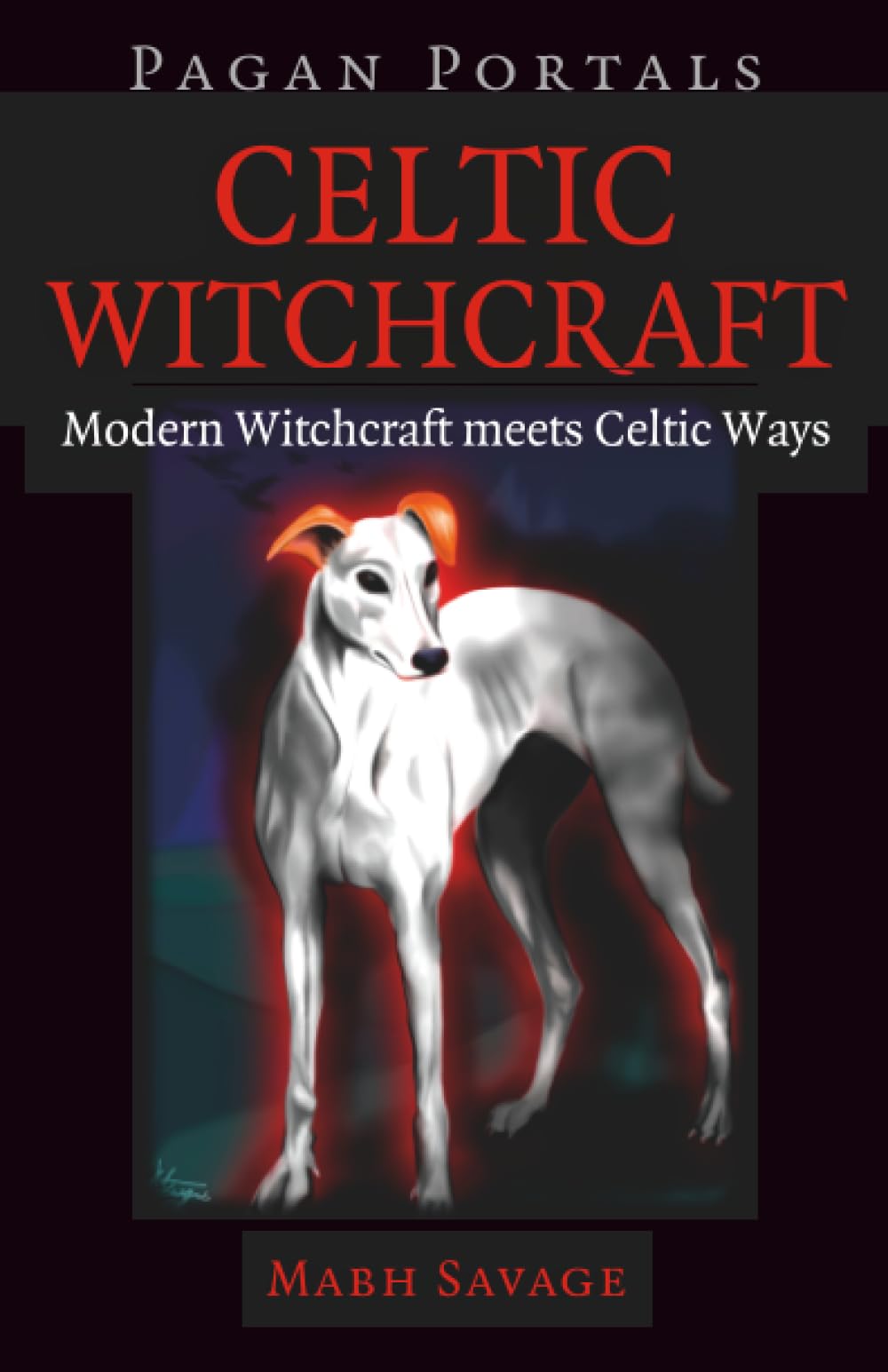
Pagan Portals - Celtic Witchcraft: Modern Witchcraft Meets Celtic Ways
$12.95
by Mabh Savage



Learn how Celtic legend and mythology can bring magic into your daily life. Walk with the Tuatha Dé Danann and hear their wisdom on the wind. See colour as a doorway to a magical world. Speak to animals and become one with the turn of the seasons. Including practical exercises that can be performed by witches of all abilities, this book will teach you how your Celtic forebears are still alive, in the sorcery and skill of the magical practitioner Mabh Savage lives in Yorkshire, England, and was raised by Wiccan parents who had a passion for Celtic history, both mythological and actual. She is now involved with several pagan groups and is exploring her heritage as a way to get closer to the world around her, and understand her ancestors more. Celtic Witchcraft Modern Witchcraft Meets Celtic Ways By Mabh Savage John Hunt Publishing Ltd. Copyright © 2015 Mabh Savage All rights reserved. ISBN: 978-1-78535-314-7 Contents Introduction and Acknowledgements, Chapter One: A Witch on a Celtic Path, Chapter Two: Stepping Stones, Chapter Three: Stopping the Clock, Losing the Calendar, Chapter Four: Colour me Red (and Black and White ...), Chapter Five: An Elemental Thing ..., Chapter 6: Wild Spirit, Chapter 7: Between Cauldron and Club, Chapter 8: Splendid Poison, Chapter 9: Highway under the Hills, CHAPTER 1 A Witch on a Celtic Path Celtic Triad: Three things to be avoided by the Wise: expecting the impossible, grieving over the irretrievable, fearing the inevitable. Witchcraft is often described as a new age religion, especially with the emergence of Wicca, the religious practice strongly associated with modern witchcraft, in the 20th century. However, you only need to look as far as the nearest fairy tale anthology to realise the term 'witch' has been with us for millennia, in many different forms. The Old English words wicce and wicca were used for female and male magical practitioners as far back as 890 CE. This shows us that witchcraft is extremely 'old age' indeed! Throughout the generations the term witch has moved from meaning wise person (usually a woman) to feared crone or hilarious hermit. As with all things that are not understood by the majority, respect gives way to fear, and fear to anger and ridicule, and as we have seen through the centuries, hatred and murder. Reassuringly, at least one ancient culture has inspired multiple stories of prophets, prophetesses, druids, poets, bards, satirists, shape-shifters, gods, goddesses and more who are not only respected but accepted as a part of day-to-day life. I'm speaking of the Celts, who adored and accepted what we now refer to as the supernatural. They accepted that gods and goddesses walked among us, and that animals held spirits and voices of their own. They knew of the power of trees, and the binding ways of words. They were held by geas, or taboo, which could not be broken. They made heroes of warriors and the wise alike. They believed in sacred objects, and great quests to find such. They stood face to face and toe to toe with the fae, those unearthly being from under the hills or beyond a spiritual veil. It is no wonder then, that modern day Paganism retains so much of their influence. This includes, as you probably know, festival dates, deities and places of worship or respect. The biggest example is the Wheel of the Year, the seasonal structure for many Pagan paths. This is based on the festivals we believe the Celts celebrated, the four primary ones being Imbolc (or Imbolg), Beltane (or Beltain), Lughnasadh (not Lammas; Lammas is an Anglo Saxon celebration although probably has similar roots – who doesn't want to celebrate at the height of summer!) and Samhain. The Celts seem to have regarded Samhain as the boundary between the light and dark parts of the year; summer's death and winter's rebirth. It's no surprise then, that many Pagans and witches see this as the start of the new year. Robert Graves famously used the Holly King and the Oak King to represent summer and winter, locked in an eternal struggle for power ( The White Goddess, 1978), which is an image that seems clearly inspired by the Celtic way of dividing light and dark, and of course, their reverence for trees. Many Wiccans or people on a similar path will find this metaphor familiar, as it is a core part of the Wheel of the Year now for some; a way to visualise the sun reaching its peak at midsummer, and the triumph of the dark in midwinter. So why, when we can all see that most 'Neopaganism' has such Celtic roots anyway, am I a Celtic witch? What does that mean, and how is it different from any other type of witchcraft? Well let's look at the 'witch' part first; when I say I am a witch, I'm saying I harness the energies around and within me to instigate change. Mahatma Ghandi said: 'Be the change we wish to see in the world.' Much of witchcraft is this; using our inherent power as a sentient being to be a force for transformation. Anyone ca