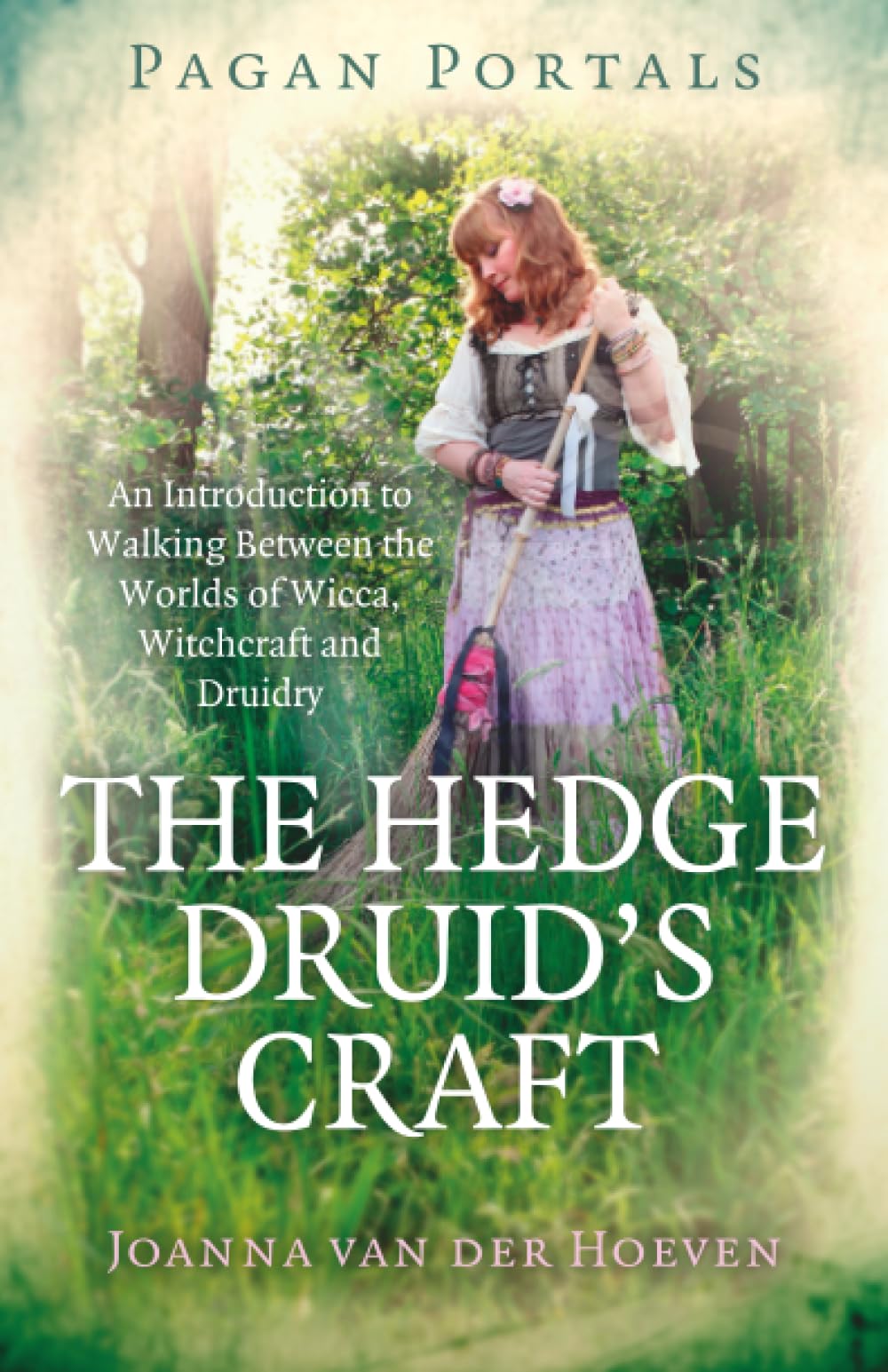
Pagan Portals - The Hedge Druid's Craft: An Introduction to Walking Between the Worlds of Wicca, Witchcraft and Druidry
$12.95
by Joanna Van Der Hoeven



The Hedge Druid's Craft blends the traditions of Wicca, Witchcraft and Druidry into a spiritual path that uses the techniques of "hedge riding" to travel between the worlds, bringing back wisdom and enchantment into our everyday lives. It is about working with boundaries, with a foot in either world, living around the edges and working with liminal times and places. For those whose paths meander and often overlap, and those who would not be constrained nor confined by labels, yet who seek some definition, this book is for you. If you are interested in Witchcraft, Wicca or Druidry, this book will sing to your soul. Joanna van der Hoeven is a Druid, Witch, best-selling author and teacher. She is the co-founder of Druid College UK. Joanna moved to the UK in 1998, where she now lives with her husband in a small village in Suffolk near the coast of the North Sea. The Hedge Druid's Craft An Introduction to Walking Between the Worlds of Wicca, Witcrafts and Druidry By Joanna van der Hoeven John Hunt Publishing Ltd. Copyright © 2017 Joanna van der Hoeven All rights reserved. ISBN: 978-1-78535-796-1 Contents Introduction from the author, Introduction from the illustrator, Part One – The Hedge Druid's Craft, Chapter One – Wicca, Witchcraft and Druidry, Chapter Two – The Hedge (Boundaries and Walking Between the Worlds), Chapter Three – The World of the Hedge Druid, Chapter Four – The Ancestors, Chapter Five – The Gods, Chapter Six – The Fair Folk (Sidhe), Part Two – The World Tree, Chapter Seven – The Lowerworld, Chapter Eight – The Middleworld, Chapter Nine – The Upperworld, Part Three – Lore, Chapter Ten – Plant Lore, Chapter Eleven – Animal Lore, Chapter Twelve – Celestial and Weather Lore, Part Four – Enchantment, Chapter Thirteen – Rites and Rituals, Chapter Fourteen – Spells and Charms, Conclusion, Bibliography and Further Reading, About the author, CHAPTER 1 Wicca, Witchcraft and Druidry Witchcraft Witchcraft is the ability to harness and use the powers of nature and one's own personal energy in order to create a desired effect in the world. It is ancient and found the world over, in various forms under different names and titles. It is often seen as an innate ability, something that one is born with and which may be passed down through generations. We often hear the term "Wise Woman" or "Wise Man" (the "Cunning Folk") to describe a witch practising in her or his community. This would have been someone knowledgeable in herbal healing or midwifery, or speaking with animals, or casting spells and charms or being able to divine the future through weather patterns. In the Middle Ages up until the present moment, Witchcraft was demonised as the Christian faith sought to exude total power and control. However, nature is resilient, and so too were/are Witches. Some of the magic and charms performed have been kept and passed down through folklore and fairy tales. Some lucky families may have kept a tradition alive by passing down wisdom through the bloodline. Though there is no "unbroken lineage" of Witchcraft per se, we can still find fragments and use our instinct and intuition, with the help of guides along the way to enable us to recover and redefine what is often called "The Old Ways". Witchcraft in itself was not known as a religion, but a practice or an art. Druidry The Druids of old were tied to the Celtic peoples, and are often equated to the role of priests in the Celtic community. They also held the knowledge and history of their people, genealogy of royal families, poetry, the arts and more. They were often treated as separate and special from the rest of the community, such as being exempt from going to war. Druidry evolved from pre-Celtic religion and spirituality; however, we do not know what that religion or spiritual path was called before the Celts, and so "Druid" is the oldest word which we have to describe a priest of the Celtic tradition that evolved throughout Europe and Britain. The word Druid stems from two words, dru and wid, meaning oak and wisdom respectively. And so, the Druids were seen as those who contained the wisdom of the oak, of nature and the natural world, and who were able to service their communities with their knowledge and their skill. They were an organised elite, as opposed to the village wisewoman/man of Witchcraft. Julius Caesar documents that there were three types of Druids: Bards, Ovates and Druids. Bards held the genealogy, songs and stories of the tribe; Ovates were connected to healing and to seership or divination; and Druids were the teachers, philosophers and those who held the law. Druid schools were in existence up until the seventeenth century. In the nineteenth century interest in the Druids began to re-emerge, in what is often termed "The Celtic Twilight". Wicca Wicca and Modern Druidry began in the 1950s. They have their roots and inspiration in the old traditions of Witchcraft and the Druids, y