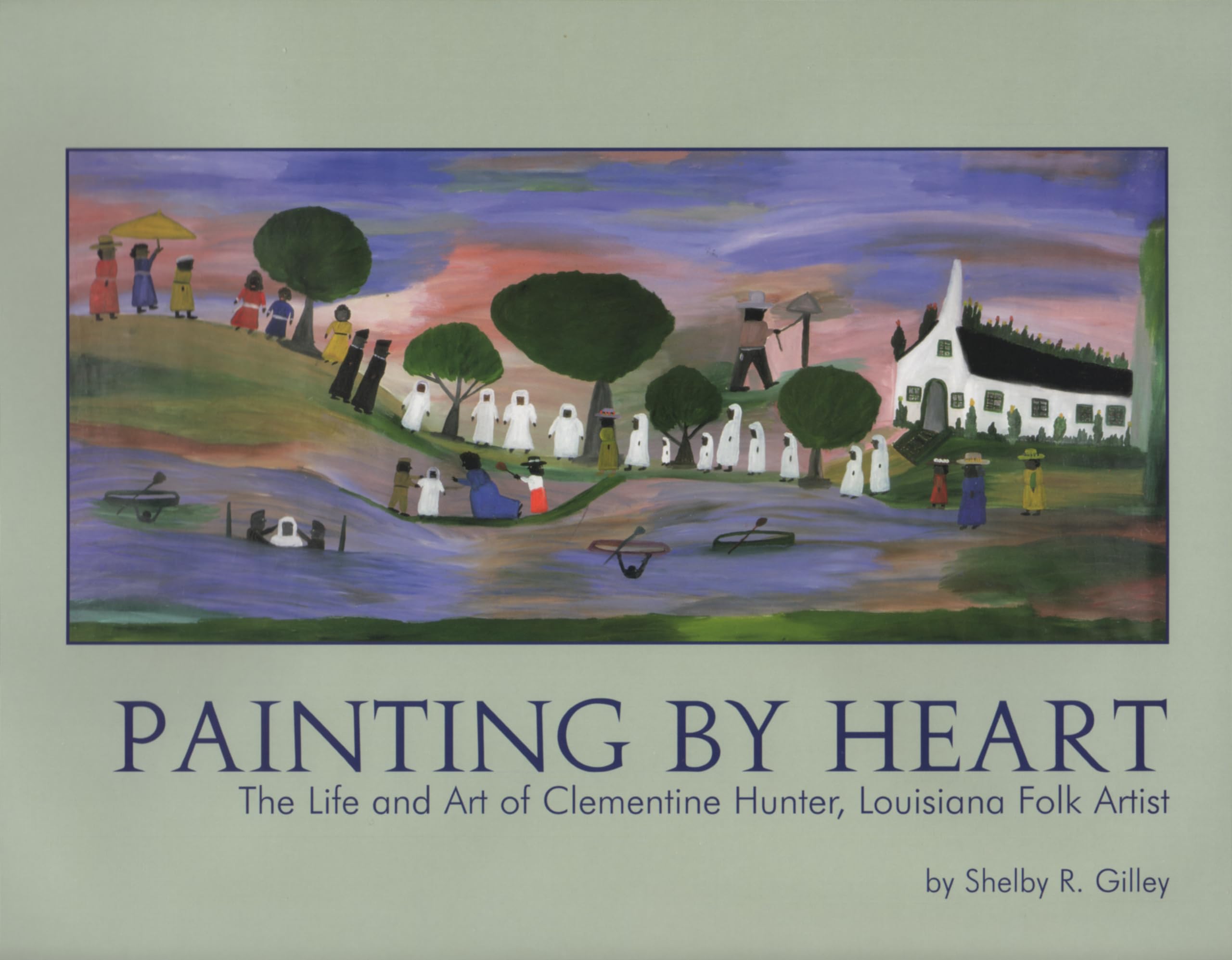
Painting by Heart : The Life and Art of Clementine Hunter, Louisiana Folk Artist
$50.00
by Shelby R. Gilley



The most definitive book about the life and work of Louisiana Folk Artist Clementine Hunter. The book details the rich history and context of Clementine's development as an artist. The artistically friendly environment at Melrose Plantation and the encouragement she received from mentors such as Francois Mignon and James Register give the reader a fuller understanding of her work. In addition to the text, there are 180 color plates and 25 black and white vintage photographs. Photographs of Clementine Hunter's art in this volume were taken by Tom Neff, John Owen, Thomas Whitehead, Zeke Zulke, and others as they were donated by private collectors. --From the Publisher I first met Clementine Hunter in 1970, and I have been fascinated by her life and her community ever since. If she had not grown up in a closely-knit Northwest Louisiana group of Franco-Africans, steeped in the culture and heritage of Louisiana, she would not have evolved from an accomplished functional artist, who made things like quilts, dolls, or curtains, into a world-renowned folk artist. During Clementine Hunter's time, Melrose Plantation was a place where literature and art were actively encouraged. Cammie Henry, the owner of the plantation, opened her home to anyone who needed a quiet place to work, as long as they were producing and not interfering with other visitors. The discovery of painting materials left behind by Alberta Kinsey, a New Orleans artist who often visited Melrose, and the ensuing encouragement to paint by her friend and mentor, Francois Mignon, allowed Clementine to explore her artistic potential. She would paint for almost fifty years, recording the things she knew best - her life at Melrose Plantation and her community's history. --From the Author Clementine Hunter, Cane river primitive painter, was born on Hidden Hill Plantation (now Little Eva Plantation) in Natchitoches Parish, Louisiana, in December 1886. Most of her life was spent as a field hand picking cotton on Hidden Hill and Melrose Plantations. In the 1940s she was a cook at Melrose when she found some tubes of paint and brushes discarded by the late Alberta Kinsey, artist house guest at Melrose. M. Francois Mignon, landscape architect, historian, and permanent guest of the Henry's at Melrose, was quick to encourage Clementine when she expressed a desire to "mark a picture." So, with Francois' urging, her own compulsion, and Alberta Kinsey's paint, Clementine began to paint her beloved Cane River country. Almost immediately a number of Cane River residents succumbed to the charm of her paintings and were her earliest collectors. Interest in Clementine's bright primitives soon assumed national proportions and her showings at the Museum of Ame! rican Folk Art in New York, The New Orleans Museum of Art, and several other major showings have added to her image. Melrose Plantation was a perfect setting for Clementine's new career. Situated on a bank of the Cane River, fifteen miles south of Natchitoches, the oldest town in Louisiana (founded by the French in 1714), the first owner of the plantation was Marie Therese, born in the Congo, brought to Natchitoches, and bought by St. Denis, the French Commandant. After passing through several owners, she became the property of Thomas Metoyer, who was a member of a prominent white family in Natchitoches. From this relationship ten children were produced. Eventually she was freed and given a land grant in the parish. Here in the late 1700's Marie Therese erected her home (which she called "Yucca") and the African House. Marie Therese was a successful planter; her main crop was indigo of fine quality and the entire crop each year was sold to the French to dye army uniforms. Eventually all their children became successful planters, and their descendants gained fame as the gentle people o! f Lyle Saxon's novel "Children of Stangers." Louis Metoyer, grandson of Marie Therese, built the present plantation house in 1833. When it was later acquired by Joseph Henry, a native of Londonderry, Ireland, the name was changed to "Melrose." His son, John Hampton Henry and John's wife, Cammie, expanded the pecan groves, restored the old buildings, and later gave refuge and solitude to many famous writers - amoung them Lyle Saxon, Rachel Field, Alexander Woollcott, Roark Bradford, James Register, Bill Spratling, Mary Land, Harnett Kane, Rose Franken, and numerous now famous artists, photographers and botanists. For 50 years - from 1898 to 1948 - Cammie Henry provided southern comfort for their talented guests. --From the Inside Flap Photographs of Clementine Hunter's art in this volume were taken by Tom Neff, John Owen, Thomas Whitehead, Zeke Zulke, and others as they were donated by private collectors. I first met Clementine Hunter in 1970, and I have been fascinated by her life and her community ever since. If she had not grown up in a closely-knit Northwest Louisiana group of Franco-Africans, steeped in the culture and heritage