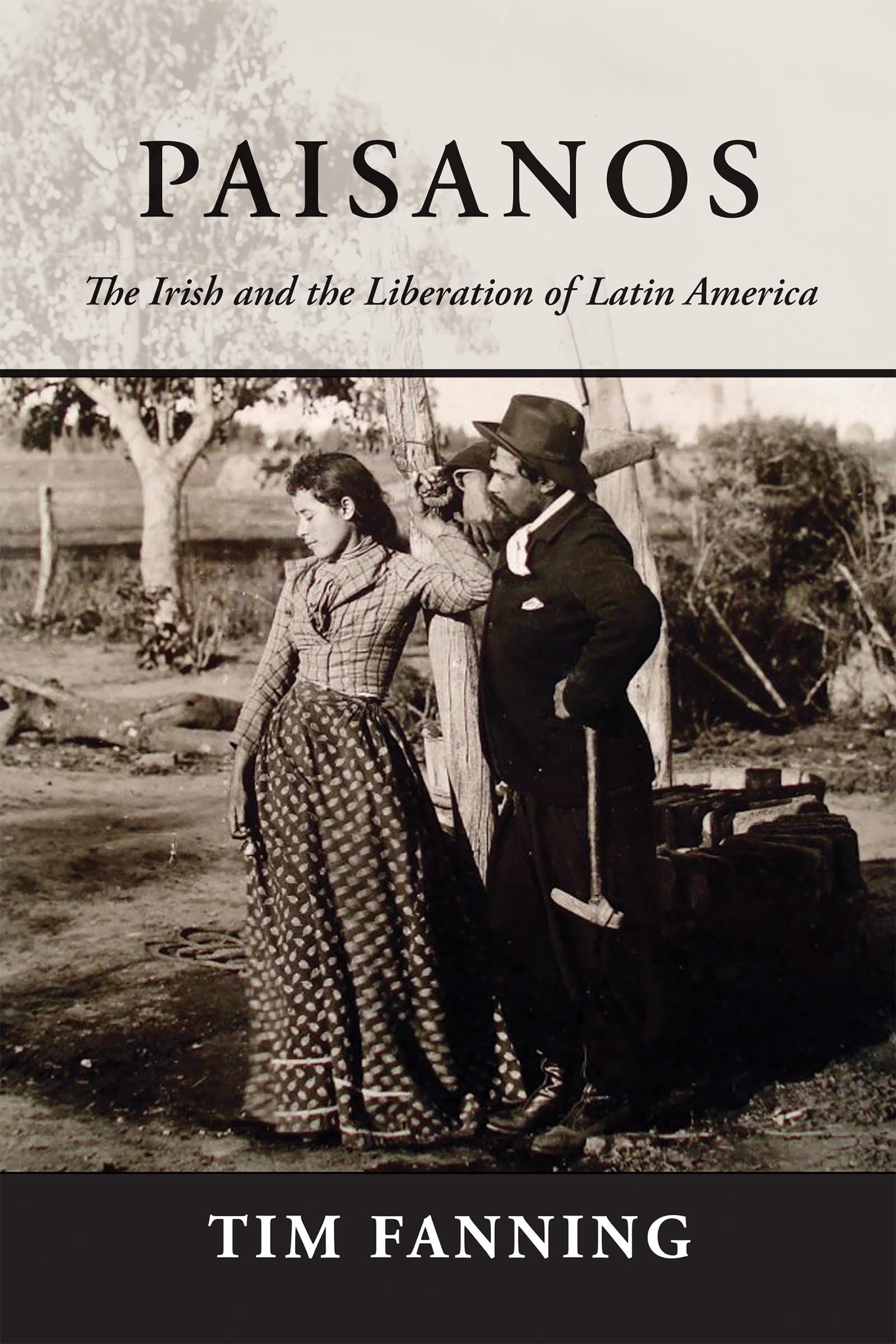



In the early nineteenth century, thousands of volunteers left Ireland behind to join the fight for South American independence. Lured by the promise of adventure, fortune, and the opportunity to take a stand against colonialism, they braved the treacherous Atlantic crossing to join the ranks of the Liberator, Simón Bolívar, and became instrumental in helping oust the Spanish from Colombia, Panama, Venezuela, Ecuador, Peru, and Bolivia. Today, the names of streets, towns, schools, and football teams on the continent bear witness to their influence. But it was not just during wars of independence that the Irish helped transform Spanish America. Irish soldiers, engineers, and politicians, who had fled Ireland to escape religious and political persecution in their homeland, were responsible for changing the face of the Spanish colonies in the Americas during the eighteenth century. They included a chief minister of Spain, Richard Wall; a chief inspector of the Spanish Army, Alexander O'Reilly; and the viceroy of Peru, Ambrose O'Higgins. Whether telling the stories of armed revolutionaries like Bernardo O'Higgins and James Rooke or retracing the steps of trailblazing women like Eliza Lynch and Camila O'Gorman, Paisanos revisits a forgotten chapter of Irish history and, in so doing, reanimates the hopes, ambitions, ideals, and romanticism that helped fashion the New World and sowed the seeds of Ireland's revolutions to follow. "[An] important and, I believe, necessary volume on the role played by Irish men and women in the emergence of the new, modern and independent republics of Latin America. . . . [This is] a welcome contribution to the literature on the history of our exiles and their descendants . . . [and] an exciting and accessible book that is a pleasure to read." ―from the foreword by Michael D. Higgins, president of Ireland "Tim Fanning's book provides the first comprehensive overview of the diverse roles played by the Irish in Latin America from Mexico to Argentina. It is essential reading for the general reader and for specialists alike. His findings point to the undiscovered riches yet to be revealed in archives throughout the region and beyond." ―Dermot Keogh, professor emeritus of history, University College Cork Tim Fanning is a Dublin-based freelance author and journalist. His books include The Fethard-on-Sea Boycott and Paisanos , which has been published in Irish, Argentinian, and Colombian editions. Political journalism in Spain was born out of the decision by the members of the Cádiz Cortes to abolish restrictions on the press. Consequently the debates between liberals and conservatives in the Cortes were reported with great interest not only in Spain but also abroad. One of the most perceptive and interested observers of the Cortes was the Irish-Spaniard José María Blanco White. The White family had adopted the surname Blanco ( blanco means white in Spanish) when they settled in Spain; José María adopted the double surname Blanco White when he was in England. From his exile in London this rather severe, impassioned, intolerant young man became not only one of the foremost propagandists for Spanish liberalism but also a fierce critic of Spanish rule in the American colonies. His fiery polemics in favour of American independence were to earn him the opprobrium of both Spanish conservatives and liberals. His biographer, Manuel Moreno Alonso, goes so far as to describe him as ‘the “inventor” of Liberalism in Spain’ and says that ‘one can say that until the Generation of ’98, nobody raised in such a continual and obsessive manner what, afterwards, has been called “the subject of Spain”.’ Blanco White possessed the zeal of the convert. He was born in Seville on 11 July 1775 into an exaggeratedly pious Irish family in deeply Catholic southern Spain whose estates in Ireland had been expropriated in the Cromwellian era. His great-grandfather was living in County Waterford when he sent four of his five children abroad ‘to escape the oppression of the penal laws.’ Blanco White’s grandfather settled in Seville, where he inherited the substantial business of his merchant uncle, Philip Nangle. The connection with Ireland remained strong when Blanco White was growing up. His grandfather’s ‘love of his native land could not be impaired by his foreign residence,’ and English was spoken at home with ‘an Irish pronunciation.’ Blanco White’s own father had been sent back to Ireland as a child so that ‘he might also cling to that country by early feelings of kindness.’ When Blanco White was a child, the family business began to fail and the money that remained was ‘just enough to save the family from such poverty as might have entirely changed their condition in the world.’ Blanco White’s aunt married an Irishman named Thomas Cahill, who took over the running of the business. Their daughter, Blanco White’s cousin, married another Irishman, by the name of Beck, one of the many Irish clerks employed by t