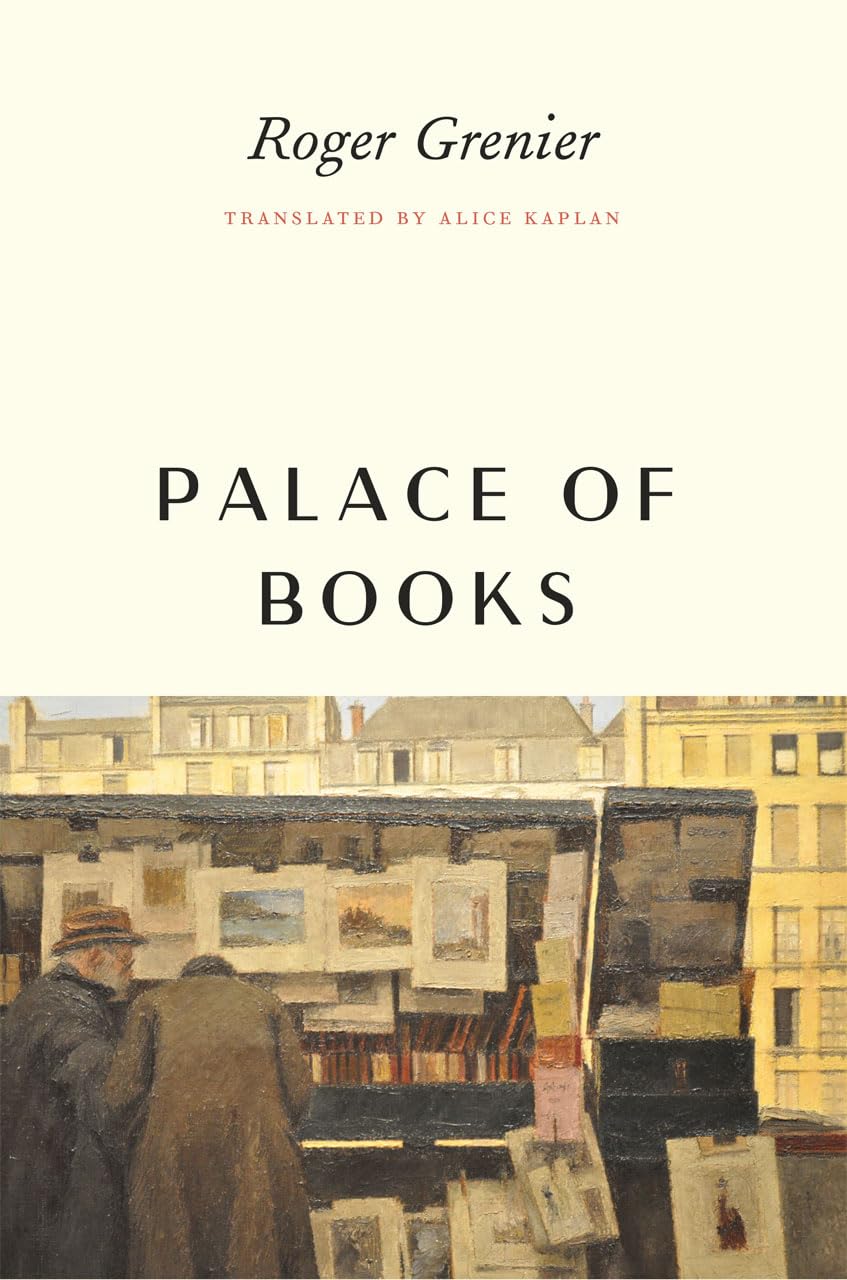



For decades, French writer, editor, and publisher Roger Grenier has been enticing readers with compact, erudite books that draw elegant connections between the art of living and the work of art. Under Grenier’s wry gaze, clichés crumble, and offbeat anecdotes build to powerful insights. With Palace of Books , he invites us to explore the domain of literature, its sweeping vistas and hidden recesses. Engaging such fundamental questions as why people feel the need to write, or what is involved in putting one’s self on the page, or how a writer knows she’s written her last sentence, Grenier marshals apposite passages from his favorite writers: Chekhov, Baudelaire, Proust, James, Kafka, Mansfield and many others. Those writers mingle companionably with tales from Grenier’s half-century as an editor and friend to countless legendary figures, including Albert Camus, Romain Gary, Milan Kundera, and Brassai,. Grenier offers here a series of observations and quotations that feel as spontaneous as good conversation, yet carry the lasting insights of a lifetime of reading and thinking. Palace of Books is rich with pleasures and surprises, the perfect accompaniment to old literary favorites, and the perfect introduction to new ones. "Reading Roger Grenier, you feel as if you're joining him in an inviting library, both of you seated in comfortable leather chairs and sipping calvados. He's read all the books in the room--how he has the time, you're not quite sure--and with a gentle and astounding ease, he recites countless lines from myriad texts and pieces them together into playful discussions of such grand topics as love, memory, death, and, naturally, writing. . . Subtle observations fill this slim volume, giving us a glimpse into the mind and life of this most sensitive of readers. While it may not leave you with many profound truths, I dare you not to fall in love." ― Daily Beast "A charming series of freeform meditations. . . . An added pleasure of Grenier's essays is that, no matter how much he has read and retained, he writes of literature as an unending pursuit." -- Sam Sacks ― Open Letter Monthly “Readers will benefit from Grenier’s wisdom expressed through his life experiences and his literary analyses. Palace of Books will amply stock the shelves of your mind.” -- Colin Steele ― Sydney Morning Herald “To anyone as well- and widely-read as Grenier … the mind itself is a ‘palace of books,’ and Grenier opens the door to his in this wide-ranging, impressively erudite, deceptively slender volume.… the enjoyment is in the virtuoso movement of Grenier’s thought. Kaplan’s translation captures the wry humor and elegant poise of prose that, like a fine wine or expensive cigar, should be allowed to linger on the tongue.” ― Publishers Weekly Alice Kaplan is the Sterling Professor of French at Yale University. She is coauthor of States of Plague , with Laura Marris, and author of French Lessons, The Collaborator, Looking for “The Stranger,” and Dreaming in French , all also published by the University of Chicago Press. She has been a finalist for both the National Book Critics Circle Award and the National Book Award. She lives in Guilford, Connecticut. Palace of Books By Roger Grenier, Alice Kaplan The University of Chicago Press Copyright © 2014 The University of Chicago All rights reserved. ISBN: 978-0-226-30834-0 Contents Foreword by Alice Kaplan, "The Land of Poets", Waiting and Eternity, Leave-Taking, Private Life, Writing about Love, Again ..., A Half Hour at the Dentist's, Unfinished, Do I Have Anything Left to Say?, To Be Loved, Works Cited, CHAPTER 1 "The Land of Poets" Committing a crime means taking action. But accounting for a crime in the newspaper or on radio and television means transforming that action into a story, into words. This creates problems. The public that feasts on crime needs its stories to have a beginning, a middle, and an end. It needs a small novel, more exciting than fiction because it's true. Reality rarely unfolds with such pleasing logic. It's usually impossible to know exactly when the slowly unfolding drama began, and just as impossible to make any sense of what the victims and protagonists had to say. The confusion isn't due to the facts but to something like a layer of concrete covering every motive, every attitude. Never has the Shakespearean-Faulknerian cliché about the "tale told by an idiot, full of sound and fury" been more apropos. This doesn't prevent reporters from inventing fine, well-crafted accounts that respond to the five basic Ws: Who, What, When, Where, Why. Which is exactly what Freud did with Oedipus's crime. He simplified an awfully confusing story, giving it his own structure. Actually, if you back up a little, his Laius had a pretty unsavory past. He'd been banished from Thebes and had to seek asylum in Pisa and in Ilia, with Pelops. And when he was allowed to return, he brought Pelops's bastar