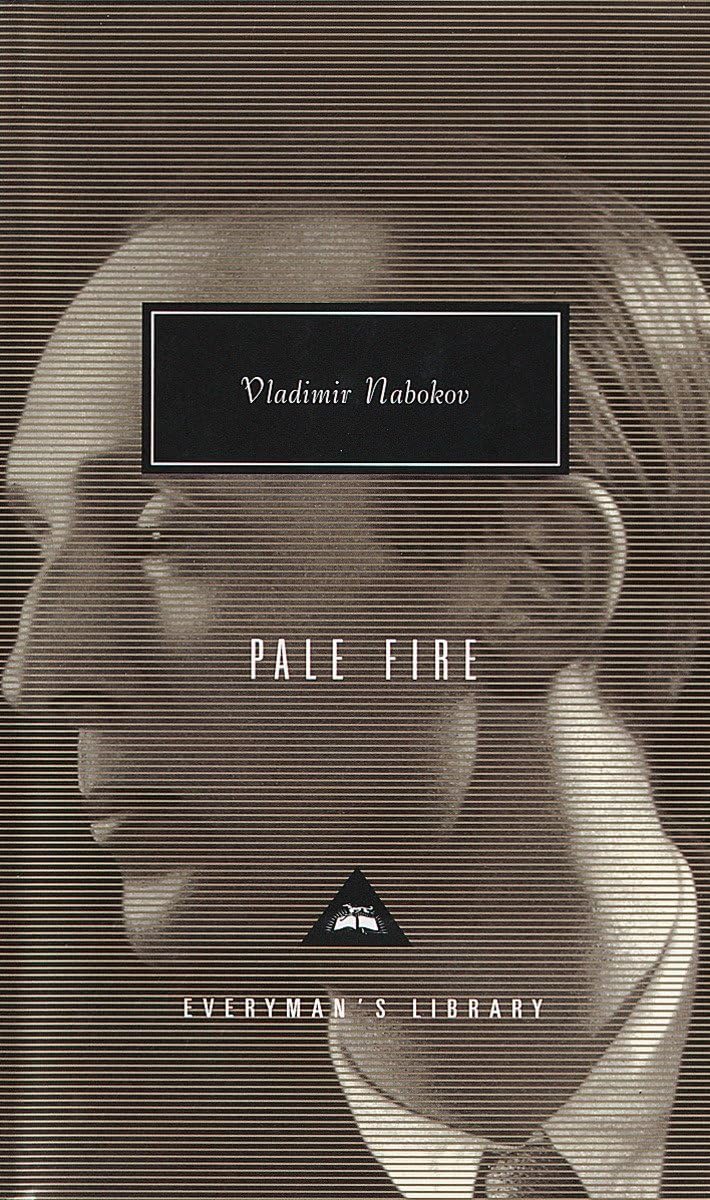
Pale Fire: Introduction by Richard Rorty (Everyman's Library Contemporary Classics Series)
$22.38
by Vladimir Nabokov



One of The Atlantic ’s Great American Novels of the Past 100 Years The urbane authority that Vladimir Nabokov brought to every word he ever wrote, and the ironic amusement he cultivated in response to being uprooted and politically exiled twice in his life, never found fuller expression than in Pale Fire published in 1962 after the critical and popular success of Lolita had made him an international literary figure. An ingeniously constructed parody of detective fiction and learned commentary, Pale Fire offers a cornucopia of deceptive pleasures, at the center of which is a 999-line poem written by the literary genius John Shade just before his death. Surrounding the poem is a foreword and commentary by the demented scholar Charles Kinbote, who interweaves adoring literary analysis with the fantastical tale of an assassin from the land of Zembla in pursuit of a deposed king. Brilliantly constructed and wildly inventive, this darkly witty novel of suspense, literary one-upmanship, and political intrigue achieves that rarest of things in literature–perfect tragicomic balance. With an introduction by Richard Rorty. "This centaur-work, half poem, half prose…is a creation of perfect beauty, symmetry, strangeness, originality and moral truth. Pretending to be a curio, it cannot disguise the fact that it is one of the great works of art of this century." —Mary McCarthy, The New Republic "As a literary tour de force it surpasses anything else Mr. Nabokov has done." — Atlantic Monthly "Scintillating, brilliantly inventive…[ Pale Fire ] has almost as many layers of meaning as an artichoke has petals." — Commonwealth "Of all [Nabokov's] inventions, Pale Fire is the wildest, the funniest and the most earnest. It is like nothing on God's earth." — New York Herald Tribune "A monstrous, witty, intricately entertaining work...done with dazzling skill." — Time "Nabokov writes prose the only way it should be written, that is, ecstatically." —John Updike With an Introduction by Richard Rorty The urbane authority that Vladimir Nabokov brought to every word he ever wrote, and the ironic amusement he cultivated in response to being uprooted and politically exiled twice in his life, never found fuller expression than in Pale Fire published in 1962 after the critical and popular success of Lolita had made him an international literary figure. An ingeniously constructed parody of detective fiction and learned commentary, Pale Fire offers a cornucopia of deceptive pleasures, at the center of which is a 999-line poem written by the literary genius John Shade just before his death. Surrounding the poem is a foreword and commentary by the demented scholar Charles Kinbote, who interweaves adoring literary analysis with the fantastical tale of an assassin from the land of Zembla in pursuit of a deposed king. Brilliantly constructed and wildly inventive, this darkly witty novel of suspense, literary one-upmanship, and political intrigue achieves that rarest of things in literature--perfect tragicomic balance. With an Introduction by Richard Rorty The urbane authority that Vladimir Nabokov brought to every word he ever wrote, and the ironic amusement he cultivated in response to being uprooted and politically exiled twice in his life, never found fuller expression than in Pale Fire published in 1962 after the critical and popular success of Lolita had made him an international literary figure. An ingeniously constructed parody of detective fiction and learned commentary, Pale Fire offers a cornucopia of deceptive pleasures, at the center of which is a 999-line poem written by the literary genius John Shade just before his death. Surrounding the poem is a foreword and commentary by the demented scholar Charles Kinbote, who interweaves adoring literary analysis with the fantastical tale of an assassin from the land of Zembla in pursuit of a deposed king. Brilliantly constructed and wildly inventive, this darkly witty novel of suspense, literary one-upmanship, and political intrigue achieves that rarest of things in literature--perfect tragicomic balance. VLADIMIR VLADIMIROVICH NABOKOV was born on April 23, 1899, in St. Petersburg, Russia. The Nabokovs were known for their high culture and commitment to public service, and the elder Nabokov was an outspoken opponent of antisemitism and one of the leaders of the opposition party, the Kadets. In 1919, following the Bolshevik revolution, he took his family into exile. Four years later he was shot and killed at a political rally in Berlin while trying to shield the speaker from right-wing assassins. The Nabokov household was trilingual, and as a child Nabokov was already reading Wells, Poe, Browning, Keats, Flaubert, Verlaine, Rimbaud, Tolstoy, and Chekhov, alongside the popular entertainments of Sir Arthur Conan Doyle and Jules Verne. As a young man, he studied Slavic and romance languages at Trinity College, Cambridge, taking his honors degree in 1922.