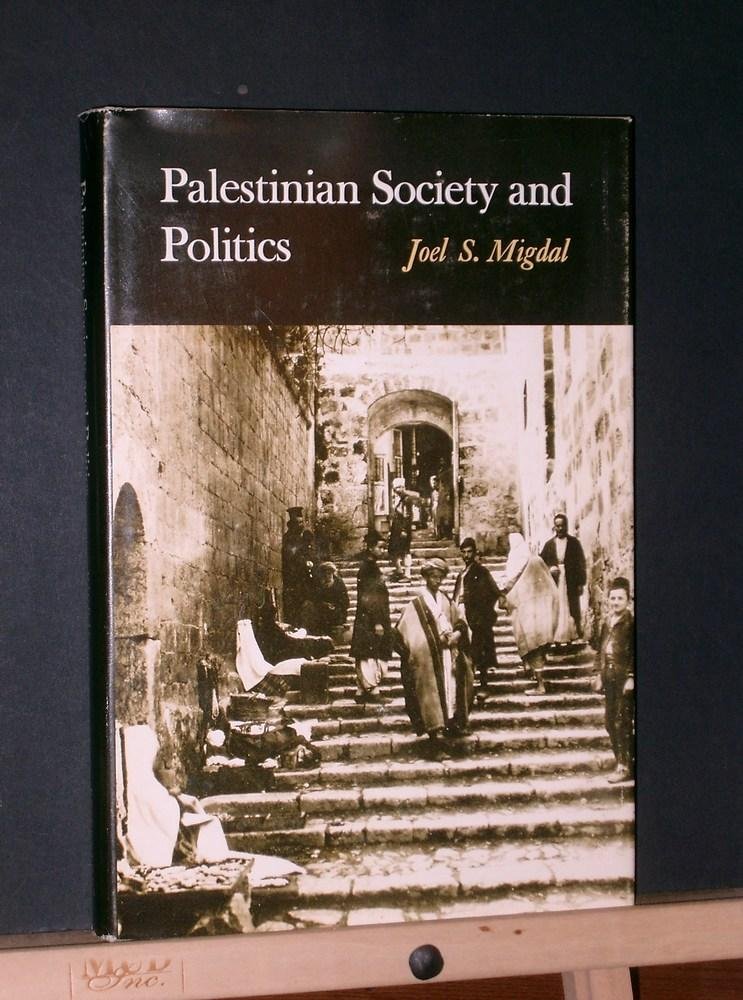
Palestinian Society and Politics (Center for International Affairs, Harvard University)
$45.00
by Joel S. Migdal



Initially published in Moscow in 1950 following the author's death, this book contains the first chapters of a large monograph Krylov planned entitled The foundations of physical statistics," his doctoral thesis on "The processes of relaxation of statistical systems and the criterion of mechanical instability," and a small paper entitled "On the description of exhaustively complete experiments." Originally published in 1980. The Princeton Legacy Library uses the latest print-on-demand technology to again make available previously out-of-print books from the distinguished backlist of Princeton University Press. These editions preserve the original texts of these important books while presenting them in durable paperback and hardcover editions. The goal of the Princeton Legacy Library is to vastly increase access to the rich scholarly heritage found in the thousands of books published by Princeton University Press since its founding in 1905. Palestinian Society and Politics By Joel S. Migdal PRINCETON UNIVERSITY PRESS Copyright © 1980 Princeton University Press All rights reserved. ISBN: 978-0-691-07615-7 Contents Maps, Figures, and Tables, ix, Preface, xi, Contributors, xv, Book I: The Effects of Regime Policies on Social Cohesion and Fragmentation By Joel S. Migdal, Introduction, Chapter 1 The Two Faces of Ottoman Rule: Palestinian Society before World War I, 9, Chapter 2 Direct Contact with the West: The British Mandate, 19, Chapter 3 Dispersal and Annexation: Jordanian Rule, 33, Chapter 4 Israeli Military Rule: Continuity at the Macro-Level, 45, Chapter 5 The Impact on Stratification of Employment in Israel: Change at the Micro-Level, 54, Conclusion, 78, Appendix Field Research in an Occupied Territory, 88, Book II: Studies in Continuity and Change under Four Regimes Edited by Joel S. Migdal, Introduction, Part One: The Palestinian Village, 99, Chapter 1 The Office and Functions of the Village Mukhtar Gabriel Baer, 103, Chapter 2 Administrative Policy in Rural Palestine: The Impact of British Norms on Arab Community Life, 1920-1948 Ylana N. Miller, 124, Chapter 3 West Bank Refugees — Between Camp and Society Shimon Shamir, 146, Part Two: Palestinian Urban Elites, Chapter 4 Conflictual Pressures and Cooperative Interests: Observations on West Bank-Amman Political Relations, 1949-1967 Shaul Mishal, 169, Chapter 5 Politics and Social Change in the West Bank Since 1967 Mark Heller, 185, Chapter 6 The Dialectics of Palestinian Politics Donna Robinson Divine, 212, Part Three: Modes of Interaction between Elites and Masses, Chapter 7 Legal Protection and Circumvention of Rights for Cultivators in Mandatory Palestine Kenneth W. Stein, 233, Chapter 8 Peasants into Workmen: Internal Labor Migration and the Arab Village Community under the Mandate Rachelle Taqqu, 261, Index, 287, CHAPTER 1 The Two Faces of Ottoman Rule: Palestinian Society before World War I The First Face of Ottoman Rule By the early decades of the nineteenth century, conditions in the provinces of the Ottoman Empire that constituted historic Palestine had deteriorated badly. The effects of all three governmental policies — security, investment, and alliances — were to make life precarious and to drive communities to be inward oriented. The security policy of the Empire, resulting from its low level of capabilities, was to provide as few police and military forces as possible while still maintaining Ottoman suzerainty. The small number of billeted soldiers did not (and probably could not) control the wanton violence that permeated the area. One old Arab proverb states, "Four are the ravages of the land: mice, locusts, Kurds and Bedouins." The Kurds may no longer have been a problem, but the Bedouins certainly continued to make the life of the fellahin (peasants) extremely difficult through raids and plunder. A vicious cycle of desertion of the land by the peasants and infiltration by Bedouins from the desert existed. The result was the depopulation of the central plains and valleys by the peasantry. Some relief from the physical insecurity came after the Egyptian-based conquest of the provinces by the forces of Muhammad 'Ali (1832-1840), but conditions again worsened after the Ottomans reestablished their rule. Settled agriculture in the most fertile parts of the country became almost an impossibility given the Ottoman policy of providing insufficient local security forces. There was a lack of integration of Arabs due to the administrative divisions of the Empire. In fact, there was no administrative unit known as Palestine. This lack of integration was compounded by the effects of Ottoman security policy. Inhabitants of Palestine tended to cluster in inward-oriented villages located in the mountains and hills of what is today called the West Bank. There they gained some measure of refuge not available in the low-lying areas and planted a variety of crops that would not be subjected to