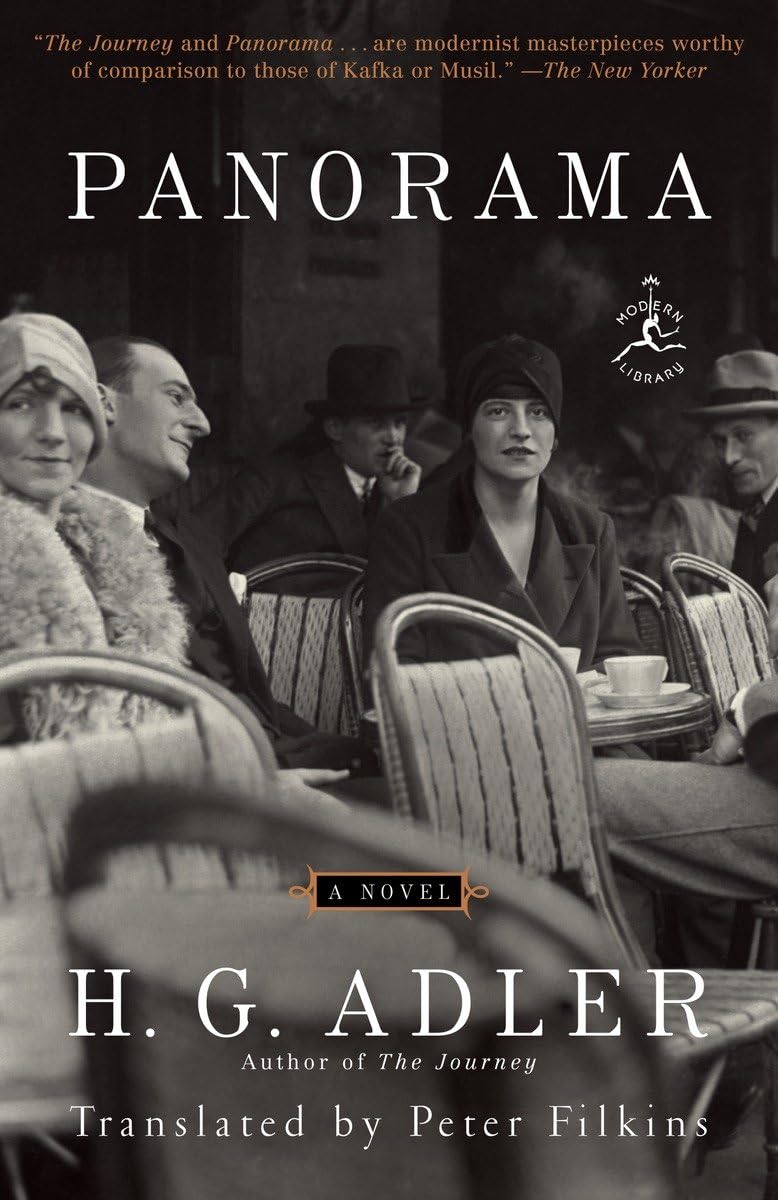



Only recently available for the first time in English, Panorama is the newly rediscovered first novel of H. G. Adler, a modernist master whose work has been compared to that of Kafka, Joyce, and Solzhenitsyn. A brilliant epic told in ten distinct vignettes, Panorama is a portrait of a place and people soon to be destroyed, as seen through the eyes of the young Josef Kramer. It moves from the pastoral World War I–era Bohemia of Josef’s youth, to a German boarding school full of creeping prejudice, through an infamous extermination camp, and finally to Josef’s self-imposed exile abroad, achieving veracity and power through a stream-of-consciousness style reminiscent of our greatest modern masters. The author of six novels as well as the monumental account of his experiences in a Nazi labor camp, Theresienstadt 1941–1945, H. G. Adler is an essential author with unique historical importance. Panorama is lasting evidence of both the torment of his life and the triumph of his gifts. “ The Journey and Panorama . . . are modernist masterpieces worthy of comparison to those of Kafka or Musil.”— The New Yorker “Haunting . . . as remarkable for its literary experimentation as for its historical testimony.”— San Francisco Chronicle “ Panorama should have been the brilliant debut of a major German writer. . . . It’s hard to fathom why we had to wait so long. . . . Under any circumstances, let alone such harsh ones, his accomplishments would be remarkable.”— The New York Times Book Review (Editor’s Choice) “Astonishing . . . Works such as Solzhenitsyn’s One Day in the Life of Ivan Denisovich, Primo Levi’s If This Is a Man and H. G. Adler’s . . . Panorama draw the strength of their narrative from direct memory.”—Simon Schama, Financial Times “[A] stirring novel . . . expertly and elegantly translated by Peter Filkins.”— Los Angeles Times H. G. Adler was the author of twenty-six books of fiction, poetry, philosophy, and history. Born in Prague in 1910, Adler was a survivor of the Holocaust. He later settled in England and began writing about his experience. Adler died in London in 1988. Peter Filkins is an acclaimed translator and the recipient of a Berlin Prize fellowship from the American Academy in Berlin. He teaches writing and literature at Bard College at Simon’s Rock in Great Barrington, Massachusetts. 9781400068517
excerpt Adler: PANORAMA The Visit to the Panorama There’s a new program today. We’re going to the panorama.” Josef hears the voice of his grandmother and looks up from his toy. Panorama. Various pictures from all over the world. “Really, are we going?” The toy is abandoned, the dominoes, the building set, the train. It’s a long way, yet Josef and his grandmother love the panorama. They sit in the streetcar, the motor rattles and sings. Josef often plays streetcar. He runs along the long curbstones of the sidewalk, which is the track. Josef hums with his mouth closed and imitates the streetcar. First he calls out, “Ding! Dong Dong!,” then comes the humming and sighing of the motor. Streetcar conductor is the best job of all, for you get to sell tickets, punch the tickets, and call out the stops. “We have to get off, Josef, come!” They draw past the embankment and see many people all dressed up. “Give me your hand! It’s so crowded here.” Already they have turned in to the quiet little lane where the panorama is located. Now they stand before the door. It’s a simple storefront with a small display window, and there Josef peers at the beautiful pictures, whether it be Vesuvius, Niagara Falls, the Great Pyramid, or other wonders of the world. There’s also an announcement for that day’s program. Josef sounds it out: “Li-ma, the Cap-i-tal of Pe-ru.”—“Come, come, there’s more to see inside.” They next enter a little lobby that is separated from the actual panorama by a heavy curtain. Behind a table on which stands a sign that says tickets sits a powdered woman. Grandmother gives her a silver coin and takes from the powdery lady two little red tickets, as well as a nickel and some copper change. Josef is allowed to pocket the nickel. “Save it! Don’t spend it on sweets!” The grandmother weaves her way with Josef through the curtain and enters an almost completely darkened room. Around a polyhedral wooden cabinet high stools are arranged. In front of each one there are two round openings, which are dark peepholes located beneath a metal shield. You hold your eyes up or press them to the shield and the program appears. An attendant receives the guests and takes them to two free spots. The grandmother sits down, but the attendant lifts Josef up and presses him close to the peepholes. The two peepholes are there so that you see everything just the way it really looks, and everything is enlarged so that it seems completely alive. Everything appears lit by brilliant golden light, as if dipped in tropical sunlight. Each picture stands there for a minute, maybe less. To Josef i
excerpt Adler: PANORAMA The Visit to the Panorama There’s a new program today. We’re going to the panorama.” Josef hears the voice of his grandmother and looks up from his toy. Panorama. Various pictures from all over the world. “Really, are we going?” The toy is abandoned, the dominoes, the building set, the train. It’s a long way, yet Josef and his grandmother love the panorama. They sit in the streetcar, the motor rattles and sings. Josef often plays streetcar. He runs along the long curbstones of the sidewalk, which is the track. Josef hums with his mouth closed and imitates the streetcar. First he calls out, “Ding! Dong Dong!,” then comes the humming and sighing of the motor. Streetcar conductor is the best job of all, for you get to sell tickets, punch the tickets, and call out the stops. “We have to get off, Josef, come!” They draw past the embankment and see many people all dressed up. “Give me your hand! It’s so crowded here.” Already they have turned in to the quiet little lane where the panorama is located. Now they stand before the door. It’s a simple storefront with a small display window, and there Josef peers at the beautiful pictures, whether it be Vesuvius, Niagara Falls, the Great Pyramid, or other wonders of the world. There’s also an announcement for that day’s program. Josef sounds it out: “Li-ma, the Cap-i-tal of Pe-ru.”—“Come, come, there’s more to see inside.” They next enter a little lobby that is separated from the actual panorama by a heavy curtain. Behind a table on which stands a sign that says tickets sits a powdered woman. Grandmother gives her a silver coin and takes from the powdery lady two little red tickets, as well as a nickel and some copper change. Josef is allowed to pocket the nickel. “Save it! Don’t spend it on sweets!” The grandmother weaves her way with Josef through the curtain and enters an almost completely darkened room. Around a polyhedral wooden cabinet high stools are arranged. In front of each one there are two round openings, which are dark peepholes located beneath a metal shield. You hold your eyes up or press them to the shield and the program appears. An attendant receives the guests and takes them to two free spots. The grandmother sits down, but the attendant lifts Josef up and presses him close to the peepholes. The two peepholes are there so that you see everything just the way it really looks, and everything is enlarged so that it seems completely alive. Everything appears lit by brilliant golden light, as if dipped in tropical sunlight. Each picture stands there for a minute, maybe less. To Josef i