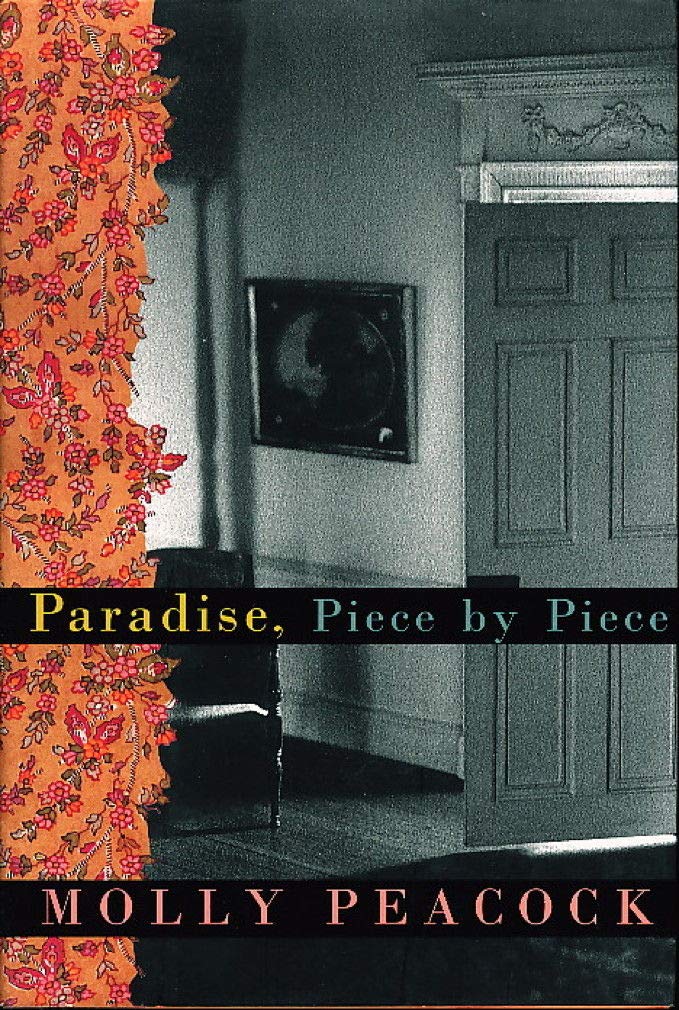



The president emerita of the Poetry Society of America explores her decision not to have children through a sincere, profound account of her growth as a poet and as a woman, and of the choices that have shaped her fate. The author of four volumes of poetry, Molly Peacock proves she is equally adept at prose in this vividly graceful memoir. Some would say that Paradise, Piece by Piece is one more story of growing up in a dysfunctional family (alcoholic father, depressed mother, rebellious younger sister). Others would focus on Peacock's turbulent romantic life, while others still would place the emphasis on her decision to remain childless. The truth of the matter is that all of these threads are vital components of a single, intricately woven tapestry, held together by Peacock's painstaking attention to detail. Anybody who has struggled to define his or her own life against the expectations and demands of others (be they society or one's own blood) will find inspiration in Molly Peacock's life. Peacock is the award-winning author of four books of poetry (e.g., Original Love, LJ 2/15/95), cocreator of the Poetry in Motion program, and past president of the Poetry Society of America. When poets turn to prose we can usually expect a high quality of writing, and we get it from Peacock. What we might not expect in a memoir is the carryover of poetic conventions of factualityAor lack thereof. Peacock tells us up front that this is "a hybrid memoir, both true and truer" with some events and characters invented or changed. The book centers on Peacock's choice not to have children and her search for a way to talk about a female life that doesn't involve motherhood. She speaks with candor, humor, and insight on her topic, about which little else is available. Recommended for large collections.AMary Paumier Jones, Westminster P.L., Lafayette, CO Copyright 1998 Reed Business Information, Inc. In this, her first prose work, poet Peacock shares a profoundly intimate tale of coming to terms with her creative identity and her decision, vital to that identity, to remain without children. As a poet, Peacock has that rare ability to examine things through words, and here, her life is the subject, a paradise she has uncovered piece by piece, to reveal the garden she has so lovingly cultivated from the bare ground of a troubled childhood. From her earliest memory of sitting beneath a kitchen table, hearing her parents pain before the enormity of marriage and parenthood, the fact of being an unwanted child discovering language, to the moment in time when she can fully feel through words what it means to be alive and free of that early burden, Peacock draws us into the journey of becoming a woman-poet who has chosen childlessness as an important part of her identity. ``The emptiness that is required for all creativity'' was an important discovery for Peacock, yet it troubled her throughout her life, sexually, emotionally, and finally creatively. This exhilarating memoir stumbles in real time upon the observation that a sonnet is ``the size of a plump made bed, and a blank page is a room . . . where consciousness sleeps.'' The sensuality of her language is a measure of the directness with which she has lived the issues of her womanhood. She stares down the blurry memories of her hard-drinking father, her burdened and dependent mother, and her self- destructive sister and finds the air she needs to thrive in those friends who stood by her, and those men who encouraged and loved her, and saw her poetry as their true offspring. Once free of inhibition, Peacock's adulthood grows out of childhood the way extraordinary fruits sometimes grow out of a waterless earth: stronger, more resilient, and bearing the kaleidoscope fruit of creativity. -- Copyright ©1998, Kirkus Associates, LP. All rights reserved. What will stay with most readers, I think, is the vivid picture she paints of the loneliness women often feel in dealing with the social pressures concerning motherhood... -- The New York Times Book Review, Margot Livesey If I could have told that girl, who waited to hear her father's car crawl up in the driveway, that things would never be as bad as they were at that moment, I think she would not have believed me. I imagine whispering into her ear, a skinny little shrimp with lank hair wearing a soiled blouse, her face at once both horrified and grim, that her life will be an adventure and that she will become a poet and live in two countries with a boy she would meet very soon. I see her turn her head a little bit on her neck, straightening her slump just a bit, and watch a slow, noncommittal sort of astonishment begin in her spine, delight moving up her vertebrae till it hits the top of her head and moves her shoulders back. I tell her--she is fourteen years old--that if she holds on for thirty years she's going to love her life. This girl does not say, "Thirty years! How will I hold on?" She does not dare complain or hope; inst