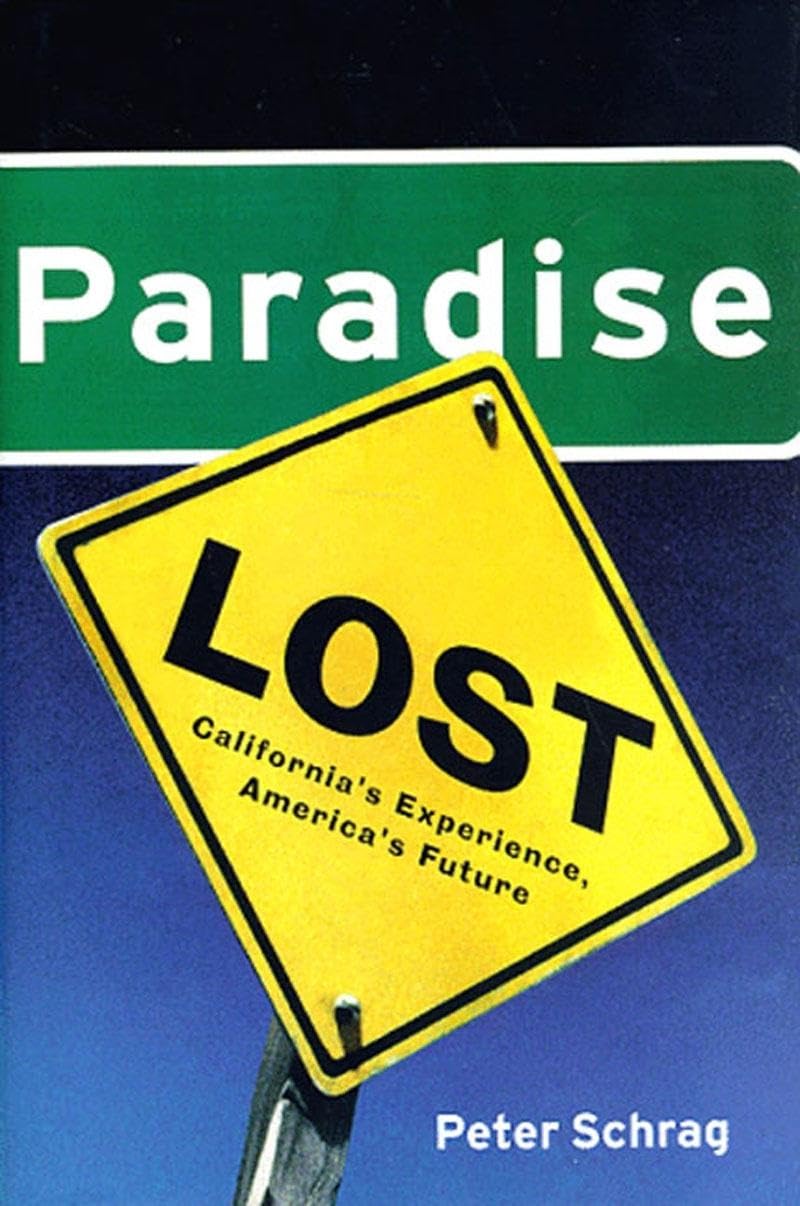



In the years after World War II, California, always regarded as an experiment for the American future, became an encouraging model for the nation. It was admired and envied for the quality of its education system, its environment, and its progressive social outlook. However, beginning with the passage of the tax-cutting Proposition 13 in 1978, and continuing through a barrage of voter initiatives, the state has pursued a determined course of retrenchment and reaction, sending it tumbling to the bottom of the nation's"quality of life" ratings. In Paradise Lost , Peter Schrag examines the relationship between the politics of that retrenchment and the great demographic changes of recent decades. His book makes a powerful case for reinvigorating our traditional structures of representative government against the increasing power of "populism" that is often disdainful of minority rights and interests. It shows that California is still a test for the nation, and a frightening indicator of our society's readiness to assimilate and serve its new citizens. In Paradise Lost veteran Sacramento journalist Peter Schrag reports on the dark side of populism in America's Golden State. California in the 1950s seemed a land of limitless potential, boosted by world-class public services and Progressive politics; today, however, its future hardly seems unbounded, its services are in shambles, and its politics are increasingly driven by rancor. Schrag places much of the blame on the state's penchant for ballot initiatives, in which citizens can bypass the legislative process and place questions directly to voters. Through a series of antitax and term-limits campaigns, he argues, these initiatives have done serious damage to the notion of representative democracy in the state. Schrag is a liberal, so not everybody will agree with his conclusions, but he is a thoughtful writer who reminds us that the United States often follows California's lead. Says Schrag, "Things had better work here, where the new American society is first coming into full view, because if it fails here, it may never work anywhere else either." For almost 150 years, California has beckoned Americans to follow their dreams to its golden shores, and millions have succumbed to the call. Now, however, the gilt is flaking and the sheen is fading as Californians come to terms with the diminished levels of services and crumbling superstructure resulting from the tax revolt that spawned Proposition 13 and succeeding tax-related ballot issues. Schrag (visiting scholar, intergovernmental studies, Univ. of California, Berkeley), a former editor of the Sacramento Bee, has written a thorough and thoughtful consideration of the effect that "government by plebiscite" has had in California. He describes the history of the progressive-era philosophy behind the ballot initiative, then carefully examines the ever-increasing use of this method to enact legislation in the Golden State and describes in detail its ultimate effect, with many possible national implications. Written in plain language with a well-documented text, this book can be appreciated by both scholars and lay readers. Highly recommended for academic and public libraries.?Jill Ortner, SUNY at Buffalo Copyright 1998 Reed Business Information, Inc. The media and often the general populace have recently looked toward California when questioning the direction of our country's affairs--or as a way of identifying important trends that may in the end affect us all. Editor of the Sacramento Bee for many years, Schrag calls on his intimate knowlege of the inner workings of California's various governmental systems to present an incisive account of the past and present forces that have impacted the Golden State. In outlining the period following World War II, Schrag shows how legions were beckoned to take up residence in cities and towns where progressive attitudes boded well for all who were lucky enough to move West at that time. Schrag continues with depictions of initiatives, such as Proposition 13, the overturning of affirmative action, and term limits--actions that indicate a far less tolerant stance combined with a bleaker outlook with regard to education and other critical quality-of-life issues. Enormously thought provoking, Schrag's book merits study. Alice Joyce An enlightening--and dismal--view of the Golden State's economic decline from a former editor of the Sacramento Bee. Schrag takes the point of view that the principal cause of California's waning from a major industrial state to its present fiscal nightmare is the voter-initiated proposition system. And the culprit of all propositions, according to him, is Proposition 13, passed in 1978 to drastically limit property taxes and reassessments, thereby diluting the quality of California's once exemplary public-school system (which drew the majority of its funding from property taxes). The issue is complicated. Schrag acknowledges that the proponents